Introduction
Security managers face a persistent challenge: traditional credentials fail at the worst moments. Keycards are lost or shared between shifts. PINs and passwords spread through teams, undermining audit trails. Badges get stolen or cloned. These vulnerabilities aren't theoretical—they create measurable security gaps in organizations protecting critical infrastructure.
When a power station can't verify that the person entering a restricted area is the authorized individual, or when a hospital loses track of who accessed patient records, the consequences ripple through compliance, safety, and operational integrity. Biometrics closes this gap with authentication that can't be transferred, forgotten, or compromised.
Vein pattern recognition is among the most accurate and spoof-resistant biometric modalities available. This guide covers how the technology works, the different types, its advantages over surface biometrics, real-world applications, and what to evaluate when deploying vein-based systems in high-stakes environments.
TLDR:
- Vein biometrics analyzes subcutaneous blood vessels using near-infrared light to verify identity with exceptional accuracy
- Palm vein systems achieve false acceptance rates below 0.00001% and complete verification in under 2 seconds
- The technology is contactless, hygienic, and stable across a lifetime—unlike fingerprints affected by cuts or aging
- Proven deployments span banking ATMs, airport boarding, hospital patient ID, seaport TWIC verification, and factory time clocks
- Built-in liveness detection makes vein biometrics significantly harder to spoof than surface modalities like fingerprint or facial recognition
What Is Vein Pattern Recognition?
Vein pattern recognition—also called vascular pattern recognition or vein matching—is a biometric identification technique that analyzes the unique network of blood vessels beneath a person's skin. Unlike surface biometrics such as fingerprints or facial recognition, vein biometrics reads internal structures that are invisible to casual observation and nearly impossible to replicate.
The technology's origins trace to 1984 when Joe Rice, an automation controls engineer at Kodak in the UK, conceived the idea after his bank cards were stolen. Rice filed a patent in 1985 and received US Patent 4,699,149 in 1987, describing a system that read veins on the back of the hand or wrist to certify identity. Early prototypes were kitchen-built experiments, but the concept proved sound.
Commercial viability arrived in the early 2000s. Fujitsu announced the world's first contactless palm vein authentication system in 2003, with Suruga Bank deploying palm scanners at branches in July 2004. Hitachi launched finger vein products around the same time.
By 2008, more than 92% of Japanese banks had adopted vein-pattern recognition—a penetration rate that no other biometric modality has matched in a single industry sector. That track record now underpins deployments across critical infrastructure, healthcare, and enterprise security worldwide.
Identification vs. Verification
Vein pattern systems operate in two distinct modes, and choosing the right one affects how you design an enrollment and access workflow:
- Biometric identification (1:N) searches a database to determine who someone is from many enrolled records
- Biometric verification (1:1) confirms a claimed identity by comparing a live scan against a single stored template
Physical access control and time-and-attendance applications almost always run in verification mode—an individual presents themselves, the system checks their scan against one stored template, and grants or denies access in under two seconds.
How Does Vein Pattern Recognition Work?
Vein biometrics works on a specific physical principle: subcutaneous blood vessels absorb near-infrared (NIR) light more readily than surrounding tissue. When NIR light in the 700–900 nm range penetrates the skin, deoxyhemoglobin absorbs strongly around 760 nm, causing veins to appear as dark patterns when imaged by a CCD or CMOS camera.
Two imaging approaches are common:
- Reflected-light systems collocate the light source and sensor, enabling compact, contactless devices ideal for palm and dorsal hand scanning
- Transmitted-light systems place the source on the opposite side of the hand, increasing contrast at the cost of bulk and higher illumination power—often used for finger vein scanners
Both approaches feed into the same two-stage process: enrollment to build the identity template, and verification to confirm it on each access attempt.
Enrollment Process
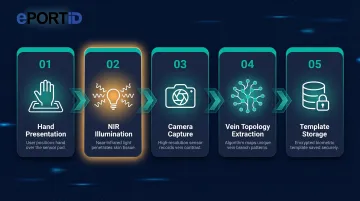
Enrollment captures the baseline template:
- The user presents their hand or finger to the sensor
- NIR LEDs illuminate the vascular network beneath the skin
- A CCD or CMOS camera captures the raw vein image as dark patterns against lighter tissue
- Software extracts the unique vein topology—bifurcations, endpoints, branching structure
- The resulting template is digitized, compressed, and stored securely in a database or smart card as an irreversible mathematical representation, not a raw image
Verification Process
Verification confirms identity at each access attempt:
- Present the hand or finger again to trigger a live scan
- A fresh template is extracted and sent to the matching engine
- Pattern-matching algorithms compare it against the stored record
- Access is granted only if the match score clears a defined threshold
- The full cycle completes in under two seconds
Liveness Detection
Because vein scanners read hemoglobin in living blood vessels, they inherently check that a real, living hand is presented. The system detects the physiological properties of circulating blood, making it resistant to spoofing with artificial replicas, printed images, or photographs—a critical advantage over surface biometrics.
Data Points and Accuracy
Palm vein systems derive identity from a large region of interest containing millions of distinguishing points. Fujitsu's F-Pro specifications state a false acceptance rate (FAR) below 0.00001% and a false rejection rate (FRR) of 1.0% with no retry. Earlier tests based on 140,000 palms reported FAR of 0.00008% and FRR of 0.01%. At that error rate, a system processing 10 million verifications would statistically produce fewer than 10 false acceptances—a meaningful benchmark for facilities like seaports, data centers, and hospitals where a single unauthorized entry carries serious consequences.
Types of Vein Biometrics
Finger Vein Recognition
Finger vein systems capture the vascular pattern inside a single finger. The user inserts a finger between an NIR LED and a CCD camera; hemoglobin absorbs the transmitted light, revealing a vein map unique to that finger.
These systems are compact enough for ATMs, kiosks, and employee time clocks, with the widest deployment in Japanese banking. The tradeoff is a smaller region of interest than palm vein — fewer data points, though accuracy remains high. One practical limitation: most finger vein readers require a finger guide or contact, which raises hygiene concerns in shared-use environments.
- Compact form factor — fits ATMs, kiosks, and time clocks
- Dominant in Japanese financial services; adoption growing in Europe
- Smaller vascular region than palm, but still high accuracy
- Physical contact or guided placement required — a hygiene consideration in high-traffic settings
Palm Vein Recognition
Palm vein systems scan the entire palm in a contactless hover gesture. The larger region of interest yields a richer vein map with more data points, enabling higher accuracy and lower error rates than finger vein.
Palm vein is the dominant contactless vein modality for enterprise deployments. Its advantages over finger vein are substantial:
- No physical contact required — the user hovers their palm briefly over the scanner
- Larger vascular network captures millions of distinguishing data points
- Fujitsu PalmSecure is the leading commercial platform globally
- By 2018, Fujitsu had sold over 1 million PalmSecure sensors across banking, healthcare, and critical infrastructure
That scale reflects the technology's reliability in the field. Philadelphia-based ePortID builds on the same Fujitsu F-Pro scanner, integrating it into purpose-built solutions for physical access control (ePortPass), time and attendance (PalmClock), seaport security (SeaPortPass), and logical access/single sign-on (HotKeyID).
Wrist and Back-of-Hand Vein Recognition
Wrist and dorsal (back-of-hand) vein recognition are less common alternatives to finger and palm vein systems. They appear primarily in specialized contexts rather than mainstream commercial deployments:
- Forensic identification and law enforcement applications
- Research environments — the PUT Vein dataset, captured at 880 nm, is a standard benchmarking resource
- Experimental access-control installations where form factor or ergonomics favor the wrist
For enterprise and critical-infrastructure use cases, palm vein remains the practical choice — broader hardware availability, more validation data, and a larger vascular map that supports higher accuracy.
Key Advantages of Vein Pattern Recognition Over Other Biometrics
Internal, Hidden Biometric
Vein patterns are located beneath the skin surface and invisible to casual observation. Unlike fingerprints that can be lifted from surfaces or facial data harvested from photos, vein patterns require specialized NIR imaging equipment and typically the subject's cooperation to capture. This makes passive collection or covert cloning practically impossible.
Contactless and Hygienic
No physical contact with the sensor is required. Users hover their palm over the scanner without touching any surface. That contactless design matters in practice:
- Eliminates cross-contamination in healthcare, food processing, and public environments
- Reduces equipment wear compared to touch-based sensors
- Remains accurate where fingerprint scanners fail — dry, abraded, or diseased skin (psoriasis, calluses) degrades fingerprint reads and requires frequent surface cleaning
Stable Across a Lifetime
Vein patterns do not change with age, minor injuries, or skin conditions. Fingerprints can be affected by cuts, calluses, or aging; facial structure changes over decades. Large twin studies show that genetically identical individuals have extra vein pattern similarity but are still distinguishable, and vascular patterns are regarded as stable in adulthood, supporting long-lived identity binding.
Uniqueness
Even identical twins who share the same DNA have distinguishable vein patterns. Palm vein systems derive identity from millions of reference points per palm — ePortID's Fujitsu-powered platform processes up to 5 million points — giving the technology an exceptionally low false-match probability suited to high-assurance physical and logical access.
Eliminates Credential Fraud and Buddy Punching
That uniqueness has a direct operational consequence: a vein pattern cannot be borrowed, shared, or transferred, so it creates an indisputable record of who was actually present.
Industry data shows 74% of employers experience buddy punching, with time theft costing 1.5–5% of gross payroll and employees stealing an average of 4.5 hours per week. Deploying vein biometrics for time and attendance eliminates proxy clock-ins and can reclaim measurable payroll leakage — often justifying system cost within three to six months in affected facilities.
Real-World Applications Across Industries
Critical Infrastructure and Access Control
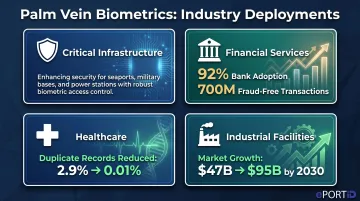
Seaports, airports, power stations, oil rigs, military bases, and data centers use vein recognition to control entry to restricted zones, replace keycards and PINs, and create auditable logs of every access event.
ePortID has deployed palm vein solutions for the US Navy, Army JTF, Marine Corps, and Port Authorities — drawing on 20 years of operational experience in logistics and security. Its SeaPortPass product integrates Transportation Worker Identification Credential (TWIC) verification with real-time checks against the TSA Cancelled Card List. That combination of biometric authentication and regulatory compliance makes it a purpose-built solution for maritime security.
Financial Services and Enterprise
More than 92% of Japanese banks adopted vein-pattern recognition between 2004 and 2008, with Hitachi providing finger vein and Fujitsu palm vein technology. Banco Bradesco in Brazil reported over 700 million ATM transactions without fraud using PalmSecure readers, demonstrating operational resilience in high-volume retail banking.
Fiserv is among ePortID's commercial clients — an indication that the technology holds up at enterprise scale, spanning both physical access control and logical access/single sign-on through HotKeyID.
Healthcare and Patient Identification
Positive patient identification at registration prevents duplicate records and medication errors, and enables identification of unconscious patients.
Carolinas HealthCare reduced duplicate medical records from 2.9% to 0.01% and achieved 97–98% patient acceptance using palm vein biometrics. A BMJ Open study documented a statistically significant reduction in medication misidentification errors (p<0.0001) using vein-authenticated medication carts. The contactless, hygienic nature of palm scanning aligns naturally with clinical infection-control protocols.
Industrial Facilities and Workforce Management
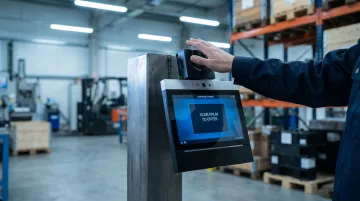
Factories, refineries, and warehouses use vein biometrics for time-and-attendance tracking, replacing punch cards and badge systems. The ROI case is direct:
- Eliminates buddy punching with identity verification tied to the individual
- Reduces payroll processing expense by automating attendance records
- Improves compliance with occupational safety head-counts
ePortID's deployments with Dow Chemical, Tata Steel, and Thyssen Krupp demonstrate what this looks like at industrial scale. The broader market reflects that trajectory: the global biometric systems market is projected to grow from $47.21 billion in 2024 to $95.14 billion by 2030 (12.3% CAGR), with palm vein biometrics alone forecast to reach $4.42 billion by 2031 (17.28% CAGR). That growth signals a stable vendor ecosystem and proven technology — lower adoption risk for organizations deploying today.
High-Throughput Public Venues
Korea Airports Corporation deployed palm vein ID at all 14 domestic airports, with 160,000 registrations and over 1 million uses shortly after launch, reducing check-in congestion. The results show palm vein handling public-scale volume without friction — making it a viable option for transit hubs, stadiums, and concert venues where speed and throughput matter as much as security.
Security Considerations: Spoofing Resistance and Liveness Detection
Why Vein Patterns Are Difficult to Spoof
An attacker attempting to spoof a vein pattern would need to:
- Obtain a high-quality NIR image of the target's vein pattern, which requires specialized equipment and typically the target's cooperation
- Fabricate a material that mimics hemoglobin's NIR absorption properties well enough to fool liveness-detection countermeasures
Compare that to lifting a fingerprint from a glass or photographing a face in public — both require no physical access to the target. Because vein patterns are internal and invisible, they set a substantially higher bar for any spoofing attempt.
Presentation Attack Detection (PAD)
That higher bar doesn't make vein systems immune. Research shows that contactless palm vein systems lacking robust PAD can be vulnerable to printed-image attacks under experimental conditions. A contactless palm vein testbed showed spoofing false accept rates up to 65% with printed images in lab settings. Researchers have also staged hand-vein bypass demonstrations using IR imaging and wax molds against certain devices.
Recommended mitigations:
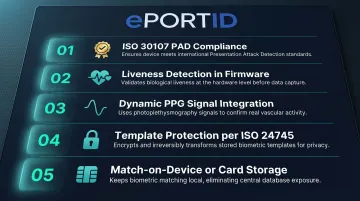
- Specify ISO 30107 PAD performance and testing in procurement requirements
- Verify that device firmware and SDKs include live-sample detection
- Consider adding dynamic photoplethysmography (PPG) signals such as pulse or SpO₂ using synchronized dual wavelengths
- Protect templates per ISO 24745 principles: irreversibility, unlinkability, confidentiality, and data minimization
- For highest-assurance environments, use match-on-device or card-based template storage to reduce server-side risk
Quantifying Random Impersonation Risk
The probability that an arbitrary individual's vein pattern matches an enrolled record is determined by the system's false acceptance rate. Fujitsu PalmSecure F-Pro specifies FAR below 0.00001%, meaning fewer than one in ten million random authentication attempts would falsely succeed—a level suitable for high-assurance verification in physical access control and regulated workflows.
Responsible Deployment Practices
Sound deployment goes beyond hardware selection. Key operational controls include:
- Store templates as encrypted, irreversible mathematical representations — never as raw images
- Restrict database access to authorized personnel and audit it regularly
- Test FAR and FRR on a scheduled basis to confirm performance under real operational conditions
For digital authentication contexts, NIST SP 800-63 clarifies that biometrics alone are not secrets and should not serve as stand-alone credentials at higher assurance levels. Deploy palm vein as a verifier-unlock factor for a cryptographic key, or pair it with an out-of-band authenticator, to align with current identity guidelines.
Frequently Asked Questions
What is vein pattern recognition for biometric identification?
Vein pattern recognition is a biometric method that uses near-infrared light to image the unique network of blood vessels beneath the skin. The vein patterns are extracted as templates and used to verify or identify individuals with high accuracy.
How does vein pattern recognition work?
NIR light is projected onto the hand; hemoglobin in the blood absorbs it, revealing the vein map as dark patterns. A camera captures the image, software extracts a mathematical template, and the system matches that template against stored records to confirm identity.
Does everyone have a unique vein pattern?
Yes. Vein patterns are unique to each individual—including between identical twins—because the vascular network forms independently during fetal development through random biological processes. No two people share the same pattern.
What is biometric pattern recognition?
Biometric pattern recognition is the automated process of measuring and analyzing a unique physical or behavioral characteristic—such as a fingerprint, iris, vein pattern, or face—to confirm or establish a person's identity.
What are the advantages of vein recognition?
Vein recognition stands out for several reasons:
- Contactless and hygienic — no surface contact required
- Internal and nearly impossible to forge or replicate
- Stable throughout life with very low false-match rates
- Checks for liveness during every verification scan
Together, these qualities make it one of the most secure biometric options available.
Looking to deploy contactless palm vein biometrics for your organization? ePortID offers purpose-built systems — including ePortPass (access control), PalmClock (time & attendance), SeaPortPass (maritime security), and HotKeyID (logical access) for physical access control, time and attendance, seaport security, and logical access. Contact ePortID at info@eportid.com or 215-627-2651 to learn more.