Introduction
Security managers at seaports, data centers, hospitals, refineries, and financial institutions face a high-stakes decision: choosing the wrong biometric authentication method means either accepting avoidable security vulnerabilities or overpaying for capabilities their operations don't require. The fingerprint vs. palm vein scanning choice carries real operational consequences: unauthorized access incidents and compliance failures both trace back to selecting technology that doesn't match your facility's threat model.
The global biometric system market is projected to grow from USD 53.22 billion in 2025 to USD 95.14 billion by 2030, a 12.3% compound annual growth rate driven by critical infrastructure, healthcare, and government adoption. Yet not all biometric technologies deliver the same accuracy, hygiene, or spoofing resistance.
This guide breaks down exactly where fingerprint and palm vein scanning diverge — on accuracy, durability, hygiene, and total cost — so you can match the right technology to your facility's actual security requirements.
Key Takeaways
- Fingerprint scanners read surface ridge patterns; palm vein uses near-infrared light to map internal vein structures that can't be photographed or lifted
- Vein patterns can't be harvested from surfaces or replicated—fingerprints can, making palm vein the stronger choice against spoofing
- Palm vein achieves a false acceptance rate under 0.00001%; fingerprint is less accurate but costs less and fits tighter form factors
- For critical infrastructure—ports, refineries, hospitals, data centers—palm vein's contactless design and built-in liveness detection justify the higher cost
- Use fingerprint for lower-risk, budget-constrained deployments; use palm vein where a breach carries regulatory or safety consequences
Fingerprint vs. Palm Vein Scanning: Quick Comparison
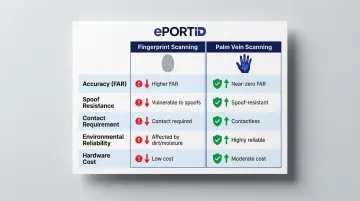
| Attribute | Fingerprint Scanning | Palm Vein Scanning |
|---|---|---|
| Accuracy (FAR) | ~0.001% (varies by device) | < 0.00001% (Fujitsu PalmSecure) |
| Spoof Resistance | High risk — latent prints from glass or screens can be replicated | Low risk — internal vein patterns require live hand; NIR imaging defeats replicas |
| Contact Requirement | Physical contact with optical or capacitive sensor | Contactless — hand hovers ~2 inches above sensor |
| Environmental Reliability | Degrades with wet, dirty, or aging skin; error rate nearly doubles with moisture | Unaffected by cuts, moisture, or surface conditions; rated -25°C to +80°C |
| Hardware Cost | Lower upfront cost; compact, widely compatible sensors | Higher upfront cost; specialized NIR hardware with ambient light controls |
What is Fingerprint Scanning?
Fingerprint scanning analyzes the unique ridge-and-valley patterns—arches, loops, and whorls—on a person's fingertip. A sensor captures these surface patterns, extracts minutiae points (ridge endings and bifurcations), and creates an encrypted digital template for matching. As the oldest and most widely deployed biometric modality, fingerprint scanning has become virtually universal in consumer electronics and basic access control applications.
The technology offers clear operational advantages: low hardware cost, compact form factor, fast authentication for 1:N matching scenarios, and near-universal user familiarity. These strengths make fingerprint scanning the right fit where budget constraints are paramount and security threats remain relatively low-stakes.
Enterprise security contexts expose a more serious problem: surface-level biometric data can be harvested without the user's knowledge. Latent fingerprints left on smartphone screens can be photographed and used to create molds that achieve spoof acceptance rates comparable to genuine captures. Lower-grade optical and capacitive sensors have been demonstrated to accept replicas made from gelatin, silicone, wood glue, and Play-Doh.
Environmental conditions compound the risk. Scanner accuracy degrades substantially with wet, dirty, or aging skin—academic studies show Equal Error Rates nearly double from 2.29% to 4.12% when comparing dry-to-dry versus dry-to-wet fingerprint matching.
Use Cases of Fingerprint Scanning
Fingerprint scanning remains a strong fit for specific applications:
- Consumer electronics unlock (smartphones, tablets, laptops)
- Small office access control with stable user populations
- Basic time-and-attendance tracking in low-risk environments
- Background check enrollment processes
- Residential security systems
The technology's limitations become liabilities in manufacturing floors (dirty or gloved hands), healthcare settings (hygiene concerns and cross-contamination risks), and high-security facilities where presentation attacks represent genuine threats. For those environments, a biometric that reads beneath the skin's surface — without contact — changes the security equation entirely.
What is Palm Vein Scanning?
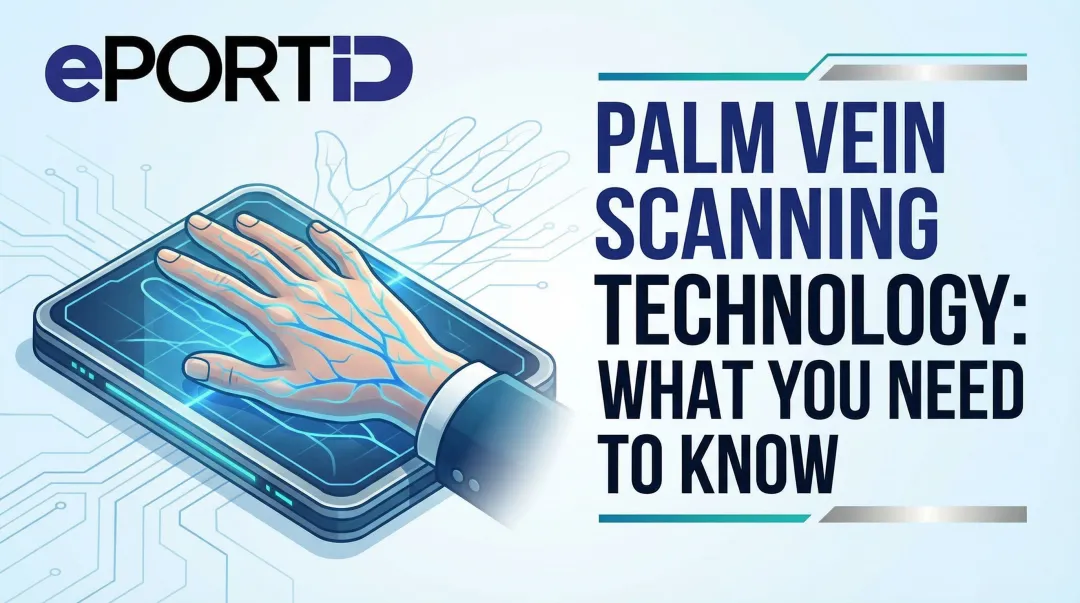
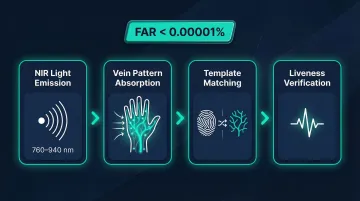
Palm vein scanning is a vascular pattern authentication method that captures subsurface biological structures invisible to the naked eye. A near-infrared sensor emits light (typically 760–940 nm wavelength) that penetrates the skin; deoxidized hemoglobin in the veins absorbs the NIR light, producing a distinct dark-line pattern that maps the unique vein structure beneath the palm surface.
This biometric map comes from an internal, living biological source — not surface skin features.
Vein patterns offer exceptional uniqueness and stability. Research confirms that vein patterns are unique even in identical twins and remain stable throughout a person's lifetime, unaffected by skin aging, surface damage, or environmental wear. Unlike fingerprint patterns that degrade with manual labor and aging, internal vascular structures maintain consistent topology from early adulthood through elderly years.
Vein patterns are internal and invisible — they cannot be photographed, traced from surfaces, or lifted from touched objects. This eliminates the latent print vulnerability that plagues fingerprint systems. Authentication also requires active blood flow, so the technology inherently checks for liveness and defeats spoofing attempts using artificial replicas or deceased tissue.
Palm vein scanning delivers superior accuracy metrics. A palm contains significantly more unique identifying features than a single fingertip, resulting in lower error rates. Fujitsu's PalmSecure technology claims a False Acceptance Rate under 0.00001% and False Rejection Rate of 1%, representing an order of magnitude improvement over standard fingerprint systems.
The contactless nature of palm vein scanning also makes it well-suited for high-traffic, shared-access environments. Users hover their hand without touching the sensor, eliminating cross-contamination risks and sensor degradation from repeated contact. ePortID's Fujitsu-powered palm vein solution delivers 99.99991% accuracy in under 2 seconds — combining throughput speed with spoofing-resistant verification.
Use Cases of Palm Vein Scanning
These characteristics translate directly into real-world deployments across high-stakes sectors:
Healthcare and Patient Identification: University of Utah Health deployed palm vein biometrics across 1.1 million annual outpatient visits. The system creates a 1:1 patient-record link, eliminating duplicate EHRs and reducing dangerous treatment errors.
Aviation and Border Control: Korea Airports Corporation deployed Fujitsu palm vein authentication at 14 domestic airports. As of 2019, the system had been used over 1 million times with 160,000 registered individuals, demonstrating scalability for high-volume public access scenarios.
Financial Services: Hyosung integrated Fujitsu PalmSecure into self-service ATMs and branch devices, replacing ID cards and PINs. The result: reduced fraud and a faster customer experience at financial touchpoints.
Critical Infrastructure: Data centers, military facilities, seaports, refineries, and industrial sites use palm vein scanning where unauthorized access carries severe operational or safety consequences. The technology's spoofing resistance and audit trail capabilities support both security objectives and regulatory compliance requirements.
Fingerprint vs. Palm Vein Scanning: Which is Better for Your Operation?
The "better" technology depends entirely on your facility's threat model, environmental conditions, and compliance requirements—not which technology is newer or more sophisticated. Security managers should evaluate several key decision criteria.
Security Risk Tolerance
If your facility handles sensitive data, critical infrastructure, or high-value assets, an access control breach can trigger severe consequences: regulatory penalties, operational disruption, or safety incidents. In those cases, palm vein's immunity to surface-based spoofing is decisive. The technology cannot be defeated by latent prints lifted from everyday objects—a vulnerability that academic research has demonstrated against fingerprint sensors.
For lower-stakes environments where the primary concern is basic access logging rather than preventing determined adversaries, fingerprint's cost efficiency may be defensible.
Environmental and Workforce Factors
Industries where workers regularly have wet, dirty, or gloved hands (manufacturing, oil and gas, food processing, maritime operations) experience high false rejection rates with fingerprint scanners, creating workflow disruptions and user frustration. Palm vein scanning performs reliably regardless of surface skin conditions and functions in complete darkness, making it well-suited for 24/7 industrial operations.
Hygiene and Throughput Requirements
High-traffic facilities such as port terminals, hospital entrances, and data center server rooms benefit directly from contactless palm vein scanning. It eliminates cross-contamination risk, removes the need for device cleaning between users, and reduces the fomite transfer risk that contact fingerprint scanners pose—a persistent concern in post-COVID facility management.
Clear Situational Recommendations:
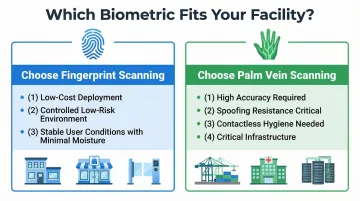
- Choose fingerprint scanning if your priority is low-cost deployment in a controlled, low-risk environment with stable user conditions and minimal exposure to moisture or contaminants
- Choose palm vein scanning if your facility requires high accuracy, spoofing resistance, contactless hygiene, and liveness verification in demanding conditions. It's the proven choice for critical infrastructure: seaports, data centers, healthcare facilities, financial institutions, and industrial sites
Conclusion
Fingerprint scanning remains a proven, accessible technology that serves many purposes well—basic access control, consumer device security, and low-risk time-and-attendance tracking. But for organizations where security failure carries unacceptable consequences, palm vein scanning's internal, contactless, liveness-verified approach represents a higher standard of protection.
The right choice eliminates buddy punching, supports regulatory compliance, and pays for itself through reduced breach risk and leaner operations. For critical infrastructure facilities—ports, refineries, hospitals, military installations, and data centers—that ROI is concrete: preventing a single unauthorized access incident can offset the entire cost of deployment.
Contact-based, surface-level biometrics simply cannot deliver that reliability at the highest threat levels.
Ready to assess which biometric solution fits your facility's specific requirements? Contact ePortID at info@eportid.com or 215-627-2651 to discuss your security environment, threat model, and operational constraints with experts who've deployed biometric systems across seaports, hospitals, and critical infrastructure for over 20 years.
Frequently Asked Questions
What is the difference between palm vein recognition and fingerprint recognition?
Fingerprint recognition scans surface ridge patterns on a fingertip using optical or capacitive sensors. Palm vein recognition uses near-infrared light to map the unique vascular pattern beneath the skin—making it internally sourced, contactless, and far harder to replicate than surface biometrics.
What makes palm vein scanning more secure than fingerprint scanning?
Vein patterns are invisible, internal, and require live blood flow to register. They cannot be lifted from surfaces, photographed, or replicated with silicone molds. Fingerprints, by contrast, leave latent prints on everyday objects that can be harvested to create replicas capable of defeating lower-grade sensors.
Are hand vein patterns unique?
Yes. Palm vein patterns are unique to each individual—including identical twins—and remain stable throughout a person's lifetime. This makes them one of the most reliable biometric identifiers available, unaffected by surface skin aging or damage.
What is the purpose of a palm vein scan?
Palm vein scanning verifies or identifies an individual's identity for access control, time-and-attendance tracking, and facility security. It's especially suited to environments where accuracy, hygiene, and spoofing resistance are non-negotiable, such as hospitals, data centers, and critical infrastructure facilities.
What are the advantages of palm vein technology?
Palm vein technology delivers contactless, hygienic operation with built-in liveness detection that works even in dirty or wet conditions. Patterns are unique even among identical twins, and accuracy rates — FAR under 0.00001% — outperform standard fingerprint systems by a wide margin.
Can fingerprint scanners be fooled or spoofed?
Yes. Lower-grade fingerprint sensors have been demonstrated to accept high-resolution replicas made from gel or silicone. Latent prints left on surfaces can be photographed and used to create spoofing materials, making fingerprint technology less suitable for high-security environments compared to palm vein scanning.