Introduction
Security managers at critical infrastructure sites face a persistent challenge: traditional credentials—keycards, PINs, passwords—can be lost, stolen, shared, or duplicated. This creates real gaps in access control and time-tracking integrity. According to the American Payroll Association, time theft from credential sharing costs businesses 1.5% to 5% of gross payroll annually, with 74% of employers experiencing losses from buddy punching.
Palm vein scanning offers a contactless biometric solution that identifies people using an internal biological trait that cannot be replicated. What follows covers how the technology works, where it's deployed, and why high-security industries—from ports and refineries to hospitals and data centers—are moving toward it.
Key Takeaways
- Palm vein scanning maps unique vein patterns inside your palm using near-infrared light, creating a biometric identity that cannot be lost, stolen, or forged
- Verification completes in under two seconds with accuracy rates exceeding 99.99% — higher than fingerprint or facial recognition
- Active use cases include access control, time and attendance tracking, healthcare patient identification, financial services, and data centers or port facilities
- Vein patterns exist beneath the skin and require living blood flow to scan, making the system extremely resistant to spoofing or identity fraud
- Deployed across critical infrastructure — from military bases and seaports to hospitals and financial institutions — where identity errors carry real consequences
What Is Palm Vein Scanning?
Palm vein scanning is a biometric authentication method that uses the unique vascular patterns inside the palm—not surface features—to verify a person's identity. These patterns form before birth and remain stable throughout a person's lifetime, making them a permanent and reliable identifier. Unlike fingerprints that degrade with age, injuries, or skin conditions, palm vein maps stay consistent for decades.
What makes palm veins particularly reliable as identifiers:
- Formed in utero — patterns are established before birth and never change
- Internally located — veins sit beneath the skin's surface, invisible to external conditions
- Uniquely dense — each map contains millions of distinct data points
- Identical-twin distinguishable — Research confirms that genetically identical twins share extra similarity in vein patterns, yet remain distinguishable
ePortID's Fujitsu-powered system derives identity from 5 million data points, creating a pattern shared by no one else on earth.
The technology's origins trace back to the early 1980s when Joe Rice, an automation controls engineer at Kodak's Annesley factory, invented vein pattern recognition. He filed his patent in 1985, covering a system that reads subcutaneous blood vessel patterns to identify individuals. The technology crossed into commercial use in the early 2000s when Fujitsu launched its PalmSecure product line, giving organizations a deployable, production-grade option that has since been adopted across healthcare, finance, and critical infrastructure worldwide.
How Does Palm Vein Scanning Work?
Enrollment and Template Creation
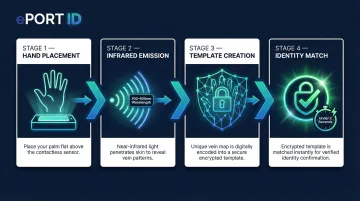
During enrollment, a user holds their palm above the scanner, which emits near-infrared light (700–900nm wavelength) that passes through the skin. This light is absorbed by the hemoglobin in deoxygenated blood traveling through the veins. The absorption creates a pattern of dark lines on the captured image that is unique to that individual.
The raw image is processed by algorithms that convert the vein pattern into an encrypted digital template—a mathematical representation, not a photograph. On subsequent scans, the system compares the live reading to the stored template and grants or denies access in under two seconds.
Liveness Detection and Anti-Spoofing
Palm vein scanners include liveness detection during each scan. The system can only read the infrared signature of flowing blood in a living hand, meaning cut-out images, silicone molds, or 3D-printed replicas cannot fool it. That said, independent research by Tome & Marcel found that presentation attacks using printed near-infrared images achieved a 65% spoofing false accept rate — which means enterprise deployments should verify that their chosen system includes robust presentation attack detection (PAD) capabilities, not just basic liveness checks.
Data Security and Privacy
Reliable systems store vein data as encrypted templates, never raw images. ePortID's Fujitsu F-Pro scanner, for example, applies this approach across several layers:
- ISO/IEC 19794-9 compliance for standardized biometric data formatting
- AES 128-bit encryption applied to every stored template
- Individual encryption keys assigned per template, not shared across records
- On-device decryption and matching — no readable biometric data leaves the hardware
This means a breach of the storage system yields encrypted data that cannot be reverse-engineered into a usable biometric image.
Technical Limitations
Physical conditions can affect scan quality. Research evaluating palm security under industrial conditions found reliability dropped nearly 30% when hands were heavily soiled with clay and 26% with oil contamination. Certain medical conditions that reduce blood circulation or cause vein visibility issues represent the primary technical limitation, though overall system reliability remains high.
Key Applications of Palm Vein Scanning
Access Control for High-Security Facilities
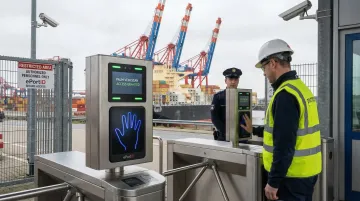
Palm vein scanning replaces keycards, fobs, and PINs at entry points for restricted areas including data centers, server rooms, refineries, military bases, port terminals, and research labs. The technology eliminates the risk of shared or stolen credentials and creates an indisputable audit trail of who entered where and when.
ePortID draws on 20 years of logistics and security experience serving the US Navy, Army JTF, Marine Corps, and Port Authorities. That background informs deployments for enterprise clients including Dow Chemical, Fiserv, and South Jersey Port Corp. — protecting critical infrastructure where credential failure is not an option.
Time and Attendance Tracking
Organizations use palm vein systems to record employee arrivals and departures, eliminating buddy punching—the practice of one employee clocking in for another. The American Payroll Association estimates that employees steal an average of 4.5 hours per week through time theft. Palm vein systems generate accurate payroll data and can deliver ROI within 3 to 6 months through reduced payroll fraud.
Healthcare Patient Identification
Hospitals use palm vein scanning to match patients to their correct medical records at check-in, reducing duplicate records and preventing medical errors. Results from real deployments are striking:
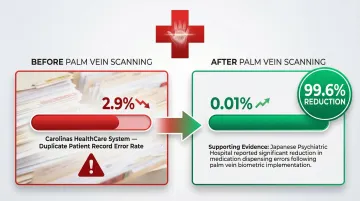
- Carolinas HealthCare System (Atrium Health) cut its duplicate medical records error rate from 2.9% to 0.01% — a 99.6% reduction — using Imprivata PatientSecure palm-vein biometrics
- A 2022 study in Japanese psychiatric hospitals found medication administration errors from patient misidentification dropped after introducing palm vein authentication
Financial Services and Banking
Palm vein authentication verifies customer identity for high-value transactions, ATM access, and secure login. Suruga Bank in Japan launched palm vein-authenticated accounts in 2004 to prevent fraudulent withdrawals. Banco Bradesco in Brazil incorporated the technology into its ATMs, acting as a stronger alternative to PINs, passwords, or physical cards that can be stolen or skimmed.
High-Stakes Testing Environments
Organizations administering credentialed exams use palm vein scanning to verify test-taker identity at check-in, preventing impersonation fraud and ensuring exam integrity. Sub-two-second, contactless verification handles high-volume check-in without bottlenecks — and because the biometric can't be transferred or faked, it closes the impersonation loophole that traditional ID checks leave open.
Benefits of Palm Vein Scanning for Enterprise Security
Uniqueness and Permanence
Vein patterns are internal, invisible from the outside, and stable for life. Unlike fingerprints that degrade with age, work injuries, or skin conditions, palm vein maps remain consistent, meaning a single enrollment serves as a reliable identifier for decades.
Superior Accuracy
Enterprise-grade palm vein systems achieve accuracy rates that far exceed other biometrics. Fujitsu PalmSecure reports a False Acceptance Rate (FAR) below 0.00001% and a False Rejection Rate (FRR) of 0.01%. For context, the NIST Fingerprint Vendor Technology Evaluation found the most accurate single-fingerprint systems achieved false rejection rates of 1.9%—roughly 190 times higher.
ePortID's Fujitsu-powered solution achieves 99.99991% accuracy—unauthorized users are stopped, and authorized users move through in under 2 seconds without friction.
Contactless and Hygienic Operation
No physical surface contact is required, providing hygiene advantages in environments where scanners are used by hundreds of people daily—warehouses, hospitals, ports. Fingerprint systems require regular cleaning, can spread contaminants, and struggle with workers who have calloused, dirty, or wet hands. Palm vein scanning avoids these issues entirely.
Operational and Financial ROI
Beyond security, palm vein systems deliver measurable business value:
- Eliminate buddy punching and time theft
- Automate attendance records
- Reduce payroll processing overhead
- Lower administrative burden from payroll disputes
- Decrease unauthorized access incidents
The technology pays for itself within 3 to 6 months, making it a financially viable investment for operations managers concerned about security and productivity.
Cannot Be Lost, Forgotten, Duplicated, or Stolen
Every credential-based alternative has vulnerabilities: keycards get left at home, PINs get shoulder-surfed, passwords get phished, and fingerprints can be lifted off any surface you touch. Palm vein patterns are internal and living—they travel with the authorized user and no one else. There is no credential to steal.
Palm Vein Scanning vs. Fingerprint Scanning
Core Technical Comparison
Fingerprint systems read external surface ridges exposed to the environment—vulnerable to cuts, calluses, aging, chemical exposure, and dry or wet conditions. Palm vein scanning reads internal vascular patterns unaffected by surface conditions.
Quick Comparison:
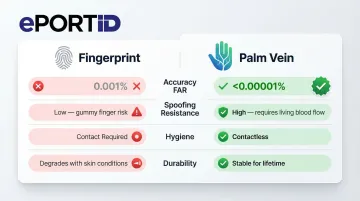
| Factor | Fingerprint | Palm Vein |
|---|---|---|
| Accuracy (FAR) | 0.001% (NIST) | <0.00001% (Fujitsu) |
| Spoofing Resistance | Low (gummy fingers succeed) | High (requires living blood flow) |
| Hygiene | Contact required, surface spreads contaminants | Contactless, no shared surface |
| Durability | Degrades with age, injuries, skin conditions | Stable for lifetime |
Spoofing and Forgery Risk
Anyone can lift fingerprints from surfaces and replicate them with silicone or gelatin to fool contact-based scanners. A foundational 2002 study by Matsumoto demonstrated that artificial "gummy" fingers made of cheap gelatin deceived optical and capacitive fingerprint sensors with acceptance rates between 68% and 100%.
In contrast, vein patterns cannot be captured without a person's knowledge—they require infrared penetration beneath the skin. Liveness detection means even a perfect replica would fail, making palm vein scanning far harder to defeat through identity fraud.
Practical Suitability for Industrial Environments
Fingerprint scanners struggle wherever workers have rough, wet, or gloved hands. Palm vein scanning handles these conditions without issue because it never touches the surface and reads patterns beneath the skin. That distinction matters in:
- Ports and warehouses where hands are exposed to weather and heavy equipment
- Food processing and pharmaceutical facilities with strict hygiene requirements
- Manufacturing floors where cuts, calluses, and chemical exposure are routine
- Oil rigs and refineries where gloves are standard PPE
For facilities like these, the contactless scan isn't just a convenience—it's the difference between a system workers can actually use and one that fails at the door.
Frequently Asked Questions
What is a palm vein scan used for?
Palm vein scans serve a range of identity verification needs:
- Access control at secure facilities and critical infrastructure
- Time and attendance tracking to eliminate buddy punching
- Patient identification in healthcare settings
- Financial transaction verification
- Identity authentication in high-stakes testing environments
The technology provides fast, contactless verification where credential integrity is non-negotiable.
Why do testing organizations use palm vein scans (e.g., MCAT, NCLEX)?
High-stakes exams use palm vein scanning to prevent impersonation fraud, ensuring the registered test-taker is the one actually sitting the exam. It verifies identity in under two seconds without physical contact, and fake IDs or proxy testers cannot defeat it — making it the right fit for high-volume environments where positive identity confirmation is required.
How does a palm vein scan work?
The scanner emits near-infrared light that passes through the skin and is absorbed by hemoglobin in the veins, creating a distinct pattern. This pattern is converted to an encrypted digital template during enrollment. Future scans are matched against that template in under two seconds, granting or denying access based on the match result.
How accurate and reliable are palm vein scans?
Palm vein scanning is among the most accurate biometric methods available. Enterprise-grade systems like Fujitsu PalmSecure achieve accuracy rates above 99.99%, with false acceptance rates below 0.00001% and false rejection rates of 0.01%. Performance is unaffected by surface skin conditions, making the technology highly reliable across diverse user populations.
Is a palm vein scan safe?
Yes, palm vein scanning is safe. It uses near-infrared light, which is non-ionizing and poses no health risk to users. The scan is contactless, eliminating hygiene concerns. Biometric data is stored as an encrypted mathematical template rather than a photograph of the hand, addressing privacy concerns about data storage and misuse.
Are palm vein scanners better than fingerprint scanners?
For enterprise security and industrial applications, palm vein scanning is generally the stronger choice. It resists spoofing, works regardless of skin condition, and achieves false acceptance rates far below what fingerprint systems can match. Fingerprint scanners remain more affordable and compact for everyday consumer use, but palm vein technology pulls ahead wherever security failures carry real consequences.