Introduction
Payment fraud losses hit $33.83 billion globally in 2023, while eCommerce fraud is projected to surge from $44.3 billion in 2024 to $107 billion by 2029. Behind these numbers lies one consistent weakness: stolen credentials account for 24% of all breaches. Cards get skimmed, passwords get phished, and PINs get shoulder-surfed. Every credential-based system shares the same structural flaw.
Biometric payment solutions are no longer theoretical — they're deployed today in banks, retail terminals, and critical infrastructure worldwide. Not all biometrics hold up equally when real money is at stake.
Fingerprints can be lifted from surfaces and spoofed with 68-100% success rates using simple gelatin molds. Facial recognition is now vulnerable to AI-generated deepfake attacks, prompting federal warnings to financial institutions.
This article explains why palm vein technology outperforms other biometrics for payment authentication — measured across fraud rates, transaction speed, false rejection, and compliance audit results.
Key Takeaways
- Palm vein technology authenticates using the unique vein pattern inside the palm via near-infrared light, with no card, PIN, or device required
- Verification completes in under 2 seconds with accuracy exceeding 99.99%
- Internal vein patterns are invisible, impossible to lift from surfaces, and require live blood flow to scan
- False acceptance rate is 100x lower than fingerprint systems and 130,000x lower than facial recognition
- Banco Bradesco processed 700 million+ fraud-free transactions using palm vein authentication
- 92% of Japanese banks have adopted the technology at scale
What Is Palm Vein Technology?
Palm vein biometrics is a contactless identity verification method that maps the unique vein network inside a person's palm using near-infrared light. The scanner emits light at approximately 760 nm wavelength—deoxidized hemoglobin in venous blood absorbs this light, causing veins to appear as dark patterns. The sensor captures this subcutaneous image and converts it to an encrypted digital template derived from more than five million reference points.
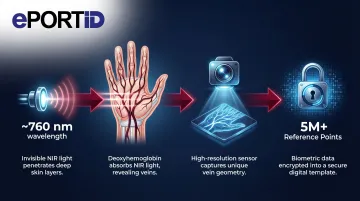
Unlike fingerprints or facial features, which are external surface characteristics, palm vein patterns exist entirely beneath the skin. That means they can't be lifted from a surface, photographed, or replicated — the same vulnerabilities that make fingerprint and facial systems targets for spoofing simply don't apply.
That reliability is precisely why high-stakes environments trust it. Where it's deployed today:
- Financial transactions: ATMs, POS terminals, cardless banking
- Critical infrastructure: Seaports, power stations, military facilities
- Healthcare: Patient identification, staff authentication
- Workforce management: Time and attendance, payroll authentication
Cards get lost. PINs get shared. Tokens get stolen. Palm vein authentication eliminates all three failure points by binding identity to something the person always carries and can never hand off.
Key Advantages of Palm Vein Technology for Biometric Payments
The advantages below are evaluated specifically for payment authentication, where stakes include financial loss, regulatory non-compliance, and customer trust erosion. Each advantage directly impacts KPIs payment operators track: fraud rates, transaction speed, false rejection, and operational cost.
Payment Fraud Prevention Through Non-Replicable Identity
Palm vein patterns are internal, invisible outside the body, and require live blood flow to be read — making them uniquely resistant to the spoofing methods that compromise other biometrics.
How this plays out in payment environments:
Vein data cannot be skimmed at an ATM, intercepted in a data breach as a usable credential, or replicated using silicone molds. Research demonstrates that artificial "gummy fingers" were accepted by fingerprint systems with 68-100% probability, while silicone spoofs achieved success rates up to 95.2% on commercial sensors. These attack vectors simply don't apply to palm vein systems.
Built-in liveness detection:
Palm vein devices only recognize patterns when blood is actively flowing within the veins, rendering photographs, prosthetics, and replay attacks ineffective. This closes the spoofing gap that has compromised fingerprint and face-based payment systems—no additional anti-spoofing hardware needed.
Real-world impact:
Payment fraud mechanisms rely on credential theft. When the credential cannot be stolen because it exists only inside the body, fraud vectors collapse. Over 92% of Japan's banks use vein-pattern recognition, and adoption resulted in sharply reduced fraud. Banco Bradesco processed 700 million+ ATM transactions without fraud using palm vein readers.
KPIs impacted: Fraud incident rate, chargeback volume, false acceptance rate, compliance audit outcomes, cyber liability insurance costs
Best fit environments: High-volume retail terminals, ATM networks, financial institutions processing large transactions, and any operation where card skimming or identity theft is a documented risk
Speed and Accuracy That Doesn't Degrade at Scale
Palm vein authentication derives its template from millions of unique data points, resulting in exceptionally low error rates. The Fujitsu PalmSecure F-Pro achieves a false acceptance rate below 0.000001%—approximately 100x lower than fingerprint and 130,000x lower than facial recognition.
How this functions in live payment contexts:
A customer hovers their palm for under 2 seconds, receives instant verification, and completes the transaction. No contact required, no retry loop, and no degradation from dirty, dry, or damaged skin that causes fingerprint scanners to fail.
Comparative accuracy:
| Biometric Modality | False Acceptance Rate (FAR) |
|---|---|
| Facial recognition | ~1.3% |
| Fingerprint | ~0.001% |
| Iris/Retina | ~0.0001% |
| Palm vein | <0.00001% |
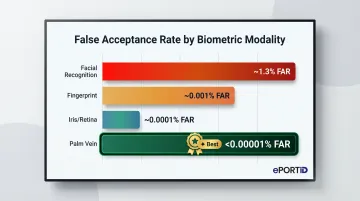
Source: Fujitsu PalmSecure Whitepaper
Environmental resilience:
External factors such as abrasions, hair, skin conditions, water, or lotions have little impact on recognition ability. By contrast, wet fingerprints show equal error rates nearly doubling from 2.29% dry to 4.12% wet—a critical failure mode in retail, food service, and industrial payment environments.
Lifetime stability:
Vein patterns remain stable throughout a person's life, meaning a template enrolled once remains valid for years without re-enrollment overhead. As people age, skin elasticity degrades and fingerprint patterns become less noticeable, reducing scanner performance—palm vein systems are immune to this degradation.
KPIs impacted: Transaction completion rate, false rejection rate, average transaction time, customer abandonment at payment point, re-enrollment frequency
Best fit environments: Retail checkout lanes, transit fare gates, hospital billing, and enterprise payroll systems where throughput and first-attempt success rates directly affect operational revenue
Credential-Free Identity Eliminates Lost, Stolen, or Shared Authentication
Palm vein authentication removes dependency on any external credential. No card to forget, no PIN to share, no phone to lose, no token to expire. The identity is always present because it is biologically embedded.
Operational reality change:
User onboarding creates a permanent biometric template. From that point forward, the palm is the payment method. No re-issuance, no account lockouts from forgotten PINs, no fraud from card sharing among family members or employees.
Compliance advantage:
Palm vein creates an indisputable, timestamped record of who authorized each transaction. This supports KYC (Know Your Customer), AML (Anti-Money Laundering), and audit trail requirements better than shared PINs or transferable cards. ePortID has applied this capability in live financial services deployments — drawing on 20 years of security experience across military and port authority environments, with commercial clients including Fiserv.
Real-world proof:
- Cardless ATM banking: Ogaki Kyoritsu Bank in Japan deployed Fujitsu palm vein systems enabling ATM access without passbook or card
- Airport boarding: Korea Airports Corporation deployed palm vein authentication at all 14 domestic airports, processing 1 million+ transactions with 160,000 registered users
- Retail payment: Lotte Duty Free launched palm vein biometric payments at Seoul's Gimpo Airport, removing the need for passports, boarding passes, or payment cards
Template portability:
The biometric template is just 1 to 2 KB in size and can be stored on smart card chips, enabling "match on device" without server-side biometric data storage—supporting data minimization principles aligned with privacy regulations.
KPIs impacted: Credential management cost, support ticket volume (PIN resets, card replacements), compliance audit pass rate, unauthorized transaction rate, payroll processing accuracy
Best fit environments: Shared-device environments such as hospital workstations, factory floors, and warehouses; financial institutions with strict KYC/AML obligations; and enterprises where buddy punching or unauthorized account access carries measurable cost
What Happens When You Rely on Inferior Biometrics for Payments
Weak authentication creates compounding costs rarely attributed back to the authentication method itself.
Documented failure modes:
- A Brazilian doctor was arrested in 2013 for using fake silicone fingers to clock in absent coworkers at a hospital; a 2018 gang in India used wax-cast fingerprint forgeries to bypass police entrance exams.
- Alcohol-based hand sanitizer produced weak fingerprint development showing few or no frictional ridges on digital scanners — exactly the condition created by pandemic hygiene protocols.
- FinCEN's November 2024 alert warned financial institutions that deepfake media is actively circumventing identity controls, recommending strengthened liveness detection.
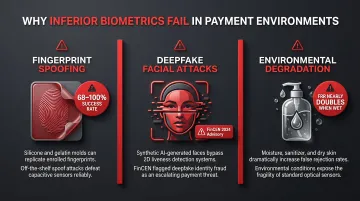
The scaling problem:
Each of these failures looks isolated on its own. Scaled across high-traffic ATMs, large retail chains, or port facility payroll systems, error rates compound fast. At enterprise volume, what starts as a minor nuisance becomes a direct revenue drain — driving up costs from refund processing, fraud investigation, and regulatory exposure while steadily eroding customer trust.
How to Get the Most Value from Palm Vein Payment Technology
Palm vein delivers full ROI when deployed as a system, not a standalone scanner. Connecting it to payment platforms, access control, time-and-attendance, and compliance reporting multiplies value well beyond authentication speed alone. Three areas determine how much value you actually capture.
Measure outcomes consistently:
Track fraud incident rates, transaction completion rates, and re-enrollment frequency before and after deployment to quantify impact. ePortID, working in partnership with Fujitsu, brings 20 years of security experience across military, port authority, and commercial financial clients — with documented performance benchmarks from real enterprise deployments.
Enrollment quality matters:
The accuracy of palm vein authentication depends on high-quality initial enrollment. Organizations should:
- Standardize onboarding procedures across all enrollment locations
- Review match rate data periodically to ensure continued specification performance
- Use batch enrollment capabilities (CSV/Excel upload) to integrate with existing identity databases
- Complete enrollment in approximately 15 seconds per hand using the F-Pro scanner
Integration architecture considerations:
Systems should meet three baseline requirements to support enterprise-grade deployments:
- Support multi-location network connectivity through secure subnets or VPNs
- Provide real-time audit trails for compliance reporting
- Interface with existing infrastructure via Wiegand or OSDP protocols
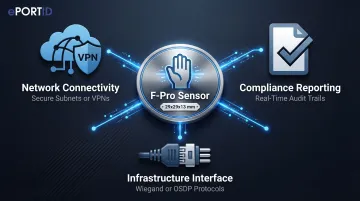
The F-Pro sensor measures just 29 x 29 x 13 mm, enabling integration into ATMs, kiosks, POS terminals, and access panels.
Conclusion
Palm vein technology earns its position as the best biometric for payments through the combination of fraud immunity, transaction-grade accuracy, and credential-free permanence. These strengths reinforce each other across every touchpoint in a payment environment.
As payment fraud continues to evolve—with eCommerce losses projected to exceed $107 billion by 2029—authentication quality becomes a measurable competitive advantage. Organizations that treat palm vein biometrics as ongoing infrastructure investment, rather than a one-time security upgrade, will see returns in fraud reduction, compliance confidence, and operational efficiency that grow over time.
The production record backs that investment case: 700 million fraud-free transactions, 92% bank adoption across an entire nation, and market projections growing from $1.99 billion in 2026 to $4.42 billion by 2031. At this scale, palm vein authentication has moved well past the pilot stage — it's the proven baseline for payment systems where fraud tolerance is zero.
Frequently Asked Questions
How does palm vein authentication work?
A near-infrared light scanner illuminates the palm, hemoglobin in the veins absorbs the light to reveal a unique vein pattern, which is converted into an encrypted digital template and matched against stored data for instant verification in under 2 seconds.
How secure is palm vein technology?
Palm vein technology is among the most secure biometrics available because vein patterns are internal, invisible, and require live blood flow to scan. They cannot be lifted from surfaces, captured remotely, or replicated with materials used to spoof fingerprints or facial recognition.
How accurate is palm vein recognition?
Palm vein systems achieve false acceptance rates below 0.000001% and false rejection rates of approximately 0.01%, derived from over five million unique data points captured per scan. In practice, that means near-zero unauthorized transaction approvals — a critical threshold for payment environments.
What does palm vein technology improve?
Palm vein technology improves fraud prevention, transaction speed, authentication reliability, compliance recordkeeping, and eliminates credential management costs such as card replacement and PIN resets. It creates indisputable audit trails for regulatory compliance while reducing authentication time to under 2 seconds.
What is a palm vein biometric?
Palm vein biometrics is a contactless authentication method that identifies individuals through the unique network of veins inside the palm—an internal biological trait that is stable throughout a person's life and unique to each individual, including identical twins.
What are the two types of biometric systems?
Biometric systems are classified as physiological (based on physical traits like fingerprints, palm veins, iris patterns, or facial geometry) and behavioral (based on patterns like voice, gait, or keystroke dynamics). Palm vein falls in the physiological category — and among physiological options, it is the only one that verifies a hidden internal trait, making it the most resistant to fraud in payment transactions.