Yet most organizations still rely on credentials that exist outside the body—easily cloned proximity cards, reused passwords, or shared access badges. According to Verizon's 2025 Data Breach Investigations Report, stolen credentials were the initial access vector in 22% of all breaches, while 61% of physical security professionals report tailgating and 38% report card sharing as ongoing vulnerabilities.
This article explains the specific privacy and security advantages that palm biometrics—particularly palm vein scanning—delivers in practice, not just on paper, and why those advantages compound over time in complex, high-volume environments.
Key Takeaways
- Palm vein biometrics verify identity using unique vein patterns beneath the skin—internal structures that are invisible, impossible to photograph, and impossible to replicate
- Verification completes in under 2 seconds with 99.99991% accuracy, and the contactless technology cannot be spoofed with photos, fake hands, or stolen credentials
- Biometric credentials can't be lost, shared, forgotten, or sold on the dark web—no card to clone, no password to crack
- Eliminates buddy punching and credential-based fraud, with most deployments recovering costs within 3-6 months
What Is Palm Biometrics?
Palm biometrics is a form of identity verification that reads internal biological data—specifically the unique vein patterns inside a person's palm—rather than surface-level traits like fingerprints or facial features. Establishing with certainty who is present has measurable value across access control, time and attendance, fraud prevention, and compliance.
There are two distinct approaches, and ISO/IEC standards define them precisely:
- Palm print recognition scans friction ridge patterns on the skin's surface — similar to fingerprints, and just as vulnerable to being lifted from touched objects or photographed at a distance.
- Palm vein recognition captures subsurface vascular patterns using near-infrared light, reading blood vessels beneath the skin that cannot be observed, photographed, or replicated from surfaces.
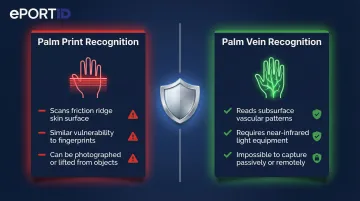
Palm vein scanning is the more secure and privacy-preserving of the two. Because it reads structures beneath the skin, it requires active participation with specialized near-infrared equipment — making passive or covert capture impossible.
Key Advantages of Palm Biometrics
These advantages focus on real-world, operational outcomes tied to measurable results in security, cost, compliance, and risk management.
Advantage 1: A Unique Biological Pattern That Cannot Be Stolen or Faked
Palm vein patterns are formed by millions of individual data points covering vein bifurcations (branching points), depth, width, and spatial arrangement. ePortID's system, powered by the Fujitsu F-Pro scanner, creates identity profiles from 5 million distinct data points, creating a pattern unique to every individual—even identical twins possess distinct palm vein patterns.
How the technology works: During scanning, near-infrared light penetrates the skin surface. Hemoglobin in the blood absorbs this light, and the resulting image captures a subsurface vascular map invisible to the naked eye. The scanning process requires active blood flow through the veins, which provides built-in liveness detection. The scanner verifies it's reading from a living person, not a photograph, fake hand, or cadaver.
Why this advantage matters:
Because vein patterns are internal, there is no surface artifact to steal. Unlike fingerprints (which can be lifted from surfaces) or facial data (which can be harvested from photos), palm vein patterns cannot be captured without a live, willing subject, which removes credential theft as a viable attack vector.
Enterprise-grade systems like the Fujitsu PalmSecure F-Pro achieve a False Acceptance Rate (FAR) of under 0.00001%, meaning unauthorized access through false matches occurs in fewer than 1 in 10 million attempts. Advanced palm vein systems also include liveness detection, making spoofing with fake hands effectively impossible in real-world deployments (though academic research has demonstrated vulnerabilities in basic sensors without proper presentation attack detection).
KPIs impacted: Unauthorized access attempts blocked, false acceptance rate, spoofing incidents, audit trail integrity.
When this advantage matters most: High-security perimeters: military bases, data centers, server rooms, chemical plants, and financial institutions where a single unauthorized access event can be catastrophic.
Advantage 2: Privacy by Design — Identity That Lives Under the Skin
Privacy by design is not a marketing term here. Palm vein biometrics physically cannot be captured passively or at a distance — a scanner requires close, deliberate proximity and the subject must actively present their hand.
Unlike facial recognition systems (which can scan crowds), palm vein systems only activate with intentional user participation. The technology cannot be used for mass surveillance or covert data collection.
This active participation requirement is critical for regulatory compliance. The European Data Protection Board (EDPB) distinguishes between active biometric authentication and passive identification: systems that capture faces indiscriminately in public spaces violate GDPR Article 9, while systems requiring deliberate user interaction do not.
The privacy implication:
Palm vein patterns are not stored anywhere on the internet, not retrievable from social media, and not available on the dark web. While threat actors compromised over 3.3 billion credentials in 2025, biometric vein data is not actively traded on dark web markets because the internal nature of vein patterns makes passive observation and theft exceedingly difficult.
Palm biometrics replace credentials that can be lost, shared, or forgotten. This eliminates the privacy and liability risks that come with managing those credentials:
- No phishing vulnerability exploiting weak passwords
- No buddy card sharing or unauthorized access transfers
- No credential reuse across systems
- No dark web exposure from data breach leaks
Legal compliance context: Under the Illinois Biometric Information Privacy Act (BIPA), organizations that collect biometric data must obtain written consent and publish retention schedules. Courts have ruled in Rosenbach v. Six Flags (2019) and Bryant v. Compass Group (2020) that mere technical violations — failing to obtain consent — constitute actionable harm even without financial damages. Palm vein systems simplify compliance because the technology requires active participation, making informed consent a natural part of the enrollment process.
KPIs impacted: Data breach exposure, credential-sharing incidents (buddy punching), compliance audit findings, identity fraud cases.
When this advantage matters most: Organizations subject to privacy regulations: HIPAA in healthcare, GDPR in Europe, CCPA in California, or those managing access to personally sensitive data in hospitals, research labs, HR systems, and payroll infrastructure.
Advantage 3: Operational Accuracy That Eliminates Fraud and Reduces Costs
Accuracy in biometrics is not just a technical specification — it has direct financial and operational implications. A high false acceptance rate means unauthorized people get in; a high false rejection rate means legitimate employees face repeated friction and delays.
ePortID's palm vein system achieves 99.99991% accuracy and completes verification in under 2 seconds, enabling high-throughput environments like seaports, factory floors, and hospital entry points to operate without bottlenecks.
Buddy punching elimination:
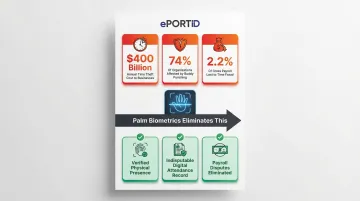
Buddy punching(where one employee clocks in on behalf of another) is a common form of time and attendance fraud. According to the American Payroll Association, time theft costs U.S. employers up to $400 billion annually, affecting 74% of organizations and draining an average of 2.2% of gross payroll.
Because palm biometrics tie verification to the physical presence of the correct individual, this form of fraud is eliminated at the point of entry. The system creates an indisputable digital record of who was present, when, and where, reducing disputes in payroll processing, strengthening compliance documentation, and supporting incident investigations.
Measurable ROI:
ePortID's PalmClock time and attendance system typically pays for itself in 3-6 months through payroll recovery alone. Organizations reduce:
- Payroll processing errors and manual reconciliation time
- Overtime calculation disputes
- Administrative overhead from managing lost or stolen access cards
- Compliance audit findings related to access records
KPIs impacted: Payroll processing accuracy, buddy punching incidents, time-to-verify, operational throughput, compliance audit pass rate, ROI timeline.
When this advantage matters most: Organizations with large, distributed workforces and shift-based operations: seaports, warehouses, factories, and hospitals where even small verification inefficiencies compound across thousands of daily transactions.
What Happens When Palm Biometrics Is Missing or Ignored
Organizations that rely on traditional credential systems—keycards, PINs, passwords—face real-world consequences that extend beyond inconvenience:
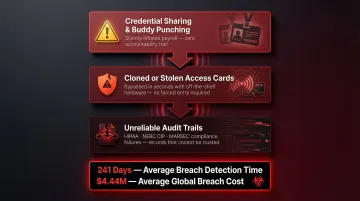
Credential sharing and buddy punching go undetected, silently inflating payroll costs and undermining accountability. Without biometric verification, there's no way to confirm that the person holding the card is the person authorized to use it.
Stolen or cloned access cards create security gaps that may not be discovered until an incident has already occurred. Legacy 125 kHz proximity cards can be cloned in seconds using off-the-shelf hardware like the Proxmark3, allowing attackers to bypass physical access controls without forced entry.
Compliance becomes harder to prove Audit trails become unreliable. Industries where audit trails are legally required—healthcare (HIPAA), utilities (NERC CIP), maritime (TWIC/MARSEC)—face increased scrutiny when access records rely on easily shared credentials rather than verified identity.
The risk compounds over time. Organizations typically discover failures only after a costly breach, payroll discrepancy, or compliance violation. IBM's 2025 Cost of a Data Breach Report found that it takes an average of 241 days to identify and contain a breach, with average costs reaching $4.44 million globally and $10.22 million in the United States.
How to Get the Most Value from Palm Biometrics
Palm biometric systems deliver the most measurable return when integrated at every relevant access point rather than deployed selectively. Partial rollouts leave gaps that credential-based threats can exploit—a single unsecured entry point undermines the security of the entire facility.
Full coverage alone isn't enough. Active monitoring turns raw data into security intelligence — access logs, attendance records, and anomaly flags are only useful if someone is reviewing and acting on them. Organizations that achieve the highest ROI pair the technology with clear protocols:
- Who gets enrolled, and how exceptions are managed
- How re-enrollment works if someone is injured or their biometric signature changes
- How data is stored, encrypted, and secured
- How the system integrates with existing HR, payroll, or access control infrastructure
ePortID's systems connect to existing infrastructure through industry-standard Wiegand and OSDP protocols for access control. For HR and payroll, they accept direct data uploads via Excel or CSV. The Power over Ethernet (PoE) architecture supports deployment up to 100 meters from power sources — no dedicated electrical work required, cutting installation time and cost.
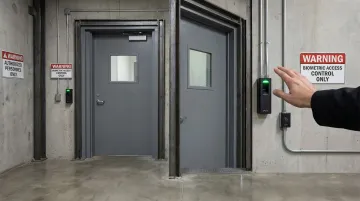
Best practice: Begin with high-risk entry points — server rooms, data centers, controlled substance storage, financial transaction areas — and expand coverage as ROI becomes evident. Most organizations that start with a targeted deployment expand to additional access points within the first year, once reduced payroll fraud and tighter access logs show up in the numbers.
Conclusion
The privacy and security advantages of palm biometrics are not theoretical—they are structural. Because the credential lives inside the body, it cannot be stolen, shared, guessed, or spoofed in the ways that undermine traditional authentication systems.
Those structural advantages compound with every month of deployment:
- Attendance records grow more accurate without ongoing admin effort
- Access incidents decrease as credential sharing and buddy punching are eliminated
- Compliance documentation stays clean because every entry is tied to a verified identity
- Operational continuity holds even when employees change phones, lose badges, or forget passwords
For organizations in critical infrastructure, healthcare, or financial services, that combination is what makes palm biometrics worth deploying at scale. The security value is immediate. The operational savings — reduced payroll errors, fewer access disputes, cleaner audit trails — typically cover the investment within three to six months. Done right, coverage expands because the results make the case on their own.
Frequently Asked Questions
What is palm biometrics?
Palm biometrics is an identity verification method that reads unique biological characteristics of the hand—either surface ridge patterns or internal vein structures—to confirm who a person is without requiring a password, card, or PIN.
What is palm vein recognition?
Palm vein recognition scans the subsurface vascular patterns beneath the skin using near-infrared light, capturing a vein map that is unique to each person and invisible without specialized equipment. This makes it harder to spoof than surface-based biometrics.
How accurate is a palm vein scan?
Enterprise-grade palm vein systems achieve accuracy rates approaching 99.99991%, with verification typically completing in under 2 seconds. This makes the technology practical for high-throughput environments like seaports, factories, and hospital entry points.
Is palm recognition safe?
Palm vein scanning is contactless and uses low-power near-infrared light, similar in strength to a TV remote. Vein patterns are internal, cannot be captured remotely, and are not available on the internet or dark web. Most enterprise systems also include liveness detection to prevent spoofing attempts.
Are palm scanners better than fingerprint scanners?
For high-security applications, palm vein scanners offer clear advantages over fingerprint readers:
- Internal vein patterns can't be lifted from surfaces or degraded by dirt and wear
- Contactless scanning is more hygienic than touch-based methods
- Liveness detection makes spoofing significantly harder than with surface fingerprints
What are the four benefits of biometrics?
Biometrics deliver four core advantages:
- Security: Identity is tied to the individual, not a credential that can be lost or stolen
- Fraud prevention: Eliminates credential sharing and impersonation
- Efficiency: Verification completes in under 2 seconds with no friction
- Auditability: Creates a reliable, indisputable record of who was present and when