Introduction
Large office buildings routinely manage hundreds of employees, contractors, and visitors moving through dozens of access points daily. Traditional key-based systems buckle under that volume, creating unauthorized access risks, data breach exposure, and real liability.
A single lost keycard can compromise an entire floor. Buddy punching quietly inflates payroll by thousands each year. At that scale, access control stops being a compliance checkbox and becomes a core business investment.
This guide evaluates the 10 best access control systems specifically engineered for large office buildings. We'll compare cloud-based mobile credential platforms, enterprise on-premise solutions, advanced biometric systems, and the key differentiators you need to assess when selecting a platform that can scale from 50 to 5,000 users without a full infrastructure overhaul.
Key Takeaways
- At scale, large office buildings need access control that handles high user volumes, multiple entry points, and distinct security zones — most generic systems can't keep up
- Top 2025 options span cloud platforms (Brivo, Kisi), enterprise on-premise solutions (LenelS2, Genetec), and contactless biometric systems (ePortID, ZKTeco)
- Selection criteria include scalability, video/visitor management integration, credential flexibility, and total cost of ownership
- Contactless biometric systems like palm vein scanning offer the strongest security and eliminate ongoing credential replacement costs
- The right system pays for itself through reduced admin overhead, eliminated buddy punching, and measurable cuts to unauthorized access incidents
What Makes Access Control Critical for Large Office Buildings
Access control in large office buildings goes well beyond door locks. These systems authenticate identities and manage permissions across multiple floors, departments, and entry points — elevators, server rooms, parking facilities, and common areas. Unlike small-office setups, enterprise access control must handle layered security zones where lobby access differs dramatically from data center or executive floor requirements.
Large office environments face distinct challenges: daily traffic volumes in the hundreds or thousands, multi-tenant complexity requiring segregated access, temporary visitor and contractor management, and tamper-proof audit trails for compliance and incident investigation.
The stakes are high. According to the FBI's 2023 Internet Crime Report, businesses lost over $12.5 billion to cybercrime — and inadequate physical access control contributed directly to breaches when unauthorized individuals reached server rooms and secure areas.
Key technology categories you'll encounter:
- Card/fob systems: RFID credentials that require physical distribution and can be lost or shared
- Mobile credential platforms: Smartphone-based access via Bluetooth or NFC, eliminating physical cards
- Biometric solutions: Palm vein, facial recognition, or fingerprint scanning tied to individual identity
- Cloud vs. on-premise management: Remote, centralized administration versus local server control
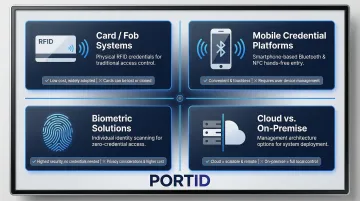
Most large buildings combine two or more of these — typically a biometric layer for high-security zones paired with card or mobile credentials for general access.
10 Best Access Control Systems for Large Office Buildings
These 10 systems were selected based on scalability, credential versatility, enterprise integration capabilities, reliability record, and suitability for high-traffic, multi-zone office environments.
ePortID (Palm Vein Biometric Access Control)
ePortID, based in Philadelphia with 20 years of experience securing military bases, port authorities, and critical infrastructure, provides a contactless palm vein biometric identity verification system in partnership with Fujitsu, whose palm vein hardware is deployed across banking, healthcare, and government sectors globally. Commercial clients include Fiserv, Dow Chemical, Tata Steel, and Thyssen Krupp.
What sets it apart: Palm vein patterns are derived from 5 million data points unique to each individual — including identical twins. Key differentiators:
- Cannot be lost, stolen, shared, or spoofed
- Verifies identity in under 2 seconds at 99.99991% accuracy
- Built-in liveness detection confirms actual vein patterns beneath the skin
- Eliminates buddy punching with indisputable attendance records
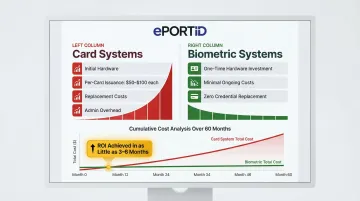
- Designed to deliver ROI within 3–6 months through operational savings
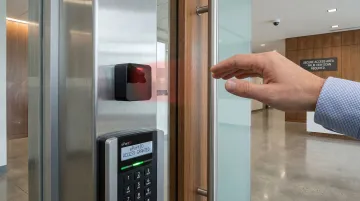
A complete deployment integrates Fujitsu F-Pro palm vein scanners, ThinLabs Door Control Units (DCU) with Power over Ethernet, ELATEC RFID readers for multi-factor authentication, and BlinkStick LED feedback systems. The PoE architecture transmits both power and data over a single cable up to 100 meters — eliminating the need for licensed electricians during installation.
| Key Features | Details |
|---|---|
| Core technology | Contactless palm vein scanning; liveness detection; 99.99991% accuracy; under 2-second verification; indisputable audit trail; multi-factor authentication |
| Best For | High-security zones (server rooms, executive floors, data centers), enterprises requiring strict identity verification and compliance |
| Pricing | Contact ePortID for enterprise pricing; designed to deliver ROI within 3–6 months of deployment |
Genetec Security Center
Genetec is a Montreal-based unified security platform vendor trusted by government agencies, airports, and large enterprises worldwide, offering access control, video surveillance, and license plate recognition in a single management interface.
Ideal for large office buildings managing multiple security systems, Genetec's open architecture integrates with hundreds of third-party devices. Its cloud/on-premise hybrid deployment model lets organizations scale without replacing existing infrastructure — a strong fit for enterprises carrying legacy systems.
| Key Features | Details |
|---|---|
| Core technology | Unified access + video management; open-platform integrations; encrypted credential authentication; cloud/hybrid deployment |
| Best For | Large enterprises and multi-site organizations needing a single-pane-of-glass security dashboard |
| Pricing | Quote-based; enterprise licensing model |
LenelS2 OnGuard
LenelS2 (a Honeywell/Carrier company) has over 30 years of experience in enterprise physical security. Its OnGuard platform is one of the most widely deployed access control systems in large commercial real estate and corporate campus environments.
OnGuard offers both on-premise and cloud (OnGuard Cloud SaaS) deployment options and supports over 200 third-party integrations — including elevator control, visitor management, and video analytics — making it well suited for complex, multi-tenant office buildings requiring deep customization.
| Key Features | Details |
|---|---|
| Core technology | On-premise and cloud SaaS options; 200+ third-party integrations; visitor management; elevator access control; video management |
| Best For | Large commercial real estate owners and corporate campuses with complex multi-system security requirements |
| Pricing | Quote-based; scalable per access point |
Brivo
Brivo is a pioneer in cloud-based access control, offering a SaaS platform purpose-built for multi-site management. Administrators can control and monitor dozens of locations from a single online dashboard without on-site servers.
For organizations managing multiple locations, Brivo supports mobile credentials, key cards, and visitor management with real-time remote access revocation. That means no physical key distribution headaches across a large, distributed workforce.
| Key Features | Details |
|---|---|
| Core technology | 100% cloud-based; mobile credentials; multi-site management; visitor management; API integrations with HR and property management software |
| Best For | Multi-location enterprises and office property managers needing centralized, remote access management |
| Pricing | Subscription-based; pricing scales with number of doors and users |
Avigilon Alta (formerly Openpath)
Avigilon Alta (a Motorola Solutions product) combines cloud-based access control with AI-powered video analytics, linking every access event with timestamped video footage for a comprehensive, automated security record.
Touchless mobile entry and triple-unlock technology (mobile app, wave gesture, or auto-unlock) keep entry moving at peak times — relevant for buildings with hundreds of employees arriving in the same morning window.
| Key Features | Details |
|---|---|
| Core technology | Touchless mobile entry; AI video analytics integration; cloud management; customizable user permissions; real-time alerts |
| Best For | Tech-forward enterprises wanting access control tightly coupled with video surveillance and AI analytics |
| Pricing | Quote-based; cloud subscription model |
HID Global
HID Global is one of the world's largest identity and access technology companies, offering a broad portfolio spanning smart cards, RFID readers, mobile credentials, and biometric authentication for organizations of any scale.
Operating in over 100 countries with more than 4,500 employees, HID anchors ASSA ABLOY's Global Technologies division, which reported SEK 23,955 million in 2024 revenue.
Its value for large office buildings is credential versatility. HID supports virtually every credential type on a single platform — making it a practical bridge for enterprises unifying legacy card systems with modern mobile and biometric access without a full infrastructure overhaul.
HID's Signo and iCLASS SE readers support over 15 credential technologies simultaneously — including legacy 125 kHz Proximity and modern 13.56 MHz Seos/Mobile Access. Multi-technology cards (such as Seos + Prox) enable phased upgrades without disruptive overnight replacements.
| Key Features | Details |
|---|---|
| Core technology | Smart cards, RFID, mobile credentials, biometrics; two-factor authentication; identity management; global scalability; OSDP support |
| Best For | Large enterprises with existing card infrastructure transitioning to modern or multi-factor credentials |
| Pricing | Varies by product line; hardware + software licensing model |
Honeywell Pro-Watch
Honeywell Pro-Watch is an enterprise-class integrated security management system designed for large, complex facilities — combining access control, intrusion detection, video surveillance, and fire system integration under a unified platform.
In regulated industries — healthcare, finance, government — where audit trails are mandatory, Pro-Watch stands out. It covers mobile, biometric, and keycard entry while generating the compliance documentation these environments require.
| Key Features | Details |
|---|---|
| Core technology | Unified access, intrusion, video, and fire management; compliance reporting; mobile + biometric + keycard support; web-based dashboard |
| Best For | Large regulated-industry office environments (finance, healthcare, government) requiring compliance-grade audit trails |
| Pricing | Quote-based enterprise licensing |
Kisi
Kisi is a cloud-based, mobile-first access control platform designed for ease of deployment and management, popular with fast-growing companies that need a flexible system their IT team can manage without dedicated security personnel.
It integrates with 70+ business tools including Slack, G Suite, and HR platforms, and automates access provisioning and deprovisioning tied to employee onboarding and offboarding — reducing administrative overhead in large offices with high staff turnover.
| Key Features | Details |
|---|---|
| Core technology | Mobile-first; 70+ software integrations; automated provisioning; audit trails and alerts; browser-based management portal |
| Best For | Fast-growing tech companies and modern offices prioritizing workflow automation and ease of administration |
| Pricing | Subscription-based; hardware sold separately; pricing per door per month |
Dormakaba
Dormakaba is a Swiss global security hardware leader with a 150+ year history, offering premium physical access control solutions including electronic locks, speed gates, and integrated building security systems for high-end commercial properties.
Known for engineering precision in high-traffic environments, Dormakaba's hardware handles thousands of daily entry events while integrating with virtually any access control software — making it a reliable physical backbone for large office deployments.
| Key Features | Details |
|---|---|
| Core technology | Premium electronic locks and speed gates; fire alarm integration; anti-tailgating; broad software compatibility; high throughput design |
| Best For | Large office buildings prioritizing durable, high-throughput physical security hardware with flexible software integration |
| Pricing | $3,000–$8,000 per unit (hardware); software integration costs vary |
ZKTeco
ZKTeco is a global leader in biometric security technology, offering optical turnstiles, fingerprint and facial recognition readers, and RFID access control systems at a price point that makes enterprise-grade biometrics accessible for budget-conscious large offices.
Its Comet Series and facial recognition terminals are widely deployed in corporate lobbies and high-traffic entry zones. A single device supports biometric, RFID, and QR code credentials — delivering multi-factor authentication at a competitive cost.
| Key Features | Details |
|---|---|
| Core technology | Facial and fingerprint recognition; RFID + QR code support; speed gates; remote management; customizable ambient lighting |
| Best For | Large offices seeking cost-effective biometric entry at high-traffic lobby and turnstile points |
| Pricing | $1,500–$6,000 per unit; software licensing additional |
How We Chose the Best Access Control Systems
Our evaluation prioritized four criteria that matter most at enterprise scale:
- Scalability — Can the system grow from 50 to 5,000 users without replacing hardware?
- Credential flexibility — Does it support the full range, from cards to biometrics?
- Integration depth — Does it connect with video surveillance, visitor management, elevator control, and HR software?
- Deployment options — Does it offer cloud, on-premise, and hybrid configurations to match different IT policies?
The most common buyer mistake: Choosing a system based on upfront hardware cost alone without accounting for licensing fees, integration complexity, and the ongoing cost of replacing lost or compromised credentials over time. A $500 card reader becomes far more costly in practice when you factor in $50–$100 per replacement card multiplied across hundreds of employees over five years.
Reliability and vendor reputation were weighted heavily because in a large office building, a system failure during peak entry times (8–9 AM, post-lunch) doesn't just create inconvenience — it creates security gaps and operational disruption. According to an Axis Communications security whitepaper, access control system downtime can cost enterprises $5,000–$10,000 per hour in lost productivity and emergency response expenses.
Biometric systems scored highest on long-term cost-effectiveness because they eliminate the ongoing expense of issuing, replacing, and managing physical credentials — a factor that compounds significantly at the scale of a large office building. Contactless options like palm vein scanning also eliminate hygiene concerns and surface contamination risks associated with fingerprint readers.
Conclusion
Choosing the right access control system for a large office building comes down to fit: how well it matches your specific security zones, user volume, integration requirements, and growth plans. Total cost of ownership matters as much as purchase price. Factor in credential replacement costs, administrative overhead, and the real business cost of a security incident before committing.
The right system will address these fundamentals:
- Credential security: Can they be lost, stolen, shared, or duplicated?
- Remote management: Can administrators respond to incidents without being on-site?
- Vendor reliability: Do they have a verifiable track record in demanding environments?
- Scalability: Will the platform grow as your headcount and facilities expand?
For corporate data centers, regulated financial offices, and other facilities where a single unauthorized entry carries serious consequences, ePortID's contactless palm vein biometric system delivers 99.99991% accuracy in under 2 seconds — with no card to lose, share, or clone. Clients including Fiserv, Dow Chemical, and Tata Steel have seen ROI within 3–6 months. Contact ePortID at 215-627-2651 or info@eportid.com to discuss deployment for your building.
Frequently Asked Questions
What is the best access control system?
The "best" system depends on building size, security requirements, and integration needs. Cloud-based platforms like Brivo or Avigilon suit multi-site management, while biometric systems like ePortID are best for high-security zones requiring the strongest possible identity verification.
What is considered the strongest access control?
Biometric access control—particularly contactless palm vein scanning—stands as the strongest option because it relies on a unique physiological trait that cannot be lost, stolen, shared, or replicated, unlike cards, PINs, or fobs.
What are the 4 types of access control?
The four main models are:
- MAC (Mandatory Access Control): Used in government and military for strict classification enforcement
- RBAC (Role-Based Access Control): Assigns permissions by job title or department
- DAC (Discretionary Access Control): Lets resource owners set their own permission rules
- Rule-Based Access Control: Applies automated policy rules based on conditions
What is the most common access control model used in modern organizations?
Role-Based Access Control (RBAC) is the most common because it assigns permissions based on job title or department, making it easy to manage access at scale as employees join, leave, or change roles.
How to secure an office building?
Install electronic access control at all entry points, segment access by zone and role, integrate with video surveillance, implement visitor management, and conduct regular access audits to revoke outdated credentials.
What is an access control measure to secure building management devices?
Building management devices — BMS, HVAC controls, and server rooms — should be secured with role-based restrictions, multi-factor authentication, and physical access logs. For the highest-security environments, biometric verification ensures only authorized personnel reach critical infrastructure controls.