Introduction
Securing a facility's perimeter today requires more than a locked gate. Critical infrastructure facilities — seaports, data centers, military bases, refineries — face evolving threats that demand layered security: automated gate hardware paired with intelligent credential verification working as a single integrated system.
That integration, however, is where most facilities fall short. Disconnected gate operators and identity verification systems create security gaps that undermine even the most robust hardware — and those gaps remain among the most exploited vulnerabilities in industrial and enterprise environments.
This guide evaluates 9 of the best gate automation and access control systems for 2026. Each system was selected against four criteria:
- Reliability under continuous, high-throughput conditions
- Security grade appropriate for critical infrastructure
- Integration capability with existing access control architectures
- Suitability for high-stakes environments where unauthorized entry carries operational and compliance consequences
Key Takeaways
- Gate automation controls physical entry; access control verifies credentials — both must work together
- Systems covered include commercial operators (LiftMaster, FAAC), cloud access platforms (Brivo, Kisi), and biometric solutions (ZKTeco, ePortID)
- Selection depends on duty cycle, credential type, integration depth, and security tier
- Biometric systems like ePortID deliver the highest identity assurance for critical infrastructure
- Choose based on your security tier, traffic volume, and whether compliance mandates non-transferable credentials
Overview of Gate Automation & Access Control Systems
Gate automation refers to motorized operators, barrier arms, and safety sensors that physically control vehicle and pedestrian entry. Access control encompasses credential-based identity verification systems that authorize or deny entry. Effective security requires both working in tandem.
The global physical access control market was valued at over $100 billion in 2026, reflecting enterprise recognition that perimeter security is central to overall facility protection. With regulatory pressure mounting and the cost of a single unauthorized access incident running into the millions, how gate hardware and identity verification connect has become one of the more consequential decisions a facility manager makes.
The 9 systems below were selected for their performance across commercial, industrial, and critical infrastructure environments — from basic gate operators to advanced biometric platforms that eliminate credential sharing and deliver detailed access logs suitable for compliance review.
9 Best Gate Automation & Access Control Systems for 2026
Systems were evaluated based on reliability, security grade, integration capability, duty cycle, credential flexibility, and real-world deployment in commercial or critical infrastructure environments.
LiftMaster
LiftMaster is one of the most widely deployed gate automation brands globally, backed by the Chamberlain Group with over 50 years in the industry. The company manufactures swing, slide, and barrier gate operators suited to residential through heavy commercial applications.
LiftMaster's MyQ smart technology ecosystem sets it apart, enabling remote monitoring, smartphone control, and integration with third-party access control systems. All products comply with UL 325 safety standards, and installation is streamlined through clear technical documentation and broad dealer support.
| Attribute | Details |
|---|---|
| Best For | Residential driveways, commercial parking, multi-site deployments |
| Key Features | MyQ smart connectivity, UL 325 compliant, photoeye and safety edge standard, AC/solar power options |
| Integration | Compatible with third-party access controllers, keypads, telephone entry systems, and card readers |
HySecurity
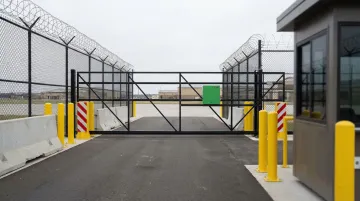
HySecurity manufactures high-cycle, industrial-grade gate operators designed specifically for high-security and high-traffic environments such as military bases, utilities, and government facilities.
The StrongArm and SlideSmart product lines deliver fast cycle speeds, anti-tailgate features, and certifications for crash-rated and ASTM-compliant security perimeters. HySecurity operators routinely handle 1,000+ cycles per day, making them suitable for installations where downtime is not acceptable.
| Attribute | Details |
|---|---|
| Best For | Military, government, utilities, industrial facilities with high cycle demands |
| Key Features | High cycle duty (up to 1,000+ cycles/day), anti-tailgate logic, UL 325 and ASTM crash rating options |
| Integration | Interfaces with all major access control platforms via relay outputs and Wiegand |
FAAC
FAAC is a global leader in access automation headquartered in Italy, with over 50 years of experience and a product line spanning residential swing/slide operators to industrial barrier arms and parking revenue control systems.
FAAC's broad commercial footprint includes airports, hospitals, and gated communities, supported by three business divisions: parking, access control, and access automation. The company's acquisition of Viking Access Systems expanded its North American presence and product portfolio.
| Attribute | Details |
|---|---|
| Best For | Commercial, institutional, and parking facility gate automation globally |
| Key Features | AC and 24V DC motors, self-locking electromechanical drives, integrated safety devices, UL 325 compliant |
| Integration | Compatible with card readers, keypads, intercoms, and HUB parking management software |
DoorKing (DKS)
DoorKing is a US-based manufacturer with decades of experience producing commercial-grade gate operators and telephone entry/access control systems. The company uniquely positions itself as a single-vendor solution for gate plus entry management.
DoorKing's vertically integrated product line (operators, telephone entry systems, and access control all from one manufacturer) reduces compatibility issues common in gated community and commercial parking deployments. Made in USA manufacturing also supports faster service and parts availability.
| Attribute | Details |
|---|---|
| Best For | Gated communities, commercial parking, multi-tenant facilities |
| Key Features | Telephone entry, card/PIN access, lane control, barrier arms, made in USA |
| Integration | DKS ecosystem (operators + entry systems + access control) with optional smart gate controller |
Brivo
Brivo is a cloud-native access control platform serving enterprise and multi-site organizations, with capabilities extending to gate control, elevator access, and visitor management through a unified online portal.
Brivo's platform secures over 100,000 locations across 80 countries, managing more than 2 million devices for 25 million users, demonstrating massive scalability. Integration breadth is a key differentiator — the platform connects natively with video surveillance, HR systems, and a wide range of third-party hardware including gate operators via Wiegand protocol support and flexible API endpoints.
| Attribute | Details |
|---|---|
| Best For | Multi-site enterprises, commercial buildings, gated facilities needing cloud management |
| Key Features | Cloud-based portal, mobile credentials, video integration, visitor management, scalable licensing |
| Integration | APIs for HR/PMS systems, major gate operators, cameras, and smart locks |
Avigilon Alta (Openpath)
Avigilon Alta (formerly Openpath) is a touchless cloud-based access control system now under Motorola Solutions, offering up to four access methods — mobile app, wave-to-enter, encrypted fobs/cards, and guest passes — through a single reader.
The platform sets an industry benchmark for frictionless, high-security entry by combining AI-enhanced video with access data in a unified platform. Alta is particularly strong for high-traffic facilities requiring fast, touchless throughput without sacrificing audit trail integrity or real-time monitoring capability.
| Attribute | Details |
|---|---|
| Best For | Corporate campuses, healthcare, high-traffic commercial facilities |
| Key Features | Four-method touchless reader, encrypted credentials, real-time video + access integration, cloud portal |
| Integration | Motorola Solutions / Avigilon camera ecosystem, third-party gate operators, HR platforms |
ZKTeco
ZKTeco is a global biometric and access control hardware manufacturer offering fingerprint, face, iris, and card-based readers integrated with gate turnstiles and door controllers. The company is widely deployed in factories, warehouses, and institutional settings.
ZKTeco's value proposition centers on cost-accessible biometric entry for organizations transitioning away from card-only systems. The broad product catalog covers standalone locks through enterprise multi-door controllers, with time and attendance functionality integrated into most product lines.
| Attribute | Details |
|---|---|
| Best For | Factories, warehouses, schools, and organizations deploying biometric access at scale |
| Key Features | Multi-modal biometrics (fingerprint, face, iris), card/PIN backup, turnstile integration, time & attendance |
| Integration | ZKBio software suite, third-party access platforms via Wiegand/OSDP, gate operators |
Kisi
Kisi is a modern cloud access control platform known for clean hardware design and user-friendly software, supporting Bluetooth, NFC, RFID, mobile, and legacy Wiegand readers. The platform serves SMBs through enterprise deployments.
Kisi's flexibility preserves existing hardware investments via Wiegand extension boards while adding cloud management, real-time audit trails, and integrations with HR and workspace platforms. This approach makes Kisi a low-friction upgrade path for organizations looking to modernize card-based legacy systems without complete hardware replacement.
| Attribute | Details |
|---|---|
| Best For | Office buildings, co-working spaces, SMBs, and enterprises upgrading legacy card systems |
| Key Features | Mobile, NFC, RFID, Bluetooth credentials; Apple Wallet support; QR code reader; real-time audit logs |
| Integration | Slack, Google Workspace, Okta, BambooHR, and third-party door hardware via Wiegand |
ePortID
ePortID is a Philadelphia-based contactless biometric identity verification solution built on Fujitsu palm vein scanning technology. The company brings 20 years of experience serving the US Navy, Army JTF, Marine Corps, and Port Authorities, with deployments now extended to commercial critical infrastructure including Fiserv, Dow Chemical, Tata Steel, and South Jersey Port Corp.
For high-security gate and facility access, palm vein identity draws from 5 million unique data points per person — a depth fingerprint and facial recognition cannot match. The system verifies identity at 99.99991% accuracy in under 2 seconds, with built-in liveness detection confirming subsurface vein patterns. Credentials cannot be lost, shared, stolen, or duplicated, eliminating buddy punching and unauthorized entry. Most deployments pay for themselves within 3–6 months through payroll and compliance savings.
Gate integration is handled through the Door Control Unit (DCU), which supports:
- Relay output: 12V signal direct to gate controllers
- Multi-factor authentication: two- or three-part verification (biometric + card + PIN)
- TWIC verification: real-time checks against TSA Cancelled card lists for seaport access
| Attribute | Details |
|---|---|
| Best For | Seaports, airports, military bases, refineries, data centers, power stations, hospitals, and any critical infrastructure requiring zero-error identity verification |
| Key Features | Contactless palm vein scanning, 99.99991% accuracy, sub-2-second verification, liveness detection, no cards or PINs required |
| Integration | Compatible with gate operators via Wiegand/OSDP, time & attendance systems, facility access platforms; Fujitsu hardware partnership; proven in US military and port authority environments |
How We Chose the Best Gate Automation & Access Control Systems
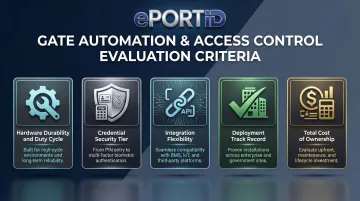
Each system was assessed on five core criteria:
- Hardware durability and duty cycle — how the operator performs under continuous commercial use
- Credential security tier — ranked PIN < card < biometric based on spoofability
- Integration flexibility — native compatibility with third-party platforms via Wiegand, OSDP, or relay outputs
- Deployment track record — proven performance in commercial and critical infrastructure environments
- Total cost of ownership — not just purchase price, but installation, maintenance, and replacement costs
The most common mistake buyers make is choosing a gate operator and an access control system independently without verifying integration compatibility. Without that check, the result is manual workarounds, security gaps, or costly rip-and-replace projects post-installation. Before committing to any system, confirm that the gate hardware and credential verification platform communicate natively via Wiegand, OSDP, or relay outputs.
For environments where identity certainty is non-negotiable — ports, military facilities, data centers, chemical plants — we weighted biometric accuracy and anti-spoofing capability heavily. That's why biometric-first platforms appear alongside traditional gate automation brands in this list. A card or PIN can be shared or stolen — a palm vein pattern cannot.
Conclusion
Choosing the right gate automation and access control system comes down to matching capability to your specific threat model, traffic volume, environment, and integration requirements — not defaulting to the most recognized brand name.
Before committing to a platform, pressure-test it against three criteria:
- Scalability — can the system grow as your site expands or your credential volume increases?
- Total cost of ownership — factor in licensing, credential management, and maintenance, not just hardware price
- Vendor support track record — a lower upfront cost often conceals higher long-term expenses in credential replacement or system incompatibility
A system that looks affordable on day one can become a liability within two years if those questions go unanswered.
Those criteria are exactly where palm vein biometrics separate from card and PIN systems. For organizations at ports, military facilities, refineries, data centers, and industrial plants, contact ePortID to learn how contactless palm vein authentication — accurate to 99.99991%, verified in under 2 seconds, and already deployed at facilities like Dow Chemical and South Jersey Port Corp. — typically pays for itself within 3–6 months.
Frequently Asked Questions
What is the most reliable automatic gate opener?
LiftMaster and HySecurity are consistently top-rated for reliability. LiftMaster's MyQ-enabled systems with UL 325 compliance suit residential through commercial use, while HySecurity's high-cycle, crash-rated operators are built for industrial and government facilities with demanding duty cycles. Reliability also depends on correct installation, duty cycle matching, and regular maintenance.
How much does an automated gate system cost?
Costs range from a few hundred dollars for basic residential openers to $5,000–$50,000+ for commercial systems with access control integration, installation, and software licensing. Plan for total cost of ownership — hardware, credentials, maintenance, and licensing fees — since ongoing expenses often exceed the initial hardware price.
Which is the best access control system?
The right choice depends on your security tier, site size, and use case. Cloud platforms like Brivo or Kisi work well for multi-site enterprises needing centralized management. Biometric systems like ePortID or ZKTeco are better fits where identity certainty is non-negotiable — high-security facilities, critical infrastructure, or environments where cards can be lost or shared. Standalone systems cover small or isolated access points with minimal traffic.
What is the difference between gate automation and access control?
Gate automation refers to motorized hardware that physically opens and closes a gate — operators, barrier arms, motors. Access control refers to the credential verification system — card readers, keypads, biometrics — that determines who is authorized to trigger that gate. A complete perimeter requires both: the access control system verifies credentials first, then issues the open command to the gate operator.
Can biometric access control be integrated with gate automation systems?
Yes, biometric readers integrate with most gate operators via standard Wiegand or OSDP interfaces. Solutions like ePortID and ZKTeco are purpose-built for perimeter deployments, verifying identity at the point of entry before the gate operator receives its open signal.
What access control system is best for critical infrastructure and industrial facilities?
Critical infrastructure environments — ports, refineries, military bases, data centers — require the highest security tiers, where biometric systems are preferred over cards or PINs because credentials cannot be lost, shared, or stolen. ePortID's contactless palm vein technology is purpose-built for these environments with a proven track record in US military and port authority deployments, delivering 99.99991% accuracy and real-time TWIC verification for maritime security.