Introduction
Most facilities planning a biometric access control upgrade hit the same wall early: the price range is enormous and the variables are hard to sort out. The global biometric system market is on track to grow from $53.22 billion in 2025 to $95.14 billion by 2030 — a 12.3% annual growth rate — partly because the cost of getting security wrong keeps rising. The average physical security breach now costs an estimated $100,000 to remediate, and 60% of companies have experienced one in the past five years.
Costs vary dramatically across this market. A basic fingerprint scanner starts under $500 per door, while enterprise-grade multi-modal systems for critical infrastructure can exceed $10,000 per door. That gap creates real risk: misreading the range leads to underbudgeting, wrong technology choices, and surprise expenses that derail deployments.
This guide gives you a clear picture of what biometric access control actually costs — broken down by technology type, cost driver, and expense category — so you can build an accurate budget before committing to a system.
Key Takeaways
- Budget $2,500–$8,000 per door all-in for commercial deployments; hardware alone ranges from $200–$10,000+ per access point
- Expect technology choice, number of access points, installation complexity, and software licensing to drive the biggest cost differences
- Low-cost fingerprint systems work for low-risk environments; critical infrastructure demands contactless, multi-factor biometric solutions
- Plan for hidden costs—enrollment, training, compliance, and maintenance—that routinely add 20–40% beyond hardware quotes
- Well-deployed systems eliminate credential replacement costs and typically pay for themselves within 3–6 months
How Much Does Biometric Access Control Cost?
There's no single fixed price for biometric access control—cost depends on biometric modality, number of secured doors, software model, and facility complexity. The two most common budgeting mistakes? Buyers who look only at hardware unit prices while ignoring software and installation, and those who over-specify technology for low-risk areas that don't require it.
Entry-Level Systems: Fingerprint Scanners ($200–$1,500 per door)
What's typically included:
- Fingerprint reader
- Basic door controller
- Standard locking hardware
- Cloud or on-premise software license
- Suitable for 1–10 doors with straightforward wiring
Best for: Small-to-mid-size commercial offices, warehouses, internal access points in larger facilities, and organizations upgrading from keycards that need a cost-effective entry point into biometrics.
Limitation: Fingerprint recognition degrades in wet or dirty conditions—Equal Error Rate nearly doubles from 2.29% for dry prints to 4.12% for wet, wrinkled fingerprints. Heavy-use environments, manufacturing floors, and facilities with moisture exposure are poor fits for this technology.
Mid-Range Systems: Facial Recognition & Palm Vein ($1,000–$3,000 per door)
What's typically included:
- Touchless reader (facial or palm vein)
- Door controller
- Electronic lock
- Cloud management license
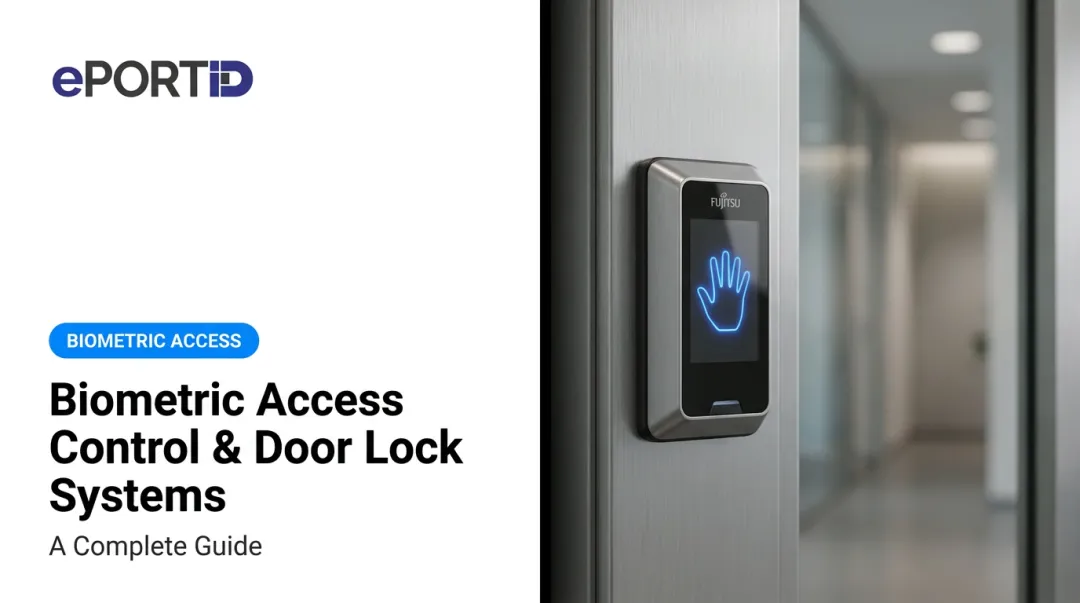
Palm vein systems like those based on Fujitsu PalmSecure technology achieve 99.99991% accuracy and incorporate liveness detection by reading vein patterns beneath the skin. For healthcare, food manufacturing, and critical infrastructure, touchless operation is a functional requirement—not a preference.
Best for:
- Facilities requiring contactless access: hospitals, labs, food processing plants, financial institutions, seaports
- Organizations eliminating buddy punching and needing indisputable time-and-attendance records
- Environments where credential sharing or card loss creates measurable security gaps
ePortID's palm vein solutions are deployed at Dow Chemical, South Jersey Port Corp., Tata Steel, and Thyssen Krupp—environments where accuracy and uptime aren't negotiable. Most clients recover the system cost within 3–6 months through payroll savings alone.
High-End Systems: Iris Scanners & Multi-Factor Authentication ($2,000–$10,000+ per door)
What's typically included:
- High-precision iris readers or multi-modal devices combining two or more biometric methods
- Advanced door hardware
- Enterprise software with full audit trails
- Often dedicated network infrastructure
Enterprise-grade deployments for critical infrastructure (military bases, data centers, power stations, refineries) typically land in the $4,000–$10,000+ per door range when installation, integration, and compliance configuration are included.
Best for: Government facilities, data centers, research labs, oil rigs, military installations, and any environment where a security breach has catastrophic operational or regulatory consequences. Multi-factor setups are the appropriate choice when compliance mandates (HIPAA, CJIS, federal security standards) require more than one authentication layer.
Key Factors That Affect the Cost of Biometric Access Control
Several variables drive the final price of a biometric access control system — and most cost surprises come from the ones vendors don't mention upfront. Here's what actually moves the number.
Technology Type and Biometric Modality
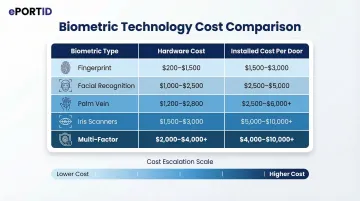
The single biggest cost variable is the chosen biometric technology:
- Fingerprint systems are the most affordable but least suited for harsh or hygiene-critical environments
- Facial recognition adds touchless convenience at moderate cost
- Iris scanners offer the highest single-factor accuracy at a premium
- Palm vein recognition sits in the mid-to-high range and is increasingly chosen for regulated industries due to its contactless operation and inability to be spoofed or replicated
| Biometric Type | Hardware Cost | Installed Cost Per Door |
|---|---|---|
| Fingerprint | $200–$1,500 | $1,500–$3,000 |
| Facial Recognition | $1,000–$2,500 | $2,500–$5,000 |
| Palm Vein | $1,200–$2,800 | $2,500–$6,000+ |
| Iris Scanners | $1,500–$3,000 | $5,000–$10,000+ |
| Multi-Factor | $2,000–$4,000+ | $4,000–$10,000+ |
Number of Access Points and Scale
Costs scale with the number of doors, but per-door costs can decrease by 20–30% for enterprise deployments of 50+ doors. Larger deployments also require centralized access management software. That shifts the licensing model from per-door pricing to site-wide or subscription-based agreements — a structural change that significantly affects total cost.
Installation Complexity and Infrastructure
Three sub-factors drive installation costs:
- Retrofit vs. new construction: Older buildings often need new conduit, cabling, and electrical work — typically $500–$1,500 per door in added costs
- Network readiness: Cloud-based facial recognition and palm vein systems need reliable low-latency connections. ePortID's Power over Ethernet (PoE) systems reduce installation complexity by eliminating the need for dedicated electrical runs, but proper network infrastructure is still required
- System integration: Connecting biometric readers to existing cameras, alarms, or time-and-attendance platforms adds $1,000–$5,000 depending on complexity
Software Model and Ongoing Licensing
Cloud-based systems carry lower upfront costs but recurring monthly fees of $50–$200 per door. On-premise systems require a server investment upfront while avoiding subscription fees — though they demand internal IT resources for maintenance.
Over a 5-year period, cloud-based ACaaS typically costs $2,000–$3,500 per door, compared to $8,000–$12,000 for on-premise deployments. For large organizations with stable headcounts and high-utilization sites, on-premise systems often become more cost-effective past the 5-to-7-year mark.
Cloud platforms are the standard choice for multi-site enterprise operations, offering remote management that cuts ongoing administrative overhead.
Compliance and Data Privacy Requirements
Organizations in regulated industries face mandatory compliance costs that vendors rarely include in quotes.
State biometric privacy laws create direct financial exposure:
- Illinois BIPA allows recovery of $1,000 for negligent violations and $5,000 for intentional/reckless violations
- Texas CUBI imposes civil penalties up to $25,000 per violation
- California CCPA allows statutory damages of $100–$750 per incident for data breaches
Federal mandates add another layer of requirements:
- NDAA Section 889 prohibits federal agencies from contracting with entities using telecommunications/video surveillance equipment from specific Chinese manufacturers (Huawei, ZTE, Hikvision, Dahua)
- HIPAA requires biometric data protection for healthcare environments
- FBI CJIS Security Policy requires biometric systems to operate with a False Match Rate of 1 in 1000 or better
Budget for compliance setup separately: consent workflows, data retention policies, and legal review typically add 20–40% on top of quoted hardware costs.
Complete Cost Breakdown: One-Time and Recurring Expenses
The total cost of a biometric access control system extends well beyond the sticker price of the scanner. Buyers who budget only for hardware typically face 20–40% in surprise costs.
Hardware Purchase (One-Time)
Biometric readers, door controllers, electronic locks, and any required server hardware for on-premise deployments. For a typical 10-door commercial installation, hardware costs range from $5,000–$25,000 depending on technology choice.
This is the most visible line item but not the largest over a 5–7 year system lifespan.
Installation and Setup (One-Time)
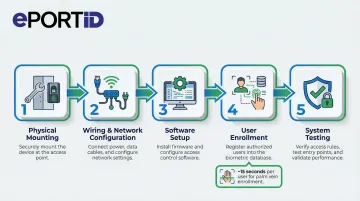
Professional installation runs $500–$2,500 per door depending on system complexity and building conditions. This includes:
- Physical mounting
- Wiring and network configuration
- Software setup
- User enrollment
- System testing
Older buildings and integrated multi-system setups sit at the high end of this range. For ePortID's palm vein systems, enrollment takes approximately 15 seconds per hand. A 200-user deployment requires roughly 100 minutes of biometric capture time, plus administrative overhead for user check-in and verification.
Software Licensing (Recurring)
Cloud-based systems carry monthly subscription fees of $50–$200 per door. On-premise software may require annual license renewal.
Over a 5-year period, recurring software fees often exceed the original hardware cost — worth scrutinizing closely before committing to a cloud-based model.
Maintenance and Repairs (Recurring)
Budget 12–18% of hardware cost annually for routine maintenance including:
- Sensor cleaning
- Firmware updates
- Battery replacements for wireless locks ($200–$500/door/year)
- Periodic hardware checks
Emergency service calls typically cost 2-3 times more than scheduled maintenance visits, not including rush delivery fees for parts or after-hours labor rates. Scheduling preventive visits is the single most effective way to control long-term maintenance spend.
Staff Training and Compliance (Periodic)
Initial staff training costs $500–$2,000 depending on system complexity and team size. Compliance audits and policy updates are periodic costs relevant to regulated industries.
High staff turnover adds re-enrollment costs that are easy to overlook. At large facilities with multiple access points, this can consume several days of HR or IT staff time per cycle.
Low-Cost vs. High-Cost Biometric Systems — What's the Difference?
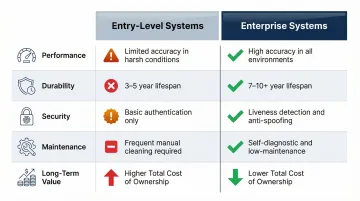
Entry-level and enterprise biometric systems both authenticate via unique biological traits. The gap between them — in accuracy, durability, and real-world reliability — is large enough to matter when a facility's security depends on it.
Performance: Lower-cost fingerprint systems may struggle with false rejections in dirty or wet environments; high-end palm vein and iris systems maintain accuracy in harsh conditions.
Durability: Entry-level systems typically last 3–5 years under heavy use; enterprise-grade systems are rated for 7–10+ years. For example, ePortID's Fujitsu F-Pro palm vein scanner is rated for 1,000,000 hours of operation—approximately 114 years of continuous use.
Security: Budget systems may lack liveness detection (vulnerable to spoofing); premium systems incorporate anti-spoofing, liveness checks, and multi-factor options. Palm vein technology detects vein patterns beneath the skin using infrared light, producing a pattern that cannot be duplicated, stolen, or spoofed.
Maintenance needs: Basic systems require more frequent sensor cleaning and calibration; advanced systems have self-diagnostic features and built-in redundancies — ePortID's systems, for instance, include six LED feedback lights with four spares, keeping operations running without manual intervention.
Long-term value: Lower upfront cost often results in higher total cost of ownership due to replacement cycles, higher false rejection rates causing operational friction, and inadequate audit trail capabilities for compliance.
Critical infrastructure perspective: At seaports, refineries, and data centers, a single unauthorized access incident — theft, sabotage, or a compliance violation — typically costs more than the entire price difference between an entry-level and an enterprise system.
How to Estimate the Right Budget for Your Facility
The right budget matches your security risk level, operational scale, compliance obligations, and long-term cost profile. A system that eliminates buddy punching, reduces payroll errors, and prevents unauthorized access within 3–6 months earns its cost quickly. Price alone is the wrong metric.
Five Key Assessment Factors
Intended use and security risk level: A server room has different stakes than a lobby entrance. Match technology capability to consequence of breach.
Number of users and access points: This directly drives hardware, licensing, and enrollment costs. Calculate realistic enrollment time (15 seconds per hand for palm vein systems means 100 minutes of capture time for 200 users).
Compliance requirements: Regulated industries must budget for consent workflows, audit trails, and legal review. Add 20–40% to hardware quotes for compliance infrastructure.
Existing infrastructure: Availability of network, conduit, and compatible door hardware affects installation cost significantly. Modern PoE systems reduce electrical work but still require proper network capacity.
Total cost of ownership horizon: Evaluate 5-year cost, not just upfront purchase price. Include recurring software fees, maintenance contracts, and potential replacement cycles.
What Most Buyers Miss
Focusing only on hardware unit price: Ignoring software, installation, and training creates budget shortfalls and deployment delays.
Underestimating enrollment and onboarding time: For 200+ users, this can consume days of dedicated staff effort. Factor administrative overhead into project timelines.
Over-specifying technology for low-risk areas: High-accuracy biometric systems on break room doors waste budget that should protect high-risk zones.
Choosing the cheapest vendor without evaluating system lifespan, support quality, or compliance readiness: A system that fails after three years or lacks proper audit trails creates higher long-term costs.
Budget Ranges by Organization Size
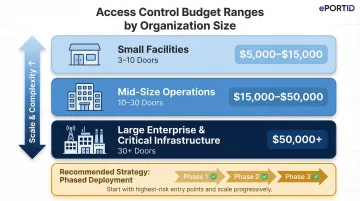
Small facilities (3–10 doors): $5,000–$15,000 total. Contactless biometric systems with basic cloud management suit this scale well and deliver fast ROI.
Mid-size operations (10–30 doors): $15,000–$50,000. Multi-factor biometric systems with centralized management become practical at this size, supporting consistent access policy across locations.
Large enterprise and critical infrastructure (30+ doors): $50,000+. Enterprise-grade biometric platforms with advanced integration, redundancy, and compliance features are the standard — and the baseline expectation for regulated environments.
Across all sizes, phased deployment is a smart approach: start with your highest-risk access points, validate performance, then expand. It manages capital outlay without compromising security where it matters most.
Conclusion
Biometric access control costs vary significantly—from under $500 per door for basic fingerprint systems to over $10,000 per door for enterprise multi-factor solutions. The right investment matches technology capability to the security, compliance, and operational demands of the facility—not simply the lowest quote on the table.
Accounting for the full cost picture—hardware, software, installation, maintenance, training, and compliance—prevents the budget gaps that catch facilities off guard. A properly specified system eliminates credential management costs, prevents unauthorized access, and can deliver measurable ROI well within the first year of operation.
That ROI case extends further than most buyers expect. The American Payroll Association estimates that time theft costs U.S. employers 1.5% to 5% of their gross payroll annually. For many organizations, biometric access control isn't just a security investment—it's a revenue protection strategy that pays for itself through operational improvements alone.
Frequently Asked Questions
What is the cost of biometric access control system?
Biometric access control systems range from $200–$10,000+ per door depending on technology type and deployment complexity. A realistic all-in budget including installation and software for most commercial deployments is $2,500–$8,000 per door. Multi-site enterprise and critical infrastructure deployments frequently exceed $8,000 per door once integration and compliance requirements are factored in.
How much does it cost to install an access control system?
Installation costs run $500–$2,500 per door. Complexity factors—retrofitting older buildings, integrating with existing systems, and urban labor rates—drive costs toward the upper end. System configuration and testing add $500–$2,000 beyond physical installation.
How much does it cost to fit a building with a card access system?
Key card/fob systems typically cost $1,000–$3,500 per door installed. Additional recurring costs include card replacement ($5–$50 per card) and administrative time. Biometric systems eliminate credential costs but have higher upfront hardware costs.
What is the average cost of a fingerprint scanner?
Fingerprint scanner hardware starts at $200–$500 for basic units and reaches $1,500 for commercial-grade readers. However, the reader is only one component—a complete installed fingerprint door system including controller, lock, and software runs $1,500–$3,500 per door.
Are fingerprint door locks worth it?
Fingerprint locks eliminate credential replacement costs and buddy punching, creating measurable savings over time. For high-security or hygiene-sensitive environments, contactless palm vein scanning offers a stronger case: it checks for liveness, resists spoofing, and requires zero physical contact—often delivering faster ROI in critical infrastructure settings.
What is the physical access control system (PACS) system?
According to NIST, a Physical Access Control System is "an electronic system that controls the ability of people or vehicles to enter a protected area by means of authentication and authorization at access control points." Biometric readers are one credential layer within a PACS, and modern enterprise PACS typically integrate with surveillance, alarm, and visitor management systems.