Choosing the wrong system exposes organizations to time theft, credential fraud, unauthorized access, and costly administrative overhead—especially in high-security or critical infrastructure environments. According to the American Payroll Association, buddy punching alone costs U.S. employers an estimated $373 million annually in payroll fraud.
The stakes are clear: in environments where identity certainty is non-negotiable, the access control and time-tracking system isn't just an HR tool—it's a critical security infrastructure component.
Key Takeaways
- Biometric time clocks verify identity using physical traits (palm vein, fingerprint, facial scan): credentials that cannot be lost, shared, or stolen
- Badge systems use RFID cards or fobs, which deploy faster at lower upfront cost, but remain vulnerable to sharing, loss, theft, and buddy punching
- Biometrics eliminate buddy punching and reduce credential management overhead long-term
- Lower-security environments can work with badges; compliance-heavy sites like seaports, power stations, and data centers need biometrics
- For critical infrastructure where identity certainty is non-negotiable, biometrics are the operationally sound choice
Biometric Time Clock vs Badge System: Quick Comparison
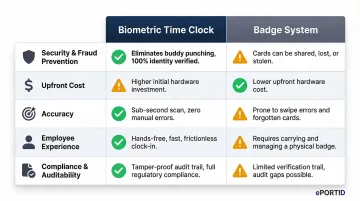
Use this table to compare the two systems across the factors that matter most for workforce security and payroll accuracy.
| Factor | Biometric Time Clock | Badge System |
|---|---|---|
| Security / Fraud Prevention | Identity tied to the person; eliminates buddy punching; liveness detection prevents spoofing | Identity tied to a physical card; susceptible to sharing, loss, theft, and cloning |
| Upfront Cost | Higher hardware investment; no ongoing credential inventory needed | Lower upfront hardware cost; ongoing card production, replacement, and management costs |
| Accuracy | Advanced systems reach 99.99991% accuracy in under 2 seconds; creates indisputable attendance records | Relies on proper card use; errors occur when cards are lost, damaged, forgotten, or shared |
| Employee Experience | No card to carry; contactless options add hygiene benefit; slight learning curve at rollout | Familiar and simple; depends on employees having badge on hand daily |
| Compliance & Auditability | Creates verified, person-linked records suitable for regulated industries; employee consent requirements vary by jurisdiction and are typically managed at deployment | Creates card-linked record, not person-verified; weaker for compliance-heavy audits |
What Is a Biometric Time Clock?
A biometric time clock identifies employees using unique physical or behavioral traits—fingerprint, facial geometry, iris pattern, or palm vein—rather than a physical object they carry. Originally reserved for high-security government installations, biometric systems have evolved into practical workforce management tools as costs have dropped and accuracy has improved sharply.
Core Biometric Modalities
Four main technologies are used in biometric time clocks today:
- Fingerprint scanning — contact-based sensors read ridge patterns; the most widely deployed option
- Facial recognition — camera-based analysis of facial geometry, fully contactless
- Iris scanning — analyzes the unique patterns in the colored ring of the eye for high-security contactless ID
- Palm vein scanning — near-infrared light captures up to 5 million vein-pattern data points beneath the skin, unique to every individual including identical twins
ePortID's palm vein solution operates at 99.99991% accuracy in under 2 seconds, the highest accuracy rate among contactless biometric options.
Operational Benefits
Biometric time clocks deliver measurable operational impact:
- Eliminate buddy punching entirely — the credential cannot be transferred to another person
- Create indisputable attendance records — each clock-in and clock-out event is tied to a verified individual, not a transferable card
- Reduce payroll processing errors — automated data capture eliminates manual entry mistakes
- Remove credential inventory management — no cards to produce, distribute, replace, or deactivate
Liveness Detection
Advanced biometric systems check for liveness during verification—confirming the scanned trait belongs to a living person, not a photo, mold, or fabricated input. This critical security layer prevents spoofing attempts in high-stakes environments where access control failures carry real consequences.
Legal and Privacy Considerations
Some jurisdictions require informed consent and clear data storage policies for biometric data. Illinois BIPA imposes statutory damages of $1,000 to $5,000 per violation, and GDPR provisions in the EU mandate explicit employee opt-in processes. Compliant systems should offer employee consent workflows and store encrypted templates, not raw biometric images.
These legal requirements shape which industries adopt biometrics most aggressively—and where the stakes of getting it wrong are highest.
Where Biometric Time Clocks Are Used
Biometrics dominate environments where identity certainty is non-negotiable:
- Critical infrastructure: Seaports, airports, power stations, oil rigs
- Regulated industries: Hospitals, financial institutions, research laboratories
- High-turnover environments: Large warehouses, manufacturing facilities
- High-security zones: Data centers, server rooms, military bases
In these settings, card-based systems carry real operational and security risks: credentials can be lost, shared, or stolen. Biometrics remove that vulnerability entirely.
What Is a Badge Time Clock System?
A badge time clock system requires employees to clock in and out by presenting a physical credential—a magnetic stripe card, RFID proximity card, or barcode badge—to a reader. Swipe cards require physical contact with the reader, while RFID/proximity cards work by tapping or waving near the reader. Many badge systems double as physical access control tools, making them dual-purpose in office and facility settings.
Core Advantages
Badge systems offer straightforward benefits:
- Low upfront hardware cost — readers and cards are inexpensive compared to biometric scanners
- Fast and familiar employee experience — most workers understand how to use a badge
- Easy integration — works with existing access control infrastructure in many facilities
- Straightforward deployment — no biometric enrollment process required
Core Vulnerabilities
The structural weaknesses of badge systems compound over time:
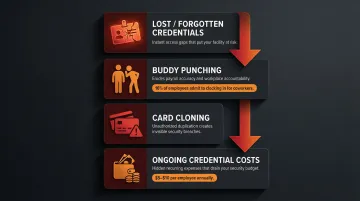
- Lost, forgotten, or damaged credentials trigger manual fallback processes that introduce errors into attendance records. Each incident requires HR time to deactivate and reissue credentials, creating a window of security risk.
- Buddy punching is the most significant operational problem. Research shows approximately 16% of employees admit to clocking in for coworkers — and the real number is likely higher, since most employees won't admit it.
- Card cloning is a growing risk in sensitive environments, where RFID credentials can be duplicated using readily available technology.
- Ongoing credential costs add up: industry estimates put average annual expenses at $5–$10 per employee when card replacement, administrative overhead, and lost productivity are factored in.
Where Badge Systems Still Make Sense
These vulnerabilities don't make badge systems obsolete — they just define where the trade-offs are acceptable:
- Lower-security office environments where access control is primarily for convenience
- Retail operations with high employee turnover and limited budgets
- Small businesses with stable workforces who reliably carry credentials
- Organizations with integrated access control systems where adding biometrics would require significant infrastructure changes
- Environments where employee opt-out from biometrics is common due to privacy concerns
Biometric Time Clock vs Badge System: Which Is Better?
The right choice depends on four primary factors: security requirements, total cost of ownership over 3–5 years, compliance obligations, and operational environment.
Situational Recommendations
Choose a badge system if the priority is low upfront investment, the environment is lower-security, and the workforce is small with stable employees who reliably carry credentials.
Choose biometrics if buddy punching is a documented problem, the facility handles sensitive assets or regulated data, workforce size makes credential management expensive, or the environment demands a verified identity record for compliance or liability purposes.
Total Cost of Ownership
Badge systems appear cheaper upfront but accumulate hidden costs: card replacement, HR admin time, manual fallback processes, and the ongoing cost of time theft that goes unchecked. Organizations with 50+ employees often find biometric systems reach cost-neutrality within 12–18 months. In critical infrastructure or high-security environments, biometric systems like ePortID's palm vein solution pay for themselves in 3–6 months through eliminated time theft, reduced payroll processing expenses, and improved compliance.
The Critical Infrastructure Case
For seaports, airports, military bases, power stations, and data centers, a badge that can be lost, stolen, or cloned is a genuine security liability—not just an HR inconvenience. In these environments, biometrics are not a premium upgrade; they are the baseline requirement for defensible access control and attendance records.
A compromised credential at a port terminal or power station doesn't just create a payroll discrepancy—it creates a potential national security incident.
Hybrid Approaches
Some organizations use badge systems as the primary method with biometric verification added at high-security entry points, or offer badges as an opt-out alternative for employees who cannot or will not use biometrics. In critical environments, though, biometrics should be the primary credential layer — badges serving only as optional secondary factors.
Real-World Scenario: What the Switch to Biometrics Looks Like
A mid-sized industrial facility using badge-based access and time tracking faces recurring challenges: lost badges requiring replacement, suspected buddy punching incidents, and inaccurate payroll records that trigger an audit. The compliance review identifies systematic timekeeping discrepancies that expose the organization to wage-and-hour liability.
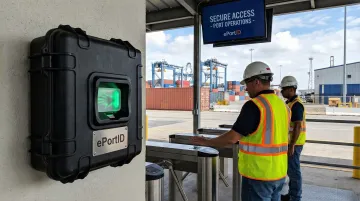
The facility selects a palm vein-based system for its contactless hygiene advantage, near-perfect accuracy, and resistance to environmental factors that degrade fingerprint readers — dirt, oil, and damaged skin. Enrollment takes 15 seconds per hand; verification completes in under 2 seconds.
Organizations like Dow Chemical, South Jersey Port Corp., and Tata Steel have deployed ePortID's contactless palm vein solution across critical infrastructure and industrial operations — with measurable reductions in buddy punching, payroll discrepancies, and clock-in processing time. For regulated environments where credential risk isn't acceptable, that track record matters.
Conclusion
Badge systems are a practical, cost-effective starting point for lower-risk environments—but they carry structural vulnerabilities that grow over time. Buddy punching, credential loss, and card cloning represent ongoing operational and security costs that many organizations underestimate during initial procurement.
Biometric time clocks solve these problems at the root by making the employee themselves the credential. Choosing between the two comes down to a straightforward question: what are the real consequences if the wrong person clocks in—or walks in?
For organizations managing access to ports, warehouses, data centers, or hospitals, the shift from badge to biometric is a risk management decision as much as a technology one. The financial case is straightforward:
- Eliminated time theft reduces payroll leakage immediately
- Lower admin overhead from fewer credential replacements and disputes
- Defensible audit records that document exactly who was where and when
Most deployments recover the investment within 3 to 6 months.
Frequently Asked Questions
What is the best system for employee time tracking?
For high-security or regulated environments, biometric systems offer superior accuracy and fraud prevention. Badge systems work for general business use where security risks are low and cost is the primary concern.
Do fingerprint time clocks ever actually work?
Fingerprint biometric clocks are reliable and widely deployed, but environmental factors like dirty or damaged fingers and dry skin can affect read rates. Contactless alternatives like palm vein scanning offer higher consistency, better hygiene, and fewer environmental dependencies.
Are biometric time clocks legal?
Biometric time clocks are legal in most jurisdictions but subject to specific regulations. Illinois BIPA, Washington State's Biometric Law, the EU's GDPR, and similar laws require employee consent, clear data use policies, and secure storage. Verify your local requirements before deployment — penalties for non-compliance can be significant.
Can a badge system and biometric time clock be used together?
Yes, hybrid setups are common. Biometrics typically serve as the primary verification method, with badge or PIN alternatives available for employees who opt out. Badges can also handle general access while biometrics secure high-risk zones.
What happens when an employee loses their badge?
A lost badge typically requires manual attendance recording as a fallback, HR time to deactivate and reissue the credential, and introduces a window of potential security risk. Biometric systems eliminate all three issues — the credential is the person.
How accurate are biometric time clocks compared to badge systems?
A badge records a tap, not an identity — accuracy depends entirely on whether the right person is holding it. Advanced biometric systems, particularly palm vein technology, achieve 99.99991% accuracy rates and create verified, person-linked records that badge systems cannot match.