Introduction
When employees clock in for absent colleagues, the financial impact is immediate and measurable. Time theft costs U.S. employers approximately $373 million annually, with the American Payroll Association estimating that buddy punching alone drains 1.5% to 5% of gross payroll. Traditional PINs and swipe cards fail because credentials are easily shared among coworkers—employees can simply hand over a badge or whisper a code.
Biometric time clocks close that gap by tying every clock-in to an unforgeable physical trait: fingerprint ridges, facial geometry, or palm vein patterns read beneath the skin's surface. The five solutions below are evaluated on accuracy, liveness detection, payroll integration, and fit across industries—so you can match the right hardware to your operation.
Key Takeaways
- Buddy punching costs employers up to 5% of payroll; biometric time clocks stop it by requiring biological identifiers unique to each person
- The five best solutions cover palm vein scanning, fingerprint, facial recognition, and enterprise-grade multimodal systems
- Key selection criteria: accuracy (FAR/FRR), liveness detection, contactless capability, payroll integration, and environmental fit
- For critical infrastructure, contactless palm vein scanning delivers 99.99991% accuracy and the lowest published false-acceptance rate of any biometric modality
What Is Buddy Punching and Why Biometrics Stop It
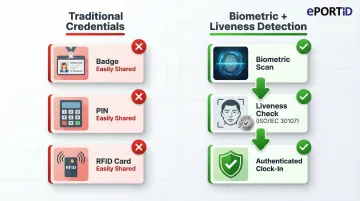
Buddy punching is time fraud where one employee clocks in or out on behalf of another who is absent or late. Traditional credentials make this easy — PINs, badges, and RFID cards cannot prevent it because they're designed to be carried and handed off:
- A badge swipes the same whether the owner holds it or a coworker does
- A four-digit PIN takes seconds to share verbally
- An RFID card reads identically regardless of who presents it
Biometrics solve this through biological authentication. Fingerprint ridge patterns, facial bone structure, and palm vein maps are intrinsically tied to one individual. They cannot be transferred, shared, or replicated, making proxy clock-ins physically impossible. That said, biometrics alone aren't completely foolproof — which is where liveness detection matters.
Liveness detection confirms the biometric trait belongs to a live person standing at the scanner, not a photograph or replica. ISO/IEC 30107 standards define Presentation Attack Detection (PAD) mechanisms that defeat photographs, video replays, and fake silicone fingerprints. Without liveness detection, even biometric systems remain vulnerable to spoofing.
5 Best Biometric Time Clocks to Stop Buddy Punching
Each solution below was evaluated across six criteria:
- Biometric accuracy and anti-spoofing capability
- Contactless vs. contact method
- Enterprise scalability
- Payroll and HR platform integration
- Suitability across industries and environments
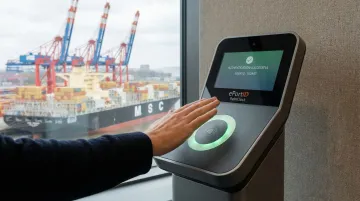
ePortID (Fujitsu Palm Vein Scanner)
ePortID is a Philadelphia-based biometric identity solutions provider with 20 years of experience serving the US Navy, Army JTF, Marine Corps, and Port Authorities. Commercial clients include Fiserv, Dow Chemical, Tata Steel, Thyssen Krupp, and South Jersey Port Corp. In partnership with Fujitsu, the company delivers contactless palm vein scanning for time and attendance through its PalmClock™ system.
The palm vein pattern is derived from 5 million reference points — unique to every individual, including identical twins. Authentication completes in under 2 seconds at 99.99991% accuracy, includes liveness detection, and produces an indisputable time and attendance record. The credential cannot be lost, shared, stolen, or duplicated because it exists beneath the skin.
| Category | Details |
|---|---|
| Key Features | Contactless palm vein scanning; liveness detection; under 2-second authentication; 5-million-point identity map unique to each individual |
| Accuracy & Security | 99.99991% accuracy; impossible to forge or duplicate; works even where fingerprints are worn or difficult to scan |
| Best For | Critical infrastructure, seaports, airports, power stations, factories, hospitals, financial institutions, data centers, military facilities |
ZKTeco (Fingerprint & Facial Recognition Time Clocks)
ZKTeco is one of the world's largest biometric hardware manufacturers, offering wall-mounted time and attendance terminals that support fingerprint scanning, facial recognition, and card-based verification. Credence Research tracks ZKTeco as a major global player in the fingerprint attendance machine market. The company serves industries from retail to manufacturing.
Wide hardware variety and accessible price points are the draw here. The ZKTeco F22 supports 3,000 fingerprint templates and 5,000 cards with 30,000 transaction logs. The uFace800 Plus extends that with multimodal authentication — 3,000 face templates, 3,000 palm templates, and 4,000 fingerprint templates — plus TCP/IP, Wi-Fi, and optional 3G connectivity.
| Category | Details |
|---|---|
| Key Features | Fingerprint and facial recognition; RFID card support; cloud and TCP/IP connectivity; large template storage (3,000+ fingerprints) |
| Accuracy & Security | High-image quality infrared detection sensor; 3-in-1 contactless palm recognition (uFace800 Plus model) |
| Best For | Small to mid-sized businesses, retail, manufacturing, and office environments needing affordable hardware |
Suprema BioEntry (Enterprise Biometric Access & Time)
Suprema is a South Korea-based biometric technology company recognized in enterprise access control and time attendance. Its BioEntry series supports fingerprint and facial recognition and is deployed across government, healthcare, and corporate environments globally. The company holds ISO/IEC 27001 and ISO/IEC 27701 certifications.
IP67/IK08 weatherproof ratings on select models like the BioEntry W3 make it one of the few options built for outdoor deployment. OSDP and Wiegand integration slots into existing access control infrastructure without ripping it out. The BioEntry W3 supports 30,000 face templates and 100,000 cards, with TCP/IP, OSDP V2, Wiegand, and RS-485 connectivity. Mobile credential support via BLE/NFC adds enrollment flexibility.
| Category | Details |
|---|---|
| Key Features | Fingerprint and facial recognition; IP67/IK08 weatherproof models; OSDP/Wiegand integration; mobile enrollment support (BLE/NFC) |
| Accuracy & Security | Live face detection; ISO/IEC 27001 and 27701 certified; MINEX certified fingerprint extractor/matcher (BioEntry P2) |
| Best For | Enterprise campuses, government buildings, healthcare facilities, and mixed indoor/outdoor deployments |
M2SYS RightPunch (Multimodal Biometric for Workforce Platforms)
M2SYS RightPunch is a software-based biometric time clock that runs on standard tablets and PCs, integrating with major workforce management platforms including UKG (Kronos). It supports fingerprint and facial recognition through a multimodal biometric engine.
RightPunch turns existing tablets and PCs into biometric terminals, eliminating the need for proprietary hardware. Liveness detection blocks spoofing, and native UKG/Kronos integration means no middleware setup. The City of Columbia, SC deployed RightPunch with finger vein readers to over 1,000 employees across 50 locations specifically to eliminate buddy punching. Offline punch capture ensures records aren't lost during network outages.
| Category | Details |
|---|---|
| Key Features | Multimodal biometrics (fingerprint, finger vein, palm vein, iris, facial); runs on standard tablets/PCs; native UKG/Kronos integration; liveness detection |
| Accuracy & Security | Biometric data not transmitted or stored externally; spoofing resistance through active liveness checks |
| Best For | Enterprises using UKG, Kronos, or similar workforce platforms looking to eliminate buddy punching without new hardware infrastructure |
Allied Time (Biometric Time Clock Hardware)
Allied Time is a US-based supplier of time and attendance hardware offering biometric clocks using fingerprint and palm recognition technology across a range of business sizes and environments. The company provides straightforward hardware pricing with US-based support.
The CB4100 model covers the essentials at a price point that works for smaller operations — contactless palm vein and facial recognition via near-infrared technology, with Wi-Fi and LAN connectivity for cloud-based data storage. USB and network transfer options keep payroll integration straightforward without custom development work.
| Category | Details |
|---|---|
| Key Features | Fingerprint and palm vein recognition; near-infrared contactless scanning; USB and network data transfer; cloud-based storage; Wi-Fi/LAN connectivity |
| Accuracy & Security | Near-infrared wave technology for palm vein authentication; contactless operation reduces hygiene concerns |
| Best For | Small to mid-market businesses in retail, office, and light industrial settings seeking cost-effective biometric hardware with US-based support |
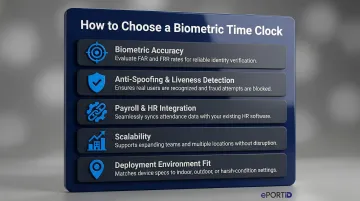
How We Chose the Best Biometric Time Clocks
Each solution was assessed against five criteria:
- Biometric modality and accuracy — including false acceptance and rejection rates
- Anti-spoofing and liveness detection — whether the system can distinguish a live person from a photo or fake
- Payroll and HR integration — ease of connecting to existing systems
- Scalability — performance across varying employee counts and multiple locations
- Deployment environment fit — indoor/outdoor suitability, high-security requirements, and field-based use cases
The most common mistake buyers make is choosing on price alone without accounting for false acceptance rate (FAR). NIST defines FAR as the proportion of verification transactions with wrongful claims of identity that are incorrectly confirmed. A system with a higher FAR will still allow buddy punching—you'll pay for unworked hours despite deploying biometrics.
For regulated or high-security industries, contactless modalities such as palm vein scanning offer measurable advantages. They require no physical contact and perform consistently even when fingerprints are worn, calloused, or affected by skin conditions. In industrial or healthcare settings — where shared-touch surfaces raise hygiene concerns and manual labor degrades fingerprint ridges — this distinction has a direct impact on both accuracy and compliance.
Conclusion
Choosing the right biometric time clock comes down to three factors: accuracy, anti-spoofing depth, and how well the system fits your operational environment. A poor fit doesn't announce itself — it shows up quietly in every payroll cycle.
Before you decide, weigh these evaluation criteria against your specific operation:
- Total cost of ownership — hardware, integration, and ongoing maintenance
- System compatibility — how well it connects with your existing payroll or HR platform
- ROI timeline — what recovered payroll accuracy and reduced admin overhead actually deliver
ePortID's palm vein system, for example, typically returns its cost within 3 to 6 months through those exact gains. For critical infrastructure or high-accuracy applications, contact ePortID at info@eportid.com or 215-627-2651 to evaluate fit for your facility.
Frequently Asked Questions
How to prevent buddy punching?
Deploy a biometric time clock that ties every clock-in to an unforgeable physical trait (fingerprint, face, or palm vein) so no employee can punch in on behalf of another. Liveness detection further prevents spoofing using photographs or fake biometric artifacts.
What is the most accurate biometric device?
Contactless palm vein scanning offers the highest published accuracy rates. ePortID's Fujitsu-powered system achieves 99.99991% accuracy because the vein pattern is internal, impossible to replicate, and consistent regardless of skin condition or environmental factors.
What is the difference between fingerprint and palm vein biometric time clocks?
Fingerprint scanners read surface ridge patterns and require contact with the sensor. Palm vein scanners read subcutaneous vascular patterns using near-infrared light and are fully contactless. This makes palm vein harder to spoof and unaffected by dirty or worn fingertips.
Are biometric time clocks legal to use?
Biometric time clocks are legal in most jurisdictions. Key regulations include BIPA in Illinois, GDPR in Europe, and CCPA in California — each requiring informed consent, data use disclosure, and compliant storage practices.
How do biometric time clocks integrate with payroll systems?
Most modern biometric time clock systems export attendance data via TCP/IP, USB, or cloud sync to payroll platforms such as ADP, QuickBooks, or UKG, eliminating manual timesheet entry and reducing payroll processing errors.
Which industries benefit most from biometric time clocks?
Industries where accurate, tamper-proof attendance records are critical: manufacturing, warehouses, healthcare, financial institutions, ports, power stations, data centers, and any environment where labor compliance or security clearance is required.