Introduction
Timesheet fraud costs organizations far more than most leaders realize. Ports, hospitals, factories, and corporate offices all face it. According to the American Payroll Association, businesses lose approximately 5-10% of gross payroll annually to time theft, with 75% of companies affected by buddy punching alone.
Those numbers point to a systems problem as much as a behavioral one. When oversight gaps make fraud easy, it happens — regardless of workforce size or industry.
Catching it early protects payroll integrity, compliance, and operational trust. Falsifying time records can also violate the Fair Labor Standards Act (FLSA), and in states like California, Colorado, and Connecticut, payroll fraud above certain thresholds carries felony charges.
Key Takeaways
- Timesheet fraud means falsifying work hours to receive unearned pay and takes more forms than most managers expect
- The American Payroll Association estimates businesses lose 5–10% of gross payroll annually to time theft
- Buddy punching, time padding, ghost employees, and unauthorized overtime are the most widespread forms
- Detection relies on cross-referencing time records, access logs, and output data for pattern anomalies
- Stopping it takes written policies, verified time capture technology, and enforcement that doesn't make exceptions
Common Types of Timesheet Fraud
Timesheet fraud typically falls into several recognizable categories, each exploiting a different gap in oversight or technology. Knowing which type you're dealing with shapes how you detect and stop it.
Buddy Punching
Buddy punching occurs when one employee clocks in or out on behalf of a colleague who isn't actually present. This is especially common in shift-based and high-volume workplaces where supervisors can't verify every arrival and departure. Research shows 75% of businesses report financial losses due to this practice, making it the single most prevalent form of timesheet fraud.
The scheme works because traditional time capture methods—PIN codes, swipe cards, or manual sign-in sheets—verify credentials, not physical presence. An employee simply shares their card or code with a trusted colleague who arrives on time while they sleep in or leave early.
Time Padding and Unauthorized Overtime
Employees inflate logged hours by arriving late or leaving early while recording full shifts, or by claiming overtime that was never worked or authorized. This is easy to get away with when organizations rely on manual timesheet systems, conduct infrequent audits, or lack supervisor visibility into shift start and end times.
Conditions that enable time padding include:
- Self-reported timesheets without verification
- Rounding policies that always favor the employee
- Managers who approve time records without reviewing them
- Systems that allow retroactive editing without audit trails
Ghost Employees
Ghost employees are fictitious or former employees kept on payroll, with wages funneled to the fraudster — typically someone with payroll or HR access. This is one of the hardest fraud types to detect, requiring cross-referencing of payroll records against active headcounts and physical access logs.
The financial exposure is significant. According to the Association of Certified Fraud Examiners, payroll schemes account for 10% of occupational fraud cases with a median loss of $50,000. In one Pennsylvania case, a restaurant manager created a ghost employee who "worked" 128 shifts over 22 pay periods, costing the business nearly $20,000.
Manual Timesheet Edits and Time Clock Manipulation
Time records can be falsified after the fact through several methods:
- Employees altering their own clock-in/out times
- Managers editing submitted timesheets to hit budget targets
- Cross-project hour reuse — logging the same hours to multiple clients or cost codes
This is particularly damaging in compliance-heavy industries like government contracting, healthcare billing, and financial services, where billing accuracy is legally required. The FLSA mandates accurate records of hours worked, and deliberate falsification can trigger civil penalties and criminal prosecution.
What Timesheet Fraud Really Costs Your Business
The financial impact extends beyond the dollar value of unworked hours. For an organization with $1 million in annual payroll, a conservative 5% loss translates to $50,000 per year. Scale that to a $5 million payroll, and potential losses reach $250,000 annually—enough to fund several full-time positions or critical infrastructure upgrades.
Falsifying time records can also violate the Fair Labor Standards Act (FLSA), exposing organizations to Department of Labor investigations and civil penalties. State laws go further:
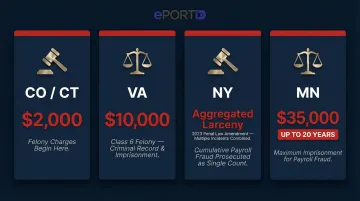
State-by-State Criminal Thresholds:
- Colorado and Connecticut: payroll fraud above $2,000 is a felony
- Virginia: willful wage violations of $10,000+ become a Class 6 felony
- New York: prosecutors can aggregate workforce-wide underpayments into a single larceny count (2023 amendment, Penal Law § 155)
- Minnesota: wage theft exceeding $35,000 carries up to 20 years imprisonment
Intent doesn't always need to be proven. Systemic errors — even unintentional ones — can trigger the same investigations and penalties as deliberate fraud, which means sloppy timekeeping processes carry real legal exposure, not just accounting headaches.
Warning Signs You're Dealing with Timesheet Fraud
Timesheet fraud rarely announces itself. It shows up in patterns — behavioral quirks, payroll outliers, and data anomalies that individually look minor but together tell a different story.
Behavioral Red Flags
Watch for employees who are:
- Consistently unavailable during scheduled hours despite logged presence
- Displaying unexplained patterns of late arrivals paired with full-day logs
- Never taking recorded meal breaks despite long shifts
- Frequently asking colleagues to "help them out" with time clock entries
- Defensive or evasive when questioned about schedule discrepancies
Behavioral cues point to intent. Data confirms it.
Data-Based Red Flags
- Hours logged that don't align with task or project progress — claimed work time far exceeds what deliverables would require
- Payroll outliers compared to peers in the same role — one employee consistently logs 20% more hours than colleagues doing identical work
- Frequent or unexplained manual timesheet edits — particularly edits made by the employee themselves or without supervisor documentation
- Rounding patterns that always favor maximum pay — clock-ins rounded down and clock-outs rounded up consistently
- Overtime claims without corresponding workload — spikes in overtime hours during slow periods
A single anomaly may be an error, but recurring patterns across one employee or a team are worth investigating before they compound into a payroll problem.
How to Detect Timesheet Fraud
Detection requires an active process using both data tools and human judgment—not just waiting for a red flag to appear.
Cross-Reference Time Data Against Work Outputs
Compare logged hours against deliverables in project management systems, customer interaction logs, production records, or access system data. A misalignment looks like this: an employee logs 40 hours on a project that generated only 15 hours of documented activity, with no work outputs to justify the difference.
This method works because hours and outputs should correlate. If they don't, either the employee is working inefficiently (a performance issue) or they're not working at all (a fraud issue).
Conduct Regular Payroll and Timesheet Audits
A timesheet audit involves:
- Reviewing submitted records against published schedules
- Checking for rounding patterns that always favor the employee
- Spotting anomalies in overtime claims
- Verifying that all edits have documented explanations
- Comparing current period data to historical averages
Set a regular audit cadence—weekly or biweekly—rather than only investigating after a suspected incident. Scheduled audits create deterrence through visibility and catch problems before they compound.
Use Automated Anomaly Detection Tools
Time-tracking platforms with anomaly detection flag irregularities automatically, such as:
- Unusually high hours compared to peer groups
- Repeated rounding to maximum increments
- Idle time recorded as active work
- Clock-ins without corresponding network logins
- Overtime claims exceeding authorization limits
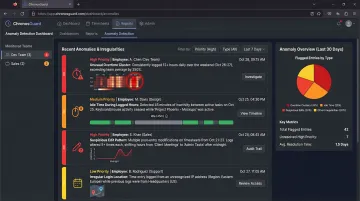
Automation removes the burden from manual review and catches patterns human auditors might miss across large datasets. The next layer of verification moves beyond software—physical and facility data provides a cross-check that's hard to fabricate.
Review Physical Access and System Logs
Physical records—door entry logs, keycard timestamps, network logins, and surveillance data—can be cross-checked directly against clock-in/out records. Discrepancies between physical presence and logged hours are a strong fraud indicator.
For example: an employee's timesheet shows clock-in at 7:00 AM, but keycard data shows building entry at 7:45 AM. The 45-minute gap represents unworked time fraudulently claimed.
Establish Anonymous Reporting Channels
According to the Association of Certified Fraud Examiners, employee tips are the single most common way workplace fraud gets discovered. Set up an anonymous reporting mechanism through:
- Third-party hotlines
- Confidential email addresses monitored by HR or legal
- Anonymous web forms
- Regular ethics surveys asking about observed violations
Communicate the channel during onboarding and reinforce it periodically. Without clear retaliation protections, employees who observe fraud are unlikely to come forward—even when they want to.
How to Prevent Timesheet Fraud
Prevention is a layered system—no single measure eliminates all fraud. A combination of clear policy, verified technology, and consistent enforcement is required.
Establish a Clear, Written Timekeeping Policy
Define exactly how employees are expected to log hours — what counts as authorized overtime, how breaks are handled, and who can edit submitted time records. Your policy should cover:
- Rounding rules and meal break requirements
- Remote work logging procedures
- Who has authority to approve or modify submitted records
- Consequences for violations (before an incident occurs)
This removes the ambiguity that lets employees rationalize inflated hours. It also strengthens your legal standing if termination becomes necessary. Review the policy at onboarding and annually, or whenever workforce structures change.
Implement Biometric Time Verification
Replace PIN-based, card-swipe, or manual entry systems with biometric time capture. Contactless palm vein scanning — used by ePortID — derives identity from 5 million unique points, tying each time entry to the individual physically present rather than a credential that can be shared or borrowed.
This directly eliminates buddy punching and time clock manipulation. Key technical properties:
- Checks for liveness through infrared detection of vein patterns beneath the skin — cannot be spoofed with a photo or duplicate
- Verification completes in under 2 seconds at 99.99991% accuracy
- Creates an indisputable, tamper-proof attendance record
Prioritize biometric verification for shift-based workforces, high employee density, or strict compliance environments — seaports, power stations, hospitals, data centers, and factories. Dow Chemical, Tata Steel, and South Jersey Port Corp. have deployed it to protect payroll integrity in exactly these settings.
Use Real-Time Monitoring and Workforce Analytics
Deploy time-tracking software that integrates with payroll and productivity data, surfaces anomalies automatically, and maintains a full audit trail. The platform should flag:
- Unexpected overtime clusters
- Idle-time spikes during logged hours
- Suspicious edit patterns (repeated retroactive changes, edits outside business hours)
This reduces reliance on manual oversight and enables managers to catch suspicious patterns early, before losses compound. Automated alerts also create a deterrence effect — employees know the system is watching.
Deploy analytics alongside biometric verification and written policy, not instead of them. Patterns that individual record checks miss are exactly what analytics are built to catch.
Define and Consistently Enforce Consequences
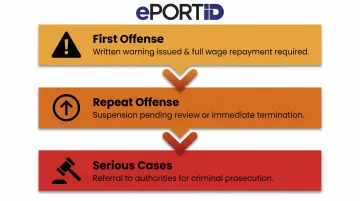
Establish a proportional, documented disciplinary process before any incident occurs. A workable escalation structure:
- First offense: Written warning and repayment of fraudulent wages
- Repeat offense: Suspension or termination, depending on severity
- Serious cases: Referral to legal counsel for criminal prosecution
Deterrence collapses when employees believe violations go unaddressed. Consistent enforcement signals organizational seriousness and discourages repeat offenses. Retroactive rule-setting — defining consequences after an incident — undermines both fairness and your legal standing in any resulting termination dispute.
Long-Term Strategies to Control Timesheet Fraud
Prevention doesn't end after implementation—it requires routine monitoring and a culture where accurate time recording is treated as a professional standard.
Best practices for sustained fraud control:
- Schedule periodic payroll and timesheet audits on a fixed calendar. Assign clear ownership to a manager or HR lead with defined audit protocols.
- Train managers to recognize fraud indicators using documented patterns, and ensure findings are recorded thoroughly for HR and legal review.
- Build accountability through ethics training — onboarding, annual refreshers, and recognition programs that reward accurate compliance. Leadership should demonstrate the same standards they require of staff.
- Replace manual and legacy time capture systems — outdated infrastructure creates the gaps that fraud exploits. Prioritize solutions that unify time capture, access control, and payroll into a single audit trail.
Organizations that treat these four pillars as ongoing commitments — not one-time fixes — consistently see lower fraud rates, cleaner payroll records, and stronger compliance outcomes.
Frequently Asked Questions
Is timesheet fraud illegal?
Yes. Falsifying time records can violate the Fair Labor Standards Act (FLSA) and state labor laws. Both employees and employers can be held accountable. In states like Colorado and Connecticut, payroll fraud exceeding $2,000 constitutes a felony, with penalties including fines and imprisonment.
What is the most common type of timesheet fraud?
Buddy punching and time padding are the most frequently reported forms, with 75% of businesses experiencing buddy punching losses. These schemes are especially prevalent in organizations without automated or biometric time verification systems.
How can biometric technology prevent timesheet fraud?
Biometric systems tie time entries to verified physical identity through characteristics like palm vein patterns that cannot be shared or duplicated. This makes it impossible for one employee to clock in for another and creates an indisputable attendance record that cannot be forged.
What should I do if I suspect an employee of timesheet fraud?
Compare time records against project outputs, system logs, and access data. Document recurring patterns rather than isolated incidents — a single anomaly may be an error, but consistent discrepancies point to fraud. Escalate to HR or legal counsel before approaching the individual directly.
Can remote employees commit timesheet fraud?
Yes. Remote workers can log hours they did not work, submit false overtime, or misreport task completion. Cross-referencing time records with project management data, system login logs, and work outputs is the most effective detection method for distributed teams.
How much does timesheet fraud cost businesses annually?
The American Payroll Association estimates businesses lose approximately 5-10% of gross payroll annually to time theft. For an organization with $5 million in payroll, that translates to $250,000-$500,000 in annual losses — a figure that compounds in large or distributed workforces.