Introduction
Picture this: It's 5:45 a.m. on a sprawling commercial site in suburban Philadelphia. The gate supervisor hasn't arrived yet, and the morning crew is gathering at the punch clock. A framing contractor's phone buzzes—his buddy's running 20 minutes behind and asks if he can "just clock me in real quick." It happens in seconds. No questions asked. No second thoughts.
This scenario plays out daily across thousands of jobsites nationwide, draining project margins and corrupting payroll accuracy. Construction sites are uniquely vulnerable to buddy punching—the practice of one worker clocking in on behalf of another.
Early-morning dark starts, large dispersed crews, rotating subcontractors, and remote gate setups all work against detection. By the time payroll discrepancies surface, the damage is already done.
This guide walks you through what drives buddy punching, what it costs when ignored, how to identify it early, and the practical steps—from clear policy to proven technology—that stop it for good.
Key Takeaways
- Buddy punching is when one worker clocks in for an absent colleague, inflating payroll and corrupting job-costing data
- Construction sites face unique risks: large crews, subcontractor rotation, manual time tracking, and minimal gate oversight
- Industry estimates put time theft losses at 1.5% to 5% of gross payroll annually
- Prevention requires layered controls—policies, supervisor accountability, GPS geofencing, and biometric verification
- Contactless palm vein scanning makes buddy punching physically impossible: credentials are tied to biology, not a badge or PIN
What Is Buddy Punching and Why Is It So Prevalent on Construction Sites?
Buddy punching is straightforward time theft: one employee clocks in or out on behalf of an absent or late coworker. The company ends up paying for hours never worked — whether the colleague was late, on an extended break, or absent entirely.
Construction sites are especially vulnerable to this. Unlike office environments where individual arrivals are easily noticed, jobsites often involve dozens or hundreds of workers spread across multiple phases, buildings, or zones. Supervisors can't watch every gate or punch clock at once.
Why Traditional Time-Tracking Systems Enable It
Most legacy systems share one fundamental flaw: they track objects or codes, not people. That distinction matters:
- Paper sign-in sheets: A worker writes their own name and their absent colleague's at the same time. No verification, no challenge.
- Punch-card clocks: One worker runs a colleague's card through the reader. The system logs the time without knowing who's actually standing there.
- PIN or swipe-card systems: The absent employee shares their card or credentials. The terminal has no way to confirm the cardholder is present.
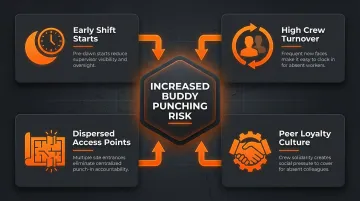
Construction-Specific Factors That Make It Worse
Several operational realities compound the problem:
- Early shift starts: Pre-dawn arrivals often occur before management is on site, leaving gate access unsupervised
- High crew turnover: Rotating subcontractor workforces mean site supervisors often don't personally know every worker, making impersonation easier and detection harder
- Dispersed access points: Large sites with multiple gates, trailers, or staging areas create more opportunities for unmonitored clock-ins
- Peer loyalty culture: Construction crews often develop strong bonds, and covering for a coworker is seen as loyalty rather than fraud
The Real Cost of Ignoring Buddy Punching on Construction Sites
Time theft costs businesses between 1.5% and 5% of gross payroll annually. On a crew of 50 workers earning $30 per hour over a six-month project, even a conservative 2% loss translates to thousands of dollars in ghost wages — and that's before accounting for the downstream damage.
Payroll compliance exposure: Under the Fair Labor Standards Act (FLSA), employers must pay for every hour logged — even hours suspected of being fraudulent. In 2026, a California drywall contractor was ordered to pay $790,000 in back wages and penalties after failing to accurately track hours worked.
Prevention costs a fraction of after-the-fact disputes, legal fees, or Department of Labor penalties.
Labor cost data becomes untrustworthy: When reported hours don't reflect actual productivity, cost-per-unit calculations go sideways. Skewed estimates feed into future bids, which can lead to underpricing — and margin erosion — on the next project.
Emergency headcounts become unreliable: Falsified attendance records are a direct safety hazard. During fires, structural incidents, or evacuations, knowing exactly who is on site can be life or death. If someone is clocked in but physically absent — or present but unlogged — emergency responders are working from faulty data.
Warning Signs Buddy Punching Is Happening on Your Site
Watch for these red flags:
- Clustered clock-in times: Workers whose arrival timestamps are suspiciously identical, or pairs who always punch in and out at exactly the same moment
- Implausible arrival patterns: Clock-ins that precede physically plausible travel times from gate to terminal
- Payroll anomalies: Labor costs consistently exceeding estimates on specific crews or shifts, or overtime patterns that don't align with observed activity
- Cultural signals: Multiple workers unconcerned about lateness or absenteeism, or supervisors reporting difficulty holding workers accountable for attendance
How to Prevent Buddy Punching on Construction Sites
No single measure eliminates buddy punching on its own. The most effective approach layers clear policy, management accountability, and technology that makes falsification impossible by design.
Establish and Communicate a Clear Attendance Policy
The policy needs to cover:
- Explicit definitions of buddy punching and time theft
- Examples of prohibited behavior
- Consequences, up to and including termination
- A clear process for reporting suspected fraud
Documentation alone isn't enough. Hold a toolbox talk or crew briefing to walk workers through the policy. Post it at site access points—not buried in an onboarding packet. Visible and understood beats filed away every time.
Empower Supervisors to Monitor and Act
Empowered oversight means:
- Real-time access to clock-in data
- Training to recognize anomalies
- A clear escalation path when fraud is suspected
- Consistent management backing when enforcement is required
Supervisors who feel unsupported won't enforce attendance policies. Management needs to back them up visibly and consistently — accountability only works when it runs from the top down.
Use GPS Geofencing to Enforce Location-Based Clock-Ins
Geofencing establishes a virtual perimeter around the jobsite. Workers can only clock in or out while physically within that boundary, blocking remote clock-ins from parking lots, vehicles, or offsite locations.
71% of construction professionals now use mobile devices for entering time, making geofencing a natural fit. One mid-sized general contractor reduced payroll processing time by 70% after deploying location-based time tracking with geofencing.
Critical limitation: Geofencing confirms a phone or device is on site — it does not confirm who is holding it. As industry evaluations note, "While geofencing answers 'Where are you?', it fails to answer 'Who are you?'" A coworker could still use a colleague's phone to clock them in. That's where identity verification picks up where location tracking leaves off.
Implement Biometric Identity Verification
Biometrics are the only method that ties a clock-in directly to the individual — not a device, not a card, not a PIN someone else can use. The credential is the person.
Which biometric performs best in construction environments?
- Fingerprint scanners struggle on construction sites. Dirty, calloused, or gloved hands — plus conditions like sweat or dry skin — cause repeated recognition failure.
- Facial recognition fails when workers wear hard hats, masks, or work under poor lighting during pre-dawn starts.
- Contactless palm vein scanning works reliably in all site conditions — no physical contact required, and it reads the unique vascular pattern beneath the skin, a pattern shared by no one, not even identical twins.

ePortID's contactless palm vein technology is designed specifically for these conditions. Accurate to 99.99991% and verified in under 2 seconds, the system uses near-infrared light to read vein patterns beneath the skin. Liveness detection means a scan cannot be spoofed by a photo or replica — it requires a living hand to register.
The system traces its origins to securing US Navy, Army JTF, Marine Corps, and Port Authority facilities — environments where identity accuracy is non-negotiable. Commercial clients including Fiserv, Dow Chemical, and Tata Steel have since applied the same technology to workforce access control.
Tips for Long-Term Prevention and Control
Technology closes the door on buddy punching, but consistent habits keep it shut. Build these practices into your standard site operations:
- Audit clock-in data on a set schedule — monthly or at each project phase. Compare logged hours against supervisor headcounts and flag any crews where reported time consistently outpaces observed output.
- Bring time integrity into toolbox talks. When supervisors treat attendance accuracy as a safety culture issue — not just an HR formality — the message carries more weight on the ground.
- Connect verified time records directly to payroll and job-costing systems. When biometric or GPS-verified entries feed into payroll calculations automatically, manual re-entry errors disappear and you get a clean audit trail for certified payroll compliance.
Conclusion
Buddy punching has identifiable causes—vulnerable systems, limited oversight, and normalized behavior—and each can be addressed with the right policies and tools.
Clear policy, supervisor accountability, and identity-verified time tracking together eliminate the conditions that let buddy punching persist. The result:
- Protected payroll accuracy
- Safeguarded project margins
- Reliable safety records
- Stronger crew morale
Frequently Asked Questions
How do construction sites prevent buddy punching?
The most effective prevention combines a clearly communicated attendance policy, supervisor oversight, GPS geofencing to enforce location-based clock-ins, and biometric identity verification. Biometrics are the only approach that makes it technologically impossible for one worker to clock in on behalf of another.
Is buddy punching illegal on construction sites?
Buddy punching is considered time theft and wage fraud. Under the FLSA, employers must pay for all hours logged — meaning the financial burden falls on the company, regardless of whether disciplinary action is pursued.
What is the difference between buddy punching and time theft?
Buddy punching is a specific type of time theft where one employee clocks in or out on behalf of another. Time theft is the broader category that also includes extended breaks, early clock-outs, and clocking in without starting work.
How much does buddy punching cost construction companies?
Industry estimates indicate time theft costs businesses 1.5% to 5% of gross payroll annually. On large, multi-month construction projects with dozens or hundreds of workers, this compounds quickly into five- or six-figure losses.
Can biometric time clocks completely eliminate buddy punching?
Yes. Properly implemented biometric systems—particularly those using palm vein scanning with liveness detection—make buddy punching effectively impossible. The biometric identity is unique to each individual and cannot be shared, copied, or handed off.
Do paper timesheets still count as a legal record for construction payroll compliance?
Paper timesheets can meet basic FLSA recordkeeping requirements, but they offer no fraud protection and are hard to defend in audits or disputes. Digital, biometrically verified records create a far stronger audit trail for certified payroll compliance.