How much does a security consultant cost?
Biometric security consulting costs vary based on facility size, complexity, and integration requirements. Most ePortID consulting engagements follow a project-based model covering assessment, system design, vendor selection, and implementation oversight. For small businesses, basic consulting packages start around $2,500-5,000 for a single-location assessment and design. Mid-size facilities with multiple access points typically invest $10,000-25,000. Enterprise clients with complex multi-site requirements may budget $50,000+ for comprehensive consulting. Importantly, systems we design consistently deliver 3-6 month ROI through eliminated time theft, reduced operational costs, and prevented security breaches—making consulting fees a fraction of realized savings.
What makes palm vein biometrics more secure than fingerprint or facial recognition?
Palm vein biometrics scans the unique pattern of hemoglobin in your hand's vascular structure—5 million data points inside the body that can't be photographed, duplicated, or altered. Unlike fingerprints (which leave residue) or faces (captured on cameras), vein patterns are invisible to surveillance. The technology verifies liveness during each scan, preventing spoofing with photos or molds. With 99.99991% accuracy, palm vein authentication is 100 times more accurate than fingerprint systems and virtually eliminates false accepts. It's contactless, hygienic, and works regardless of skin condition, age, or environmental factors. For consulting clients requiring the highest security standard, it's the only biometric we recommend.
Can biometric systems integrate with our existing access control infrastructure?
Yes. ePortID consultants specialize in integration architecture. Our palm vein readers output standard Wiegand signals (any bit format) or OSDP protocols compatible with 95% of commercial access control systems from manufacturers like Software House, Lenel, HID, Honeywell, and Genetec. We can interface with electric strikes, mag-locks, turnstiles, vehicle gates, and elevator controls. For data access applications, our DAM solution works as a peripheral device requiring zero core system integration—it simply replaces password entry. During consulting, we audit your current systems, identify integration points, and design solutions that enhance security without requiring expensive infrastructure replacement. Most implementations take 2-4 weeks.
What compliance requirements do biometric access control systems address?
Our consulting covers multiple regulatory frameworks. For critical infrastructure, we design systems meeting CFATS, MTSA, and NERC-CIP standards requiring multi-factor authentication and audit trails. Healthcare implementations address HIPAA requirements for patient identity integrity and workforce authentication for EHR access. Educational institutions comply with the Clery Act's campus security mandates. Seaport clients meet TWIC verification requirements with real-time TSA Cancelled Card List checks. Financial institutions satisfy PCI-DSS and SOX controls for data access. Defense contractors meet NIST 800-171 and CMMC identity verification standards. During initial assessment, we map your specific compliance obligations to system design requirements.
How long does biometric system implementation take after consulting?
Implementation timelines depend on facility size and system complexity. For single-location installations (1-5 access points), implementation typically takes 1-2 weeks following consulting completion. Mid-size facilities with 10-25 readers average 3-4 weeks. Enterprise multi-site rollouts span 8-12 weeks with phased deployment. The process includes hardware installation, network configuration, user enrollment, integration testing, and staff training. Our consultants create detailed implementation roadmaps during the design phase, identifying critical path items and coordination requirements. Rush installations for high-priority security upgrades can be accelerated with dedicated project teams. Post-implementation, we provide 30-90 days of optimization support ensuring system performance.
What return on investment can we expect from biometric access control?
Most ePortID systems deliver full ROI within 3-6 months through quantifiable savings. Time and attendance applications eliminate buddy punching (averaging 2-5% payroll cost reduction). Physical access control prevents credential sharing, reducing security breach risks and associated incident costs. Data access management eliminates password reset help desk tickets (averaging $70 per reset). Healthcare implementations prevent medical identity theft incidents (averaging $13,500 per case). Reduced operational expenses include eliminated badge replacement costs, streamlined visitor management, and automated compliance reporting. A 100-employee facility typically saves $15,000-30,000 annually. Enterprise clients report six-figure savings. During consulting, we model projected ROI specific to your operational metrics.
Do employees need to carry cards or remember passwords with biometric systems?
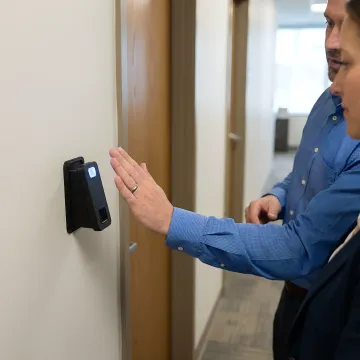
No. That's the fundamental advantage of palm vein biometrics—your identity is derived from your unique vascular pattern, which you always carry and can never lose, forget, or share. For physical access, employees simply hold their hand over the reader for under-2-second verification. No cards, key fobs, or PINs required (though multi-factor options combining biometric + card + PIN are available for high-security areas). For data access, our DAM solution stores passwords within your vein pattern—you scan to authenticate, and the system logs you into applications automatically. This eliminates password fatigue, reset requests, and credential sharing. Enrollment takes 60 seconds per user.
What ongoing support and maintenance do biometric systems require?
Palm vein systems require minimal maintenance due to contactless operation and solid-state components with no moving parts. Recommended quarterly inspections ensure reader cleanliness and network connectivity. Annual firmware updates maintain security protocols and add features. Our consulting includes maintenance plan design specifying inspection schedules, spare parts inventory, and user administration procedures. ePortID offers support contracts providing 24/7 technical assistance, remote diagnostics, priority parts replacement, and annual system health audits. Typical maintenance costs run 8-12% of initial system investment annually. The Fujitsu palm vein readers carry two-year warranties for manufacturing defects. Most clients designate an internal system administrator trained during implementation for day-to-day user management.