Introduction
Every day, fitness centers lose revenue to shared key fobs, cloned access cards, and credential fraud — security gaps that are invisible until you run the numbers. With 81 million Americans holding gym memberships in 2025 and annual retention rates averaging just 66.4%, the operational burden of managing credentials, replacing lost fobs, and verifying membership status has never been higher.
The problem sharpens at 3 a.m. As 24/7 unmanned gym models expand — Anytime Fitness alone opened 365+ locations in 2025 — traditional access methods show their core weakness: no staff on-site means no one catching a borrowed key fob at the door.
Biometric access control solves this differently. Instead of verifying what a member carries (a card) or knows (a PIN), these systems verify who they are — using unique biological traits like fingerprints, facial features, or palm vein patterns. This guide covers everything gym operators need to make that shift: where traditional methods fail, which biometric technologies work best in 2026, and how to implement them without disrupting member experience.
TLDR:
- Traditional gym access methods lose revenue to credential sharing — key fobs and PINs can be lent or cloned
- Palm vein scanning reaches 99.99991% accuracy and holds up with wet, dirty, or calloused hands
- Biometric systems eliminate credential replacement costs, reduce staffing overhead, and typically achieve ROI within 2-4 years
- Illinois BIPA and Texas CUBI require written consent before any biometric data collection — compliance comes before deployment
Why Traditional Gym Access Methods Are Failing in 2026
The core vulnerability shared by key fobs, PIN codes, and membership cards is simple: all are credentials that can be lent, lost, cloned, or shared. Unlike a biometric trait physically tied to one individual, a plastic fob or four-digit code is transferable—and that transferability creates structural revenue loss and operational burden.
Credential Fraud and Membership Sharing:
The fitness industry has long recognized credential sharing as a revenue problem, though no reliable industry-wide figures from HFA, IBISWorld, or Statista pin down the exact cost. What is verifiable: 66.4% annual retention means roughly one-third of all credentials must be deactivated and recycled each year.
Every shared key fob represents a non-paying user consuming equipment, space, and amenities. The access system has no way to distinguish a legitimate member from someone using a borrowed card.
Operational Burden of Credential Management:
High churn creates ongoing administrative costs. Gyms replacing lost fobs at $5-$10 per credential and charging members $30-$100 monthly in replacement fees still absorb staff time for deactivation, reactivation, and manual verification. Peak-hour bottlenecks compound the problem—front-desk check-ins slow entry, create queues, and introduce human error when verifying membership status manually.
24/7 Unmanned Operations Expose Structural Weaknesses:
That manual verification problem disappears in unstaffed gyms—and not in a good way. Anytime Fitness is targeting 10,000 units and 10 million members by 2030, and the model it represents has a fundamental credential problem: no staff means no one to catch a borrowed QR code or confirm the person entering matches the membership account.
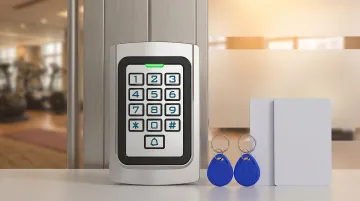
Traditional access control relies on one of two mechanisms:
- Physical presence — a staff member checking IDs and matching faces to accounts
- Transferable credentials — fobs, PINs, or QR codes that verify the card, not the person
Neither approach works in an unmanned environment. One requires staff that aren't there; the other makes sharing trivially easy.
Types of Biometric Access Control for Fitness Centers
Fingerprint Recognition
Fingerprint scanning reads ridge patterns on a member's fingertip, comparing each entry attempt to a template captured during enrollment. The modality's main advantage is widespread availability and relatively low hardware cost—$200-$1,500 per door—making it an accessible entry point for gyms exploring biometrics.
The Gym-Specific Limitation:
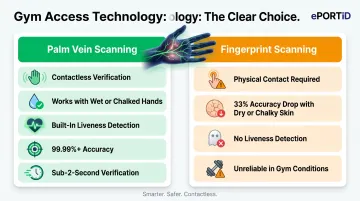
Research published in Sensors (2025) found that dry skin conditions cause a 33% degradation in detectable minutiae features on fingerprint scanners, while wet conditions increased detection by 39-68%—but in unpredictable ways. Gym environments amplify this problem: sweaty hands post-workout, chalked fingers from weightlifting, and calloused skin from equipment all reduce scan reliability. False rejections create member frustration precisely when traffic is highest—morning and evening rush hours—turning a security measure into a check-in bottleneck.
Facial Recognition
Facial recognition systems use cameras to match a member's face to an enrolled template, enabling hands-free entry. For gyms where members arrive carrying duffel bags, water bottles, or equipment, that contactless convenience is real.
Legal and Privacy Risks:
Before deploying facial recognition, gym operators must navigate state-level biometric privacy laws. Key frameworks to understand:
- Illinois BIPA (740 ILCS 14/): Requires written informed consent before collection, mandates data destruction within three years, and grants a private right of action at $1,000-$5,000 per violation. The Facebook BIPA settlement for $650 million illustrates the litigation exposure.
- Texas CUBI: Imposes up to $25,000 per violation, enforced by the Attorney General (no private right of action).
- Other states: Washington, Colorado, and several others have enacted or proposed similar frameworks—compliance requirements vary and continue to expand.
Deploying facial recognition without mapping these obligations creates material legal risk.
Palm Vein Scanning
Palm vein scanning is the most secure and hygiene-friendly biometric modality available in 2026. Near-infrared light captures the unique vascular pattern beneath the skin's surface—a pattern that cannot be replicated, stolen from a surface, or fooled by a photograph or prosthetic.
The technology operates within the 700-900 nm near-infrared range, with 850 nm wavelengths penetrating approximately 3.57 mm beneath the skin. Deoxidized hemoglobin in vein vessels absorbs more infrared light than surrounding tissues, creating a vascular shadow image unique to each individual—even identical twins have different palm vein patterns.
That uniqueness translates directly into performance. Leading contactless palm vein systems—such as those powered by Fujitsu PalmSecure technology and deployed by ePortID—achieve extraordinary accuracy. iBeta-certified testing (April 2018) of the Fujitsu PalmSecure F-Pro recorded an observed False Match Rate of 0.000 with a 95% confidence interval of 0.000306, 0% failure-to-enroll, and 0% failure-to-acquire. Identity is derived from millions of data points, and verification completes in under two seconds—fast enough to handle peak gym traffic without creating a bottleneck.
Liveness Detection:
Built-in liveness detection is the critical differentiator. The scan only works on a living hand with active blood flow—without blood flowing, the vascular image disappears. This eliminates spoofing risks entirely. Unlike fingerprint scanners vulnerable to lifted prints or facial recognition systems potentially fooled by high-resolution photos, palm vein scanning requires the actual enrolled individual to be physically present.
Performance Under Gym Conditions:
Palm vein scanning is unaffected by surface skin conditions—grease, dirt, dry or wet surfaces, wear and tear—that degrade fingerprint performance. For fitness centers where members arrive with sweaty, chalked, or calloused hands, this reliability advantage is not theoretical; it directly prevents the false rejections that create member frustration and entry delays.
Iris and Retinal Recognition
Iris recognition scans the unique patterns in the colored ring around the pupil, offering high accuracy in a contactless format. The modality is used in premium or high-security facilities but remains less common in standard fitness center deployments due to higher hardware costs ($1,500-$3,000 per door) compared to palm vein or facial recognition. For most gym operators, that $1,000-$1,500 premium per door is hard to justify when palm vein scanning delivers comparable accuracy at lower cost.
Biometric vs. Traditional Access Control: Why the Upgrade Makes Sense
Credential Sharing Is Eliminated by Design
A biometric trait cannot be handed off the way a key fob or PIN can. Each entry attempt is tied to a specific enrolled individual, so unauthorized access is physically prevented — not just discouraged by policy. A member cannot lend their palm vein pattern to a friend or family member. The system requires the actual enrolled person to be present at the door.
Staff Dependency Drops Significantly
The front-desk check-in model requires staff, creates queues, and introduces human error. Biometric entry handles verification autonomously in under two seconds. That frees your team to focus on what actually drives value:
- Member retention and relationship-building
- Upselling classes, personal training, and add-on services
- Facility maintenance and service quality
For 24/7 unmanned gym models, biometric systems enable secure operation without any on-site personnel.
Audit Trails Become Indisputable
Biometric access logs create a verifiable record of exactly who entered, which area, and when. That matters for liability management, capacity compliance, and investigating equipment damage or theft. Unlike card-based systems — where multiple people can share the same credential — biometric logs tie every access event to a specific individual with no ambiguity.
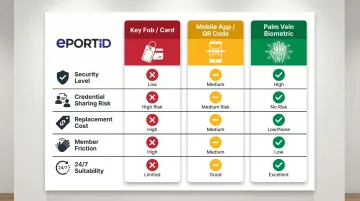
System Comparison:
| Access Method | Security Level | Credential Sharing Risk | Replacement/Loss Cost | Member Friction | 24/7 Unmanned Suitability |
|---|---|---|---|---|---|
| Key Fob/Card | Low | High—easily shared or cloned | $5-$10/fob + admin time | Moderate—can forget card | Poor—no verification of user identity |
| Mobile App/QR Code | Moderate | Moderate—codes can be screenshotted/shared | None, but requires phone/battery | Moderate—phone dependency | Moderate—still transferable |
| Biometric (Palm Vein) | High | None—physically inseparable from individual | None after enrollment | Low—hands-free, sub-2-second verification | Excellent—verifies actual individual present |
The "Too Complex" Concern Doesn't Hold Up
Modern biometric systems are built for high-volume, low-friction environments. Enrollment takes under a minute at sign-up. After that, members need nothing — no card, no app, no PIN. The day-to-day experience is straightforward: walk up, scan, door opens. That's measurably simpler than digging for a membership card or waiting for a QR code to load on a phone screen.
Key Business Benefits for Gym Operators
Revenue Protection and Membership Integrity
Every shared key fob represents a non-paying member using the facility. While authoritative industry statistics on credential sharing percentages remain unavailable, the structural problem is clear: traditional credentials are transferable, biometric traits are not. Biometric access makes this form of fraud structurally impossible—each access attempt requires the enrolled member to be physically present.
Reduced Operational Costs
Eliminating credential hardware delivers immediate savings:
- No fob replacements at $5–$10 per unit
- No card printing or magnetic stripe maintenance costs
- No reader repairs for worn RFID chips or damaged cards
- Fewer front-desk staff hours spent on check-in management, freeing personnel for member service and retention
ePortID's palm vein systems—proven across US Navy, Marine Corps, and port authority deployments—typically recover installation costs within 3 to 6 months through combined credential elimination and staffing reduction. The 2-4 year ROI timeline cited for commercial biometric upgrades reflects these ongoing operational savings compounding over time.
24/7 Access Without Security Compromise
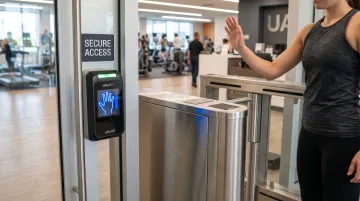
Biometric systems allow gyms to operate fully unstaffed during off-peak hours without creating a security vulnerability. Each entry is still verified against an enrolled member identity, and the system can be monitored remotely in real time. Denied entry attempts, unusual access patterns, or attempts by former members to enter after termination generate immediate alerts—even when no staff are physically present.
Member Experience and Retention
Hands-free entry—no card to find, no app to open, no PIN to remember—reduces check-in frustration, especially during morning and evening peak traffic. Research from The Retention People and Les Mills found that regular staff contact reduces cancellations by 33%, and structured onboarding drives 87% retention at six months versus 60% without. No study directly links biometric check-in to churn reduction, but the data confirms that access experience quality affects member satisfaction.
How to Choose and Implement Biometric Access Control for Your Gym
Assessment Questions Before Selection
- How many entry points need coverage? (Main entrance, locker rooms, group fitness studios, equipment areas)
- Will the system integrate with existing gym management or billing software?
- Is the facility fully staffed or operating on an unmanned 24/7 model?
- What is the member demographic and their comfort level with biometric enrollment?
- What is your budget for upfront hardware versus ongoing operational savings?
Enrollment and Rollout Process
Biometric enrollment typically takes under a minute per member. During sign-up, new members present their chosen biometric trait (palm, fingerprint, face) to the scanner, which captures and encrypts the template. For existing members transitioning to biometric access, facilities can conduct enrollment during check-in over a defined rollout period (two weeks works well), capturing templates as members arrive for workouts.
Fallback Protocols
What happens if a member's biometric scan fails—due to injury, temporary skin condition, or equipment malfunction? Well-designed systems support fallback options such as RFID card or PIN entry. This keeps members moving through the door even when primary biometric verification hits a snag.
Integration Layer
Biometric access systems should connect to gym management platforms to automatically activate or deactivate access based on membership status, flag expired memberships in real time, and generate usage analytics.
Systems interfacing via Wiegand or OSDP protocols can integrate with existing electric strikes, mag-locks, and door control hardware. Choosing a vendor with proven integration experience across demanding environments reduces deployment risk — ePortID's background in military, port authority, and critical infrastructure settings is one example of the depth worth looking for.
Privacy Laws and Biometric Data Compliance
Gym operators must navigate a complex regulatory landscape before deploying biometrics in 2026.
U.S. State-Level Biometric Laws
Illinois BIPA (740 ILCS 14/): Requires written informed consent before collection, a disclosed purpose and retention period, and destruction within three years of last interaction. Private right of action enables class-action lawsuits — $1,000 per negligent violation, $5,000 per intentional violation. Facebook's $650 million settlement shows what's at stake for any organization that collects biometric data carelessly.
Texas CUBI (Bus. & Com. 503.001): Requires informing individuals and receiving consent before capture, with destruction within one year after purpose expires. Enforcement is by Attorney General only (no private right of action), with civil penalties up to $25,000 per violation.
Washington My Health My Data Act (RCW 19.373): Includes biometric data within "consumer health data" definition, requires clear affirmative opt-in consent, and prohibits consent via general terms of use.
GDPR (European operators): Article 9 classifies biometric data as a "special category" requiring explicit consent for specified purposes, with fines up to 4% of annual global turnover or €20 million — whichever is higher.
Storage Architecture as a Compliance Decision
Systems that store only an encrypted mathematical template — not a raw biometric image — provide stronger security and a cleaner compliance posture. Centralized database storage creates a single point of failure and higher regulatory risk. On-device or template-only storage reduces both attack surface and data retention obligations, satisfying data minimization requirements under BIPA and GDPR.
Recommended Compliance Steps
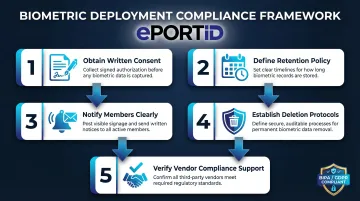
- Obtain written informed consent before enrollment, disclosing purpose and retention period
- Implement a defined data retention policy (align with BIPA's three-year maximum or jurisdiction-specific requirements)
- Provide clear member notification about what biometric data is collected, how it's stored, and when it's deleted
- Establish deletion protocols for terminated memberships, ensuring templates are purged when members cancel
- Work with vendors who provide compliance documentation and support for state-level biometric laws
Frequently Asked Questions
Is fingerprint or palm vein scanning better for gym access control?
Palm vein scanning offers significant advantages for gym environments: contactless operation, resistance to spoofing, built-in liveness detection, and consistent performance regardless of hand condition after a workout. Fingerprint scanning is a lower-cost entry point but degrades under gym-specific conditions (wet, chalked, or calloused hands).
How does biometric access control prevent membership fraud at gyms?
Biometric traits are physically inseparable from the enrolled individual. Unlike a key fob or PIN, they cannot be lent, shared, or transferred—each access attempt requires the actual enrolled member to be physically present at the door.
Is biometric data from gym members protected under privacy laws?
Yes. State biometric laws in the U.S. (Illinois BIPA, Texas CUBI, Washington MHMD) and GDPR in Europe impose compliance obligations. Gym operators must obtain member consent and implement a clear data retention policy before collecting any biometric information.
What does it cost to install biometric access control in a fitness center?
Costs vary by facility size, entry points, and biometric modality. Small gyms (1-2 entry points) typically invest $5,000–$15,000; mid-size facilities (3-5 entry points) range $15,000–$50,000. Most facilities recover costs within 2-4 years through reduced staffing and fraud losses.
Can biometric systems integrate with existing gym management software?
Most enterprise-grade biometric access systems support API integration with popular gym management platforms via Wiegand or OSDP protocols, enabling automatic access activation and deactivation tied to membership billing status. Verify integration capabilities with your vendor before deployment.
How long does biometric enrollment take for new gym members?
Modern biometric enrollment typically takes under a minute per member at sign-up. After the initial scan, no further setup is required—members simply present their biometric trait (palm, fingerprint, face) to enter.