Introduction
Gym owners face a daily challenge: high-traffic facilities where hundreds of members touch shared surfaces constantly—keypads, card readers, fobs—creating both hygiene concerns and security vulnerabilities. Bacterial loads on shared fitness equipment range from 7.6 x 10^9 to 1.0 x 10^13 CFU/mL, with MRSA present in 100% of sampled gym surfaces. Meanwhile, credential sharing and tailgating drain revenue—facilities lose thousands monthly to unauthorized access.
Touchless access control addresses both concerns with a single system upgrade. This guide breaks down every option—from mobile Bluetooth to palm vein biometrics—so you can choose what actually fits your facility.
TLDR:
- Touchless access eliminates shared-surface contact while preventing credential sharing and tailgating
- Options range from mobile Bluetooth to truly touchless biometric systems like palm vein scanning
- Unstaffed 24/7 facilities using touchless systems see average monthly revenue gains of $7,301
- Biometric systems eliminate per-credential replacement costs and buddy punching
- Most facilities recover the investment within 3–6 months
What Is Touchless Gym Access Control?
Touchless gym access control is a category of entry systems that allow members to gain access without physically touching a reader, keypad, or device. These systems combine hardware (readers, barriers) and software (membership and credential management) to automate and secure facility entry.
Understanding the Touchless Spectrum
The term "touchless" covers a wide range of systems — and they're not equivalent. Two categories define the spectrum:
Truly touchless systems (the member's body is the credential):
- Facial recognition cameras
- Palm vein biometric scanning
- No device required; hands-free verification
Touch-lite systems (still require handling or presenting a device):
- Mobile Bluetooth/NFC (requires taking out phone and tapping)
- QR code scanning (requires displaying code)
- While more hygienic than shared keypads, members still interact with personal devices
A truly touchless system removes hygiene concerns and makes credential sharing physically impossible — two problems that touch-lite systems only partially address.
Touchless vs. Traditional Access Methods
Traditional access credentials create multiple vulnerabilities:
| Traditional Method | Touchless Biometric |
|---|---|
| Key fobs can be lost, stolen, or forgotten | Credential is the person—cannot be lost |
| Swipe cards can be shared between members | Impossible to share biometric identity |
| PIN codes can be observed and duplicated | Unique physiological pattern cannot be replicated |
| Require physical contact with shared surfaces | Zero-touch verification |
| Ongoing replacement costs as credentials wear out | One-time enrollment, no recurring credential costs |
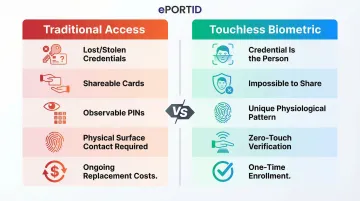
For gym operators, that last row matters as much as the security ones: eliminating recurring fob replacements and card reprints often offsets a meaningful share of the system's upfront cost.
Why Gyms Are Going Touchless: Key Benefits
Security and Unauthorized Access Prevention
Touchless biometric systems eliminate credential sharing and buddy punching—where one member lets in another using their fob or card. In gyms, where revenue depends entirely on paying memberships, preventing unauthorized entry directly protects income.
Implementing access control with tailgating detection can recover $7,500 in monthly revenue for fitness facilities. Traditional keycard systems are highly vulnerable—cards are easily passed through doors or shared among friends and family.
Biometric systems solve this by tying access to each member's unique physiology. When a member's credential is their palm vein pattern, there's simply nothing to pass along, share, or duplicate.
Hygiene and Member Health
Gyms are high-touch, high-traffic environments. Research found that MRSA was present in 100% of sampled gym equipment, with bacterial loads averaging 2.5 x 10^12 CFU/mL on shared surfaces. Touchless entry removes a frequent contact point from the member experience—the very first touchpoint they encounter.
The data backs this up: 69% of returning gym members reported being confident in their gym's safety measures. Visible hygiene protocols—including touchless entry—translate directly into member confidence and retention.
24/7 Operations with Reduced Staffing
Touchless systems allow gyms to offer round-the-clock access without requiring staff at the entrance. Cloud-based management software enables remote credential issuance, revocation, and monitoring—reducing labor costs and enabling the profitable 24-hour gym model.
The numbers are compelling:
- Gym receptionists earn a median hourly wage of $14.00 ($29,080 annually)
- Total payroll can consume 34.7% to 43.9% of a club's total revenue
- Extending to 24/7 unstaffed operations generates average monthly gains of $7,301
Eliminating a single overnight front-desk shift saves approximately $40,880 annually in direct wages, not including benefits or taxes.
Automated Attendance Tracking and Business Insights
Touchless systems generate clean, timestamped entry logs tied to verified member identities. This data helps gym owners:
- Identify peak usage times for optimal class scheduling
- Monitor capacity and maintain safety compliance
- Detect suspicious patterns (same credential used at multiple locations simultaneously)
- Optimize staffing based on actual traffic patterns
- Track member engagement to predict churn risk
Every entry scan adds to a growing dataset that makes staffing, scheduling, and retention decisions more precise over time.
Member Experience and Competitive Differentiation
A fast, frictionless entry experience (under 2 seconds) improves member satisfaction and reduces lobby congestion. Members simply walk up, verify, and enter—no fumbling for cards, no forgotten fobs, no waiting in line.
50% of new members quit within their first six months, and annual retention averages just 66.4%. Every friction point in the member experience contributes to that churn — and the entrance is where the experience starts.
For gyms competing on experience — not just equipment or price — touchless check-in is a visible, daily reminder that the facility is well-run and member-first.
Types of Touchless Gym Access Systems
Mobile-Based Entry (Bluetooth/NFC)
Members use a smartphone app to unlock the door via Bluetooth or NFC. While highly convenient and avoiding physical tokens, this is a "touch-lite" method—members still need to take out their phone and tap or activate the app.
Pros:
- Low upfront cost for readers
- Easy to issue and revoke credentials remotely
- No physical cards to replace
- Integrates with membership apps
Cons:
- Relies on phone battery (dead phone = no entry)
- Members can technically share app credentials
- Requires members to always carry their phone
- Still requires physical interaction with device
QR Code Gym Entry Systems
Members present a QR code (on their phone or a printed card) to a scanner. Many gym management software platforms integrate QR-based entry with refreshed codes that expire to prevent sharing.
Pros:
- Inexpensive to deploy
- Integrates seamlessly with membership software
- Can work with printed codes for members without smartphones
Cons:
- Codes can still be photographed and shared
- Not truly credential-to-person verification
- Reader calibration issues in varying lighting
- Printed codes defeat the hygiene benefit
Facial Recognition Systems
Members are enrolled by photographing their face; the camera reader identifies them on approach. This is truly touchless — no phone, no device, completely hands-free.
Pros:
- Fast and hands-free verification
- High throughput for busy facilities
- Ultimate convenience for members
Cons:
- Performance degrades in varying lighting or with masks/glasses
- Raises significant privacy concerns
- Illinois BIPA imposes statutory damages of $1,000 to $5,000 per violation for collecting facial geometry without written consent
- Facial data can potentially be captured from photos or public images
- Legal compliance requirements vary by jurisdiction
Contactless Palm Vein Biometric Scanning
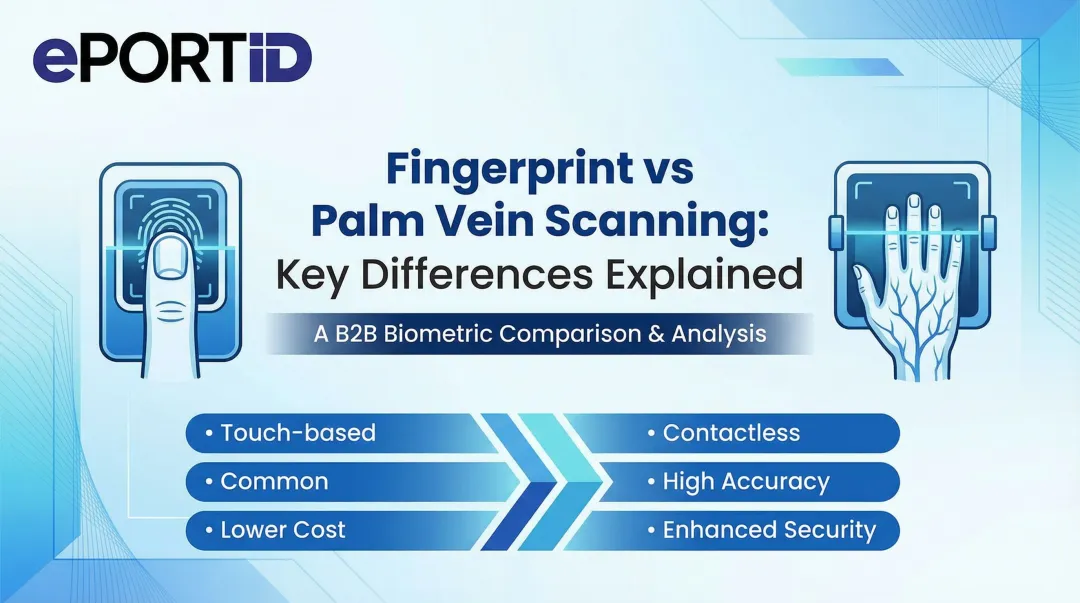
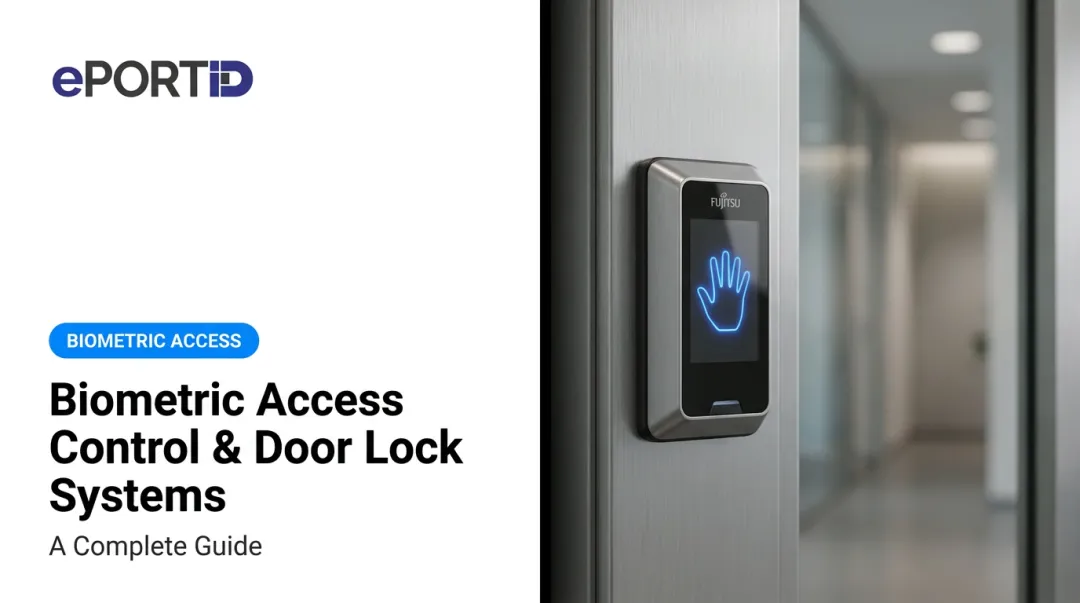
Palm vein scanning uses near-infrared light to map the unique vascular pattern beneath a member's skin. That pattern is unique to each individual — including identical twins — making it the most accurate touchless biometric available.
ePortID's solution, developed in partnership with Fujitsu, achieves 99.99991% accuracy and completes verification in under 2 seconds — derived from 5 million data points per scan.
How it works:
- Member holds hand over the reader (no contact required)
- Near-infrared light penetrates the skin to detect vein patterns
- System verifies liveness to prevent spoofing
- Verification completes in under 2 seconds
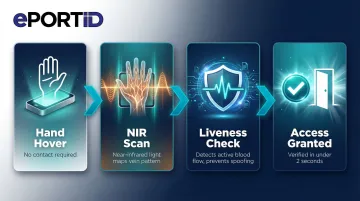
Unlike facial recognition, palm vein data cannot be captured from a photo or public image. The reader detects actual blood flow beneath the skin during every scan, so there is no practical way to spoof or clone the credential. It cannot be lost, shared, or forgotten — because the credential is part of the person.
Pros:
- Highest accuracy of any biometric (99.99991%)
- Fastest verification (under 2 seconds)
- Cannot be spoofed with photos or replicas
- Superior privacy protection (internal biometric)
- Zero contact required
- No device needed
Cons:
- Higher upfront hardware cost
- Requires initial enrollment process
- Brief onboarding session needed at first enrollment
System Comparison
| System Type | Truly Touchless | Credential Shareable | Requires Device | Accuracy Level | Approximate Cost Tier |
|---|---|---|---|---|---|
| Mobile Bluetooth/NFC | No | Yes (app login) | Yes (smartphone) | Medium | Low |
| QR Code | No | Yes (screenshot/photo) | Yes (phone or card) | Low-Medium | Low |
| Facial Recognition | Yes | No | No | Medium-High | Medium-High |
| Palm Vein Biometric | Yes | No | No | Highest (99.99991%) | Medium-High |
Key Components of a Touchless Gym Entry System
Entry Readers and Authentication Hardware
Physical devices installed at entry points perform the actual authentication:
- Mobile Bluetooth/NFC readers — Communicate with member smartphones via wireless protocols
- QR code scanners — Optical readers that decode barcode patterns
- Facial recognition cameras — AI-enabled cameras that analyze facial geometry
- Biometric palm scanners — Near-infrared sensors that capture vascular patterns
The reader authenticates the credential and communicates the result to the control software, which then triggers the door or barrier to unlock. ePortID's palm vein solution uses the Fujitsu F-Pro scanner, which connects to a Door Control Unit (DCU) that manages the entire verification and access control workflow.
Physical Barriers and Door Hardware
The type of physical entry point affects both security level and member flow:
Electronic lock doors:
- Most common and cost-effective
- Higher tailgating risk without additional sensors
- Best for facilities with staff oversight
Tripod or full-height turnstiles:
- Physically restrict one person per credential
- Detect and prevent tailgating
- Higher security for 24/7 unstaffed facilities
Speed gates:
- High throughput for busy facilities
- Fast open/close cycle minimizes lobby congestion
- Premium option for high-volume locations
Barrier choice should match your facility's risk profile and traffic patterns.
Access Control Software and Integrations
The software layer manages the entire credential lifecycle:
- Credential enrollment — Initial biometric capture or credential issuance
- Membership validation — Real-time verification of active membership status
- Time-based permissions — Access only during active membership or specific hours
- Real-time alerts — Notifications for denied entries or suspicious patterns
- Entry audit trails — Complete logs of who entered when
The system must sync with your gym membership management platform so access permissions update automatically. When a membership lapses or is canceled, access is revoked immediately — no manual intervention needed.
How to Choose the Right Touchless Access System for Your Gym
Assess Your Security Needs and Risk Profile
Start by evaluating your specific risk factors:
High-risk indicators requiring sophisticated biometric systems:
- 24/7 unattended operation
- Multiple unsupervised entry points
- History of unauthorized access or theft
- Recurring membership fraud (credential sharing)
- High-value equipment or inventory on premises
Lower-risk scenarios where mobile or QR systems may suffice:
- Staffed facilities during all operating hours
- Single entry point with visual oversight
- Smaller membership base with strong community accountability
Once you've placed your facility in one of these categories, use it as your baseline when comparing system types in the sections below.
Consider Member Volume and Credential Management Overhead
Systems using physical tokens (even NFC cards) incur ongoing replacement and issuance costs as membership grows:
- Average annual gym member retention is 66.4%, meaning roughly one-third of your membership turns over yearly
- Physical proximity cards cost approximately $5.86 per unit in bulk
- Key fobs cost approximately $6.34 per unit in bulk
- Facilities save approximately $1,200 annually on lost credential replacement by eliminating physical media
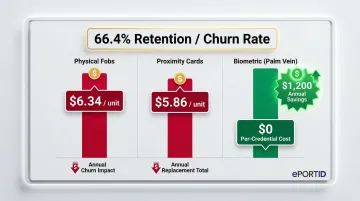
With one-third of members churning annually, those per-credential costs add up fast. Biometric systems carry zero per-credential cost after initial enrollment, so the financial advantage grows in proportion to your membership size.
Evaluate Integration and Scalability Requirements
Your touchless access system should connect directly with:
- Gym membership management software — Automatic sync of membership status
- Billing systems — Access tied to payment status
- Security camera setup — Video verification of entry events
- Existing access control infrastructure — Compatibility with current door hardware
For multi-location gyms, cloud-based systems enable:
- Centralized management across all facilities
- Remote credential issuance and revocation
- Unified reporting and analytics
- Expansion to new entry points without overhauling existing hardware
ePortID's systems, for example, add new entry points by connecting additional Door Control Units via Power over Ethernet — no core system replacement required.
Calculate ROI and Total Cost of Ownership
Look beyond upfront cost to total cost of ownership:
Cost categories to include:
- Initial hardware and installation
- Replacement tokens and administrative time
- Front-desk staffing (especially overnight)
- Losses from unauthorized access
- Liability from security incidents
Revenue and savings opportunities:
- Extended hours without staffing costs
- Recovered revenue from eliminated credential sharing
- Eliminated buddy punching and time theft
- Reduced administrative overhead
Advanced biometric systems like ePortID's palm vein solution are designed to pay for themselves within 3 to 6 months through reduced payroll processing expense, eliminated buddy punching, and prevented unauthorized access.
To model your specific numbers, contact ePortID at info@eportid.com or 215-627-2651 — they can estimate ROI based on your facility size, membership volume, and operational structure.
Frequently Asked Questions
What are the 4 types of access control?
The four main models are Discretionary (DAC), Mandatory (MAC), Role-Based (RBAC), and Attribute-Based (ABAC) access control. Gyms most commonly use RBAC, granting access based on membership tier or role—member, staff, or trainer.
What is a biometric entry system?
A biometric entry system uses unique physical characteristics—such as fingerprints, facial features, or palm vein patterns—to verify a person's identity and grant or deny access. This eliminates the need for physical tokens or PINs that can be lost, stolen, or shared, providing superior security and accountability.
How to make gyms more accessible?
Touchless 24/7 entry removes the dependency on staff hours, so members can access the facility whenever it fits their schedule. Self-service check-in eliminates wait times and friction at the door, which matters most for members with busy or unpredictable routines.
What is the most secure touchless gym entry system?
Contactless biometric systems—particularly palm vein scanning—represent the highest level of touchless security. The credential is the person's own physiology and cannot be replicated, shared, or stolen, unlike mobile apps, QR codes, or fobs. Palm vein technology achieves 99.99991% accuracy with liveness detection that prevents spoofing.
Can touchless gym access work without staff on site?
Yes, cloud-based touchless access systems are designed for unstaffed or after-hours operations. Remote credential management, real-time alerts, and complete audit logs allow gym operators to monitor and control access from anywhere, enabling profitable 24/7 operations without overnight staffing costs.
How much does a touchless gym access system cost?
Costs range from low-cost QR/mobile systems to mid-range RFID to premium biometric solutions. Evaluate total cost of ownership—including credential replacement, staffing savings, and revenue recovered from prevented unauthorized access—not just upfront hardware price.
Eliminate credential sharing, reduce staffing costs, and give members a safer experience. Contact ePortID at info@eportid.com or 215-627-2651 to discuss your facility's needs and model your ROI with palm vein biometric access control.