What is the difference between access control and visitor management?
Access control focuses on granting or denying physical or logical entry to authorized personnel based on credentials like cards, PINs, or biometrics—typically for employees with recurring access rights. Visitor management specifically handles temporary, one-time, or infrequent access for guests, contractors, and vendors, requiring pre-registration, identity verification, badge printing, and host notification. ePortID's biometric systems enhance both: our ePortPass solution provides multi-factor authentication for employee access control, while our visitor management capabilities verify guest identities with 99.99991% accuracy, create comprehensive audit trails, and enable time-bound, location-specific permissions without relying on easily lost or shared credentials.
How does palm vein biometric technology work?
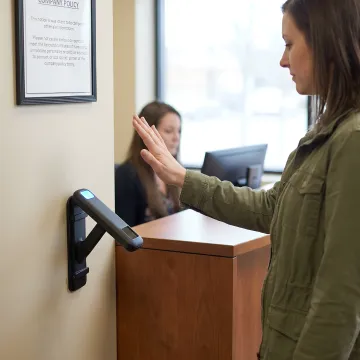
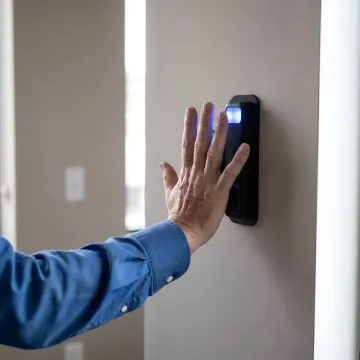
Palm vein biometric technology uses near-infrared light to capture the unique vein pattern beneath the skin's surface. Hemoglobin in deoxygenated blood absorbs this light, creating a distinct vein map from 5 million data points—unique even among identical twins. The contactless scanner reads this pattern when users hold their hand 2-4 inches above the device, verifying identity in under 2 seconds. Unlike fingerprints or facial recognition, vein patterns exist inside the body, making them impossible to forge, photograph, or steal. The system also checks for blood flow (liveness detection) during each scan, preventing spoofing attempts with photos, molds, or replicas.
Can biometric visitor management systems integrate with our existing security infrastructure?
Yes, ePortID solutions are designed for seamless integration with existing access control systems. Our ePortPass technology interfaces via industry-standard Wiegand or OSDP protocols, allowing it to work with most commercial access control panels, electric strikes, mag-locks, turnstiles, and gate systems. You don't need to replace your current infrastructure—our biometric layer adds authentication security on top of your existing setup. For data access management, our DAM solution works standalone on any laptop, tablet, or PC, or can connect multiple locations via secure VPN with static IP locking. Integration typically requires minimal configuration and doesn't demand changes to your core systems.
What happens if the biometric system fails to recognize an authorized visitor?
ePortID's palm vein technology delivers 99.99991% accuracy, making false rejections extremely rare. If recognition fails, the system supports multi-factor authentication fallbacks: users can present an RFID card, enter a PIN, or use a combination of credentials depending on your security configuration. System administrators receive real-time alerts for repeated failed attempts, allowing immediate support intervention. The platform also logs all access attempts—successful and denied—creating a complete audit trail. During initial enrollment, the system captures multiple vein pattern samples to ensure reliable recognition across varying conditions. If environmental factors (extreme cold affecting blood flow) cause issues, re-scanning typically resolves recognition within seconds.
How do you handle visitor pre-registration and check-in workflows?
Our visitor management system supports flexible workflows tailored to your operational needs. Visitors can be pre-registered by hosts through a web portal, receiving QR codes or temporary credentials via email. Upon arrival, guests scan their palm for instant identity verification and automatic host notification. The system can print temporary badges, capture photos, require legal acknowledgments (NDAs, safety waivers), and assign time-bound access permissions to specific areas. For contractors and vendors, enrollment creates reusable profiles with expiration dates and location-specific access rights. Check-out is equally streamlined—a simple palm scan logs departure time, calculates visit duration, and updates the host. All visitor data is encrypted and retained per your compliance requirements.
Is contactless palm vein scanning truly secure against spoofing attacks?
Palm vein biometrics offers superior anti-spoofing protection compared to fingerprint or facial recognition systems. Because vein patterns exist beneath the skin and require active blood flow, they cannot be captured by cameras, lifted from surfaces, or replicated with molds. Our Fujitsu-powered scanners incorporate liveness detection, verifying hemoglobin presence and blood flow during each scan to prevent attacks using photos, videos, severed limbs, or artificial replicas. The near-infrared scanning wavelength penetrates skin but doesn't work on lifeless tissue. Independent security audits confirm palm vein technology's resistance to presentation attacks, making it ideal for high-security environments like critical infrastructure, defense facilities, and financial institutions where credential forgery poses significant risks.
What are the typical costs and ROI for implementing a biometric visitor management system?
Implementation costs vary based on facility size, number of access points, and integration complexity. For time and attendance applications, our PalmClock system typically pays for itself within 3-6 months by eliminating buddy punching and time theft—enterprises commonly recover 2-5% of payroll expenses. We offer flexible pricing models treating the system as an operating expense rather than capital investment. ROI extends beyond direct savings: reduced security incident rates, eliminated credential replacement costs (lost cards, forgotten PINs), improved compliance audit performance, and decreased administrative overhead for visitor badge management. For critical infrastructure clients, the value of preventing a single unauthorized access incident far exceeds system costs. Request a security assessment for customized pricing.
How quickly can a biometric visitor management system be deployed across multiple locations?
Deployment timelines depend on facility complexity and existing infrastructure. For single-location implementations, basic ePortPass systems can be installed and operational within 1-2 weeks, including equipment mounting, network configuration, and staff training. Multi-location rollouts benefit from our fully networkable architecture—once the first site is configured, additional locations replicate faster using centralized management tools. Our equipment attaches quickly to doors, turnstiles, gates, and vehicle entry points without extensive construction. Enrollment can occur gradually or en masse using mobile scanners. For organizations with existing Wiegand-compatible access control, integration often requires only cabling and protocol configuration. Large enterprise deployments typically complete within 4-8 weeks, with phased rollouts minimizing operational disruption.