Introduction
In 2015, FinCEN reached an $8 million settlement with Caesars Palace for willful and repeated Bank Secrecy Act violations, including allowing anonymous gambling in private gaming salons and failing to monitor suspicious high-roller transactions. More recently, the Nevada Gaming Commission approved a $7.8 million fine against Caesars Entertainment for failing to identify and investigate a high-risk illegal bookmaker over seven years. These enforcement actions underscore a critical reality: regulators treat identity verification and access control failures as direct threats to casino licenses.
Those fines reflect operational vulnerabilities that show up on casino floors every day:
- Unauthorized access to cash counting rooms and back-of-house areas
- Self-excluded patrons re-entering the property undetected
- Insider theft enabled by shared or borrowed credentials
- Surveillance gaps that surface during regulatory audits
Traditional PIN codes and keycards cannot reliably prevent credential sharing or stop the buddy-punching schemes that cost operators millions annually.
Biometric access control has evolved from a competitive edge to a security baseline. But adoption alone isn't enough — implementation quality determines whether the system genuinely closes those gaps or just adds a layer of compliance theater.
Key Takeaways
- Casinos face layered threats—banned patron re-entry, insider collusion, unauthorized vault access—that PINs and keycards consistently fail to stop
- Biometric systems eliminate credential sharing and create auditable identity verification across gaming floors, cash rooms, and back-of-house zones
- Match the biometric to the risk: contactless palm vein scanning for vaults and cash rooms, facial recognition for patron screening at entry points
- Liveness detection prevents spoofing attacks with photos or replicas, making it essential in any high-stakes casino deployment
- BIPA, CCPA, and BSA compliance demands documented retention policies and explicit patron consent before any biometric enrollment begins
Security Guidelines for Biometric Access Control in Casinos
Casino security is not one-size-fits-all. The biometric rigor protecting your vault should not be the standard for a general employee entrance. Effective deployment starts with understanding this distinction and building authentication strength around asset value, not convenience.
Biometric access control is not a set-and-forget installation. It requires continuous policy enforcement, regular audit reviews, and integration discipline to remain effective against evolving threats.
General Security Precautions
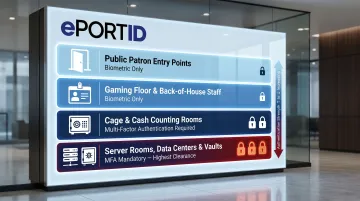
Before selecting hardware, classify your access zones. Define at minimum four security tiers:
- Tier 1: Public patron entry points
- Tier 2: Gaming floor and back-of-house staff areas
- Tier 3: Cage and cash counting rooms
- Tier 4: Server rooms, data centers, and vaults
Assign required authentication strength to each tier. Multi-factor authentication (biometric plus PIN or proximity card) should be mandatory for all Tier 3 and Tier 4 areas. Biometric-only authentication works for Tier 1 and Tier 2 points where throughput and patron experience matter most.
At all patron-facing entry points, integrate your self-exclusion and banned persons registry directly with the biometric access system. Manual checks fail when staff are busy, distracted, or colluding. Real-time database integration ensures flagged individuals are detected before they reach the gaming floor. Pennsylvania's Gaming Control Board levied a $260,905 fine against BetMGM for 152 instances of allowing self-excluded individuals to gamble online, illustrating how enforcement gaps create direct regulatory liability.
Security During Implementation
Start every deployment with a documented site security assessment. Map all physical access points, identify staff routing paths, locate high-value asset zones, and flag any legacy systems (keycard, PIN pad) that will coexist with or be replaced by biometrics.
Enrollment fraud is a genuine attack vector that most deployments underestimate. If an unauthorized individual registers their biometrics in place of an employee, the system becomes a liability rather than a safeguard. Require government ID verification for all staff at enrollment, match the name and photo to the individual being enrolled, and keep a record of the verification process.
Define your data architecture before installing any hardware. Regulators will request this documentation during audits, and retrofitting these decisions after deployment is far costlier than establishing them upfront. Decide:
- Where biometric templates will be stored (on-device, centralized server, or encrypted cloud)
- Who holds access rights to that data
- What your retention schedule is
- What your deletion protocol covers
Security During Operations
Schedule access log audits weekly at minimum for restricted zones. Look for after-hours entries, repeated failed scan attempts, or access to areas outside a staff member's authorized role. These patterns often surface insider threats or credential misuse days before a breach occurs.
Configure real-time alerts for:
- Forced entry attempts
- Multiple consecutive failed biometric scans at the same terminal
- Access attempts at restricted zones outside scheduled operating windows
Train security staff with a clear response protocol when the system flags a potential self-exclusion match or unusual access pattern. Include verification steps and escalation paths to avoid both false detentions and missed threats.
Choosing the Right Biometric Modality for Casino Security
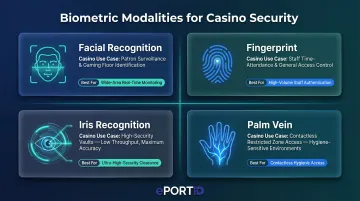
Casinos actively deploy four primary biometric modalities, each suited to specific use cases:
- Facial recognition: Patron surveillance and identification on gaming floors
- Fingerprint: Staff time-and-attendance and general access control
- Iris: High-security vaults where throughput is low and accuracy is paramount
- Palm vein: Contactless, high-accuracy access for restricted zones and hygiene-sensitive environments
Contactless biometric modalities are increasingly preferred in high-traffic casino environments. They eliminate physical contact with shared surfaces and process authentication in under two seconds. ePortID's contactless palm vein scanning, built on Fujitsu technology, derives identity from approximately 5 million subsurface vascular points that cannot be reproduced, shared, or stolen.
Why Liveness Detection is Non-Negotiable
Liveness detection verifies that the biometric sample comes from a living person during the authentication process, not from a photograph, silicone fingerprint, or 3D-printed mask. In casino deployments, presentation attacks are documented threats.
NIST's Face Analysis Technology Evaluation (FATE) PAD quantified the accuracy of 82 passive, software-only face presentation attack detection algorithms operating on 2D imagery of various presentation attack instruments. The evaluation documented attack types including print attacks (photographs) and replay attacks (video screens). Performance varied widely across all 82 algorithms — meaning the liveness detection label alone tells you nothing about whether a system will actually stop a spoofing attempt.
In high-value casino access environments, omitting liveness detection to reduce hardware costs leaves you exposed to the exact attack types NIST documented: printed photos and video replay screens. Choose systems that meet ISO/IEC 30107-3 presentation attack detection standards and that independent labs such as iBeta have tested and verified.
Single-Modal vs. Multimodal Deployments
Single-modal systems (one biometric type) are appropriate for most access points where speed matters. Multimodal systems — for example, face plus palm vein, or iris plus PIN — should be required for cash vault and data center access where the cost of a single unauthorized entry is catastrophic.
False Acceptance Rate (FAR) and False Rejection Rate (FRR) measure biometric system accuracy. In restricted zone deployments, these two metrics pull in opposite directions:
- FAR (False Acceptance Rate): Probability the system grants access to an unauthorized user — the higher-risk failure in vault or data center contexts
- FRR (False Rejection Rate): Probability the system denies access to a legitimate user — an operational inconvenience, but recoverable
Minimizing FAR takes priority over minimizing FRR in high-security zones. Granting access to an intruder is never recoverable; a frustrated but legitimate employee can try again.
Regulatory Compliance and Data Privacy for Casino Biometrics
Casinos operate under unique regulatory pressures that make biometric access control both a security tool and a compliance asset.
Bank Secrecy Act (BSA) Obligations
Casinos are treated as financial institutions under federal law and must maintain transaction records. FinCEN's guidance for casinos and card clubs emphasizes four core obligations:
- Risk-based AML program design and documentation
- Customer identification procedures for significant gambling transactions
- SAR filing at $5,000 when suspicious activity is detected
- CTRs for cash transactions over $10,000
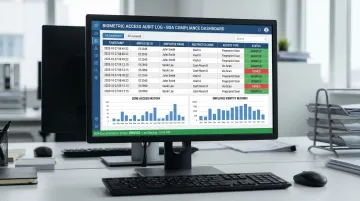
Biometric identity verification creates a precise, timestamped record of who accessed cash handling areas, when, and for how long. That record directly supports BSA compliance by documenting personnel access patterns and establishing accountability for transactions occurring in restricted zones.
State-Level Biometric Privacy Laws
Illinois Biometric Information Privacy Act (BIPA): 740 ILCS 14/20 imposes statutory penalties of $1,000 per negligent violation or actual damages (whichever is greater), and $5,000 per intentional or reckless violation or actual damages, plus attorneys' fees and injunctive relief. BIPA requires written notice and consent before biometric collection, prohibits selling or profiting from biometric data, and mandates a publicly available retention schedule.
Texas Capture or Use of Biometric Identifier Act (CUBI): Requires prior notice and consent before capture for commercial purposes, prohibits sale or disclosure with limited exceptions, and requires destruction within a reasonable time and no later than one year after the purpose expires. Enforced exclusively by the Texas Attorney General, with civil penalties up to $25,000 per violation.
Washington State RCW 19.375: Prohibits enrollment of biometric identifiers for a commercial purpose without notice and consent, limits disclosure and retention, and is enforced solely by the Attorney General under the Consumer Protection Act. No private right of action exists, but violations carry civil penalties.
GDPR and CCPA Obligations
Casinos serving international or California-based guests must address GDPR and CCPA requirements. Both laws treat biometric data as a special category of sensitive personal information — GDPR Article 9 and California's CCPA each impose distinct obligations:
- GDPR: Requires explicit opt-in consent, data minimization, and breach notification within 72 hours to authorities (plus notice to affected individuals where high risk exists)
- CCPA: Grants consumers the right to request deletion of personal data and to opt out of the sale or sharing of sensitive personal information
Gaming Commission Regulatory Requirements
Nevada Gaming Commission Regulation 5 Surveillance Standards require comprehensive surveillance coverage of restricted areas including cage and vault, count rooms, and surveillance room access controls. The standards mandate written surveillance system plans, defined approval and notification processes, and restrictions on remote access to surveillance systems.
While Nevada does not explicitly mandate biometric technologies, the regulation requires monitoring all doors to count rooms and cage/vault activities—creating a framework where biometric audit trails become de facto evidence of compliance. New Jersey and other major gaming jurisdictions impose comparable surveillance standards, so verifying the specific requirements for your state before deployment is essential.
Common Security Mistakes to Avoid
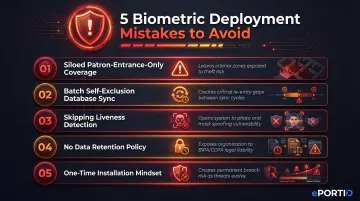
Five deployment errors consistently undermine casino biometric programs — each with direct financial or legal consequences.
Siloed coverage at patron entrances only. Cash counting rooms, chip vaults, and server rooms left behind PINs or legacy keycards create a high-risk gap where financial exposure is greatest. Insider theft documented by the Association of Certified Gaming Compliance Specialists includes cashier skimming approaching $1 million, dealer-surveillance collusion, and slot RNG manipulation — all enabled by weak access controls and poor segregation of duties.
Batch-processed self-exclusion database integration. A banned patron can re-enter through a secondary entrance or during a system update window if your database sync runs on a schedule rather than in real time. Live integration is non-negotiable.
Skipping liveness detection to cut hardware costs. This opens the door to spoofing attacks using printed photographs or silicone molds. In a high-stakes environment, a single successful spoof costs far more than the hardware savings.
No documented biometric data retention or deletion policy. Holding biometric data beyond its purpose creates direct liability under BIPA, CCPA, and GDPR — and exposes your organization to regulatory action for data you have no legal basis to keep.
Treating deployment as a one-time installation. Biometric template databases require regular penetration testing and firmware updates. Unlike passwords or keycards, compromised biometric templates cannot be reissued — a point ISO 24745 Biometric Information Protection makes explicit. Once breached, the damage is permanent.
Conclusion
Biometric access control works in casinos when the technology, governance, and audit practices are aligned — not just installed. Choosing the right system for each security tier matters, but so does what happens after deployment: how enrollment data is managed, how exceptions are reviewed, and how often the whole program is stress-tested against evolving threats.
That's where most programs fall short. The technical foundation is in place, but the operational discipline isn't. Start by evaluating your access control posture zone by zone, then build from these priorities:
- Liveness detection to close spoofing vulnerabilities at every controlled entry point
- Self-exclusion integration that flags problem gamblers in real time, not after the fact
- Regulatory alignment with your jurisdiction's data retention and audit trail requirements
- Ongoing review cycles that treat compliance as a continuous posture, not a one-time certification
The fines documented in this guide make the stakes clear. Regulators apply the same identity verification rigor to casinos that they apply to banks and financial services. Your access control systems need to reflect that standard.
Frequently Asked Questions
Do casinos use biometrics?
Yes. Most major casinos use biometrics for patron surveillance—primarily facial recognition to flag known cheaters and banned individuals—and for employee access control. Adoption is growing in self-exclusion enforcement and cash handling areas, driven by regulatory pressure and the need for audit-proof identity verification.
How do casinos detect cheating?
Casinos use facial recognition integrated with surveillance systems to identify known cheaters from databases, combined with behavioral analytics and pit manager tracking. Biometric identification makes this process faster and more accurate than manual methods, enabling real-time alerts when flagged individuals enter the property.
What do casinos see when they scan your ID?
ID scanning captures name, date of birth, and ID number for age verification and AML compliance. That data is increasingly cross-referenced against self-exclusion lists or linked to a biometric profile, creating a persistent identity record tied to your visit history.
What is the most secure biometric for casino access control?
For restricted areas requiring the highest security, contactless palm vein and iris scanning offer the lowest false acceptance rates and are the hardest to spoof. Facial recognition is better suited for high-throughput patron-facing applications where speed and user experience matter more than absolute accuracy.
Can biometrics help enforce casino self-exclusion programs?
Yes. Facial recognition at entry points, integrated with self-exclusion databases, can automatically flag enrolled individuals before they reach the gaming floor—replacing error-prone manual checks. Pennsylvania's $260,905 fine against BetMGM for allowing self-excluded patrons to gamble illustrates the regulatory cost of enforcement gaps.
How do casinos comply with biometric data privacy laws?
Compliance requires explicit consent before enrollment, documented retention and deletion schedules, and encrypted template storage. State-specific laws like BIPA and CCPA apply based on patron residency, not casino location—so exposure follows your patrons, not just your address. Non-compliance creates direct legal liability.