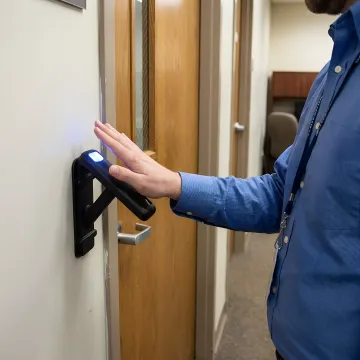
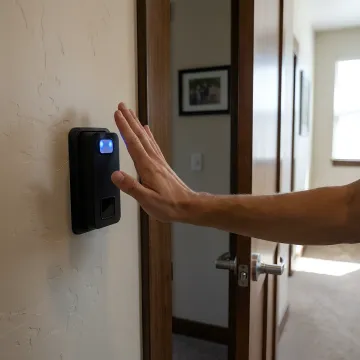
How does a palm lock work?
A palm vein lock uses near-infrared light to capture the unique pattern of veins beneath the skin of your palm. When you hold your hand over the scanner, the device maps approximately 5 million data points from your vein structure, creating a biometric template that's completely unique to you—even identical twins have different vein patterns. During verification, the system compares the live scan against the stored template in under 2 seconds with 99.99991% accuracy. Because the veins are internal, they cannot be photographed, copied, or stolen like fingerprints or facial features, and the system includes liveness detection to prevent spoofing attempts.
Are palm vein door locks safe?
Yes, palm vein door locks are among the most secure biometric solutions available. The vein pattern is internal to your body and invisible to the naked eye, making it impossible to replicate or steal. The technology checks for blood flow (liveness detection) during each scan, preventing the use of fake hands or photographs. With 99.99991% accuracy, false acceptance rates are virtually zero. Additionally, the contactless scanning method is hygienic and prevents the cross-contamination concerns associated with fingerprint readers. The encrypted biometric data is stored securely and cannot be reverse-engineered to recreate the original vein pattern.
How do I enroll users in the palm vein system?
User enrollment is quick and straightforward. Each person simply holds their hand over the scanner for 2-3 seconds while the system captures their unique palm vein pattern. The administrator assigns the user a profile with specific access permissions, time restrictions, and authorized zones. The entire enrollment process takes less than a minute per person. Once enrolled, users can be granted immediate access or scheduled for future activation. The system supports unlimited users and allows batch enrollment for large teams. No special training is required for users—the contactless process is intuitive and hygienic.
Can the palm vein lock integrate with my existing access control system?
Absolutely. Our palm vein locks are designed for seamless integration with existing access control infrastructure. They support standard industry protocols including Wiegand (in any bit format) and OSDP (Open Supervised Device Protocol). The system can power electric strikes, mag-locks, turnstiles, and vehicle gates. You can implement palm vein authentication as a standalone solution or layer it with your existing card readers and PIN pads for multi-factor authentication. For networked environments, the system connects via secure sub-net or VPN using static IPs, enabling centralized management across multiple locations with real-time monitoring and reporting.
What happens if the scanner gets damaged or loses power?
The system includes multiple safeguards. In the event of power loss, the lock typically defaults to a fail-secure position (remaining locked) for high-security applications, or fail-safe (unlocking) for life-safety applications, depending on your configuration. Battery backup options are available for critical installations. All biometric templates and access permissions are stored in non-volatile memory, so no data is lost during power interruptions. If a scanner unit is damaged, it can be replaced without re-enrolling users, as the biometric database is maintained separately. The system generates alerts for hardware malfunctions, and our two-year warranty covers manufacturing defects.
How long does verification take and what is the accuracy rate?
Verification is remarkably fast—each palm scan takes under 2 seconds from presentation to door unlock. The system achieves 99.99991% accuracy, which translates to an exceptionally low false acceptance rate (approximately 0.00001%). False rejection rates are equally minimal, ensuring authorized users gain access reliably on the first attempt. The 5 million data points captured from each palm create a biometric signature so unique that even identical twins register as different individuals. This combination of speed and accuracy makes palm vein technology ideal for high-traffic environments where both security and user throughput are critical.
Is palm vein scanning safe for health and privacy?
Palm vein scanning is completely safe and non-invasive. The system uses harmless near-infrared light, similar to what TV remote controls use, to illuminate the vein pattern beneath your skin. There is no radiation, no UV exposure, and no physical contact required. From a privacy standpoint, the vein pattern cannot be reverse-engineered to recreate the original biometric data—the stored template is a mathematical representation, not an image. The technology complies with biometric privacy regulations, and the contactless operation eliminates hygiene concerns associated with fingerprint scanners. No personal health information is captured or stored.
What ongoing maintenance does the system require?
Palm vein locks require minimal maintenance. The scanner lens should be cleaned periodically with a soft, dry cloth to remove dust or smudges—typically once every few weeks depending on environmental conditions. There are no moving parts in the scanner to wear out or replace. Software updates are deployed remotely when available to enhance security and functionality. The system performs self-diagnostics and alerts administrators to any hardware issues. Battery backup units (if installed) should be tested quarterly. Audit logs should be reviewed regularly for security monitoring. Most organizations find that routine maintenance takes less than 30 minutes per quarter per installation.