Introduction
Paper sign-in logs still sit at the front desks of thousands of facilities — and attackers know it. Organizations across healthcare, finance, manufacturing, and critical infrastructure are replacing them with visitor management systems (VMS) that verify identity, enforce access policies, and create audit-ready records in real time.
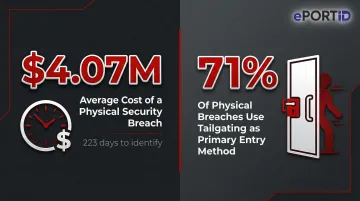
The operational stakes are measurable. Physical security breaches cost organizations an average of $4.07 million and take 223 days to identify, with tailgating accounting for the primary entry method in 71% of physical breaches. Each incident carries compliance exposure, legal liability, and operational costs that a paper log was never designed to prevent.
This article delivers a ranked list of the best visitor management systems for 2026, spanning general-purpose platforms and high-security biometric solutions. Whether you run a corporate office or a critical infrastructure site, the evaluation criteria and FAQs below will help you match the right system to your facility's actual risk profile.
Key Takeaways
- A VMS digitizes guest registration, ID verification, access authorization, and real-time on-site tracking
- Top 2026 options range from cloud-based software for offices to hardware-based biometric systems built for critical infrastructure
- Key criteria: security depth, compliance capabilities (HIPAA, GDPR), access control integration, and scalability
- Envoy, Visitly, YAROOMS, and Eptura cover general enterprise needs with strong feature sets at accessible price points
- High-security environments — ports, refineries, data centers — benefit from biometric solutions like ePortID, which verify identity to 99.99991% accuracy in under 2 seconds
What Is a Visitor Management System?
A visitor management system (VMS) is a digital platform that identifies, logs, and manages everyone entering a facility. It replaces paper sign-in sheets with automated, auditable workflows — giving security teams real-time tracking, access control integration, and documentation that holds up under audit.
The global VMS market was valued at $1.63 billion in 2023 and is projected to reach $3.98 billion by 2030, representing a 13.4% compound annual growth rate. This acceleration reflects post-pandemic demand for contactless, audit-ready solutions across healthcare, education, manufacturing, and critical infrastructure.
The sections below cover the top-performing VMS options for 2026, evaluated across security depth, feature set, and proven reliability in high-stakes environments.
Best Visitor Management Systems for 2026
Each system below was evaluated on security capability, ease of deployment, compliance features, integration ecosystem, scalability, and real-world client validation. The list spans biometric critical infrastructure solutions to cloud-based enterprise platforms—so there's a fit regardless of industry or facility type.
ePortID
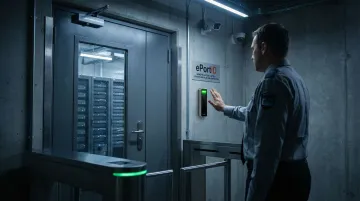
ePortID is a Philadelphia-based biometric identity verification company with 20 years of experience in logistics and security for the U.S. Navy, Army JTF, Marine Corps, and Port Authorities. In partnership with Fujitsu, it delivers contactless palm vein scanning for enterprise and critical infrastructure clients including Fiserv, Dow Chemical, South Jersey Port Corp., Tata Steel, and Thyssen Krupp.
Why it stands out: ePortID's palm vein technology derives identity from 5 million unique points, a pattern shared by no one — not even identical twins. The system is accurate to 99.99991%, completes verification in under 2 seconds, and uses liveness detection to block spoofing attempts.
Because this biometric cannot be lost, shared, replicated, or forged, it directly eliminates buddy punching, unauthorized facility access, and payroll fraud at the source.
| Feature Category | Details |
|---|---|
| Key Features | Contactless palm vein scanning; liveness detection; indisputable time-and-attendance records; prevents unauthorized access to facilities and data; integrates with payroll and facility management systems |
| Best For | Seaports, airports, power stations, oil rigs, refineries, military bases, data centers, hospitals, financial institutions, and any high-security critical infrastructure site |
| ROI / Pricing | Documented to pay for itself in 3–6 months through reduced payroll processing expense and eliminated unauthorized access losses; contact ePortID for pricing |
Envoy
Envoy is a widely deployed enterprise VMS serving corporate, healthcare, manufacturing, and education sectors. It covers visitor registration, contractor check-ins, and multi-location management from a centralized cloud platform.
Why it stands out: Envoy integrates with access control systems, performs ID scanning and watchlist checks, and supports customizable sign-in flows by visitor type. The platform sends emergency notifications via SMS, Slack, or Teams, and serves over 16,000 workplaces globally with GDPR and CCPA compliance backed by SOC 2 certification.
| Feature Category | Details |
|---|---|
| Key Features | ID scanning, watchlist verification, custom sign-in workflows, multi-location management, emergency notifications, digital NDA signing |
| Best For | Mid-to-large enterprises, corporate offices, manufacturing, healthcare, and education environments needing secure multi-site visitor authentication |
| Pricing | Free Basic plan; paid plans start at approximately $109/location/month (billed annually) |
Visitly
Visitly is a purpose-built visitor sign-in platform that digitizes check-ins for guests, contractors, and employees without requiring an app download. It serves technology, healthcare, manufacturing, utilities, and nonprofit sectors.
What makes it different: Visitly offers customizable check-in flows by visitor type, real-time host notifications, digital NDA/policy signing, printable visitor badges with photos, and HIPAA-compliant data storage. It provides exportable visitor logs for compliance audits and features real-time access approval or denial, with facial recognition watchlist screening and sex offender checks for educational environments.
| Feature Category | Details |
|---|---|
| Key Features | Contactless check-in, HIPAA compliance, custom workflows, real-time host alerts, visitor badge printing, exportable audit logs, health screening questions |
| Best For | Mid-sized to enterprise businesses in healthcare, technology, transport, and manufacturing seeking an affordable and compliance-ready VMS |
| Pricing | Starts at $49/location/month (Starter); Business plan at $75/location/month; Enterprise pricing available |
YAROOMS
YAROOMS is an enterprise workplace management platform that integrates visitor management with desk and room booking, hybrid work scheduling, and workplace analytics. It is designed for mid-to-large organizations that want a unified operational system.
Why it stands out: YAROOMS supports pre-registration and self-registration via a digital reception app, custom-branded check-in interfaces, safety questionnaires, digital signatures, multi-location management within one dashboard, and analytics with detailed visit logs. Its hardware-agnostic design works on any iOS or Android tablet.
| Feature Category | Details |
|---|---|
| Key Features | Pre-registration, self-service kiosk check-in, custom branding, safety questionnaires, visitor photo capture, multi-location support, analytics and audit logs |
| Best For | Enterprise organizations in healthcare, finance, government, education, and tech that require VMS integrated with space booking and workplace analytics |
| Pricing | Approximately $99/location/month or $950/year per location |
Eptura Visitor (formerly Proxyclick)
Eptura Visitor is a cloud-based VMS built for large, multi-site organizations with strict security requirements. Formerly known as Proxyclick, it serves corporate headquarters, manufacturing facilities, and high-security environments globally.
Why it stands out: Eptura offers destination dispatch to guide visitors to the correct floor or department, separate workflows for contractors versus guests, touchless check-in via QR codes or RFID, access control system integration, and watchlist screening capability. Its quote-based Advanced and Power tiers allow organizations to scale security features as needed, with ISO 27001 and GDPR compliance.
| Feature Category | Details |
|---|---|
| Key Features | Destination dispatch, touchless QR/RFID check-in, contractor vs. guest workflow separation, access control integration, watchlist screening, pre-registration |
| Best For | Large enterprises, multi-site manufacturing, and high-security corporate facilities requiring deep access control and workflow customization |
| Pricing | Quote-based only (Advanced and Power tiers); contact Eptura for current pricing |
How We Chose the Best Visitor Management Systems for 2026
Each system on this list was evaluated across four dimensions:
- Security depth: authentication method, access control integration, watchlist screening
- Compliance readiness: HIPAA, GDPR, CCPA, and sector-specific regulations
- Deployment practicality: ease of setup, hardware requirements, staff training burden
- Real-world validation: industries served, case evidence, longevity of use
The common buyer mistake: prioritizing interface aesthetics or lowest price point over actual security capability and integration fit for their specific facility type.
Key Selection Criteria
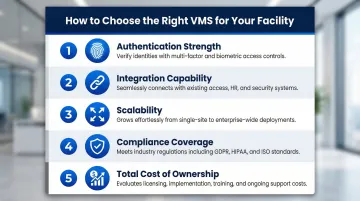
1. Authentication strength: Software-only check-ins provide basic accountability. Biometric systems using palm vein recognition deliver higher certainty that the authenticated individual is physically present — critical in environments where social engineering accounts for 70% of unauthorized access events.
2. Integration capability: Does it connect with existing physical access control systems (PACS), HR systems, and access hardware? Integration protocols matter: OSDP supports AES-128 encryption and bi-directional communication, while legacy Wiegand interfaces lack encryption and are vulnerable to cloning.
3. Scalability: Can it handle multi-location rollout and growing visitor volumes? Cloud-based platforms like Envoy and Eptura provide centralized dashboards for managing multiple sites, while biometric systems like ePortID support networked enrollment across distributed facilities.
4. Compliance coverage: Does it meet the regulatory standards relevant to your sector — HIPAA for healthcare, GDPR for European operations, CCPA for California-based organizations, federal standards for government facilities? Systems with explicit compliance documentation reduce audit burden and legal exposure.
5. Total cost of ownership: Factor in hardware, per-location fees, and measurable ROI from payroll fraud reduction or incident response savings. Time theft costs U.S. employers approximately $11 billion annually, with 75% of businesses affected by buddy punching. Biometric systems that eliminate this fraud can deliver documented ROI within months.
A corporate office managing 50 daily visitors has fundamentally different security needs from a refinery, port, or data center controlling access to restricted zones. A system calibrated to the wrong security tier creates risk gaps that no polished dashboard can compensate for.
Conclusion
The right VMS for 2026 is the one that aligns with your facility's actual security exposure, compliance obligations, and operational scale—not simply the most well-known brand or lowest monthly fee.
Before finalizing a decision, evaluate each platform against four factors:
- Ongoing performance — uptime reliability and vendor support track record
- Scalability — consistent enforcement across multiple locations
- Integration depth — compatibility with physical access control infrastructure
- Total cost of ownership — including measurable loss prevention, not just licensing fees
For general corporate environments, cloud-based platforms offer solid feature sets at accessible price points. For critical infrastructure, ports, hospitals, and financial institutions, biometric solutions provide identity certainty that software-only VMS cannot replicate — verified to 99.99991% accuracy in under two seconds.
ePortID's contactless palm vein system includes built-in liveness detection to prevent spoofing and consistently pays for itself within 3 to 6 months. Contact ePortID at info@eportid.com or 215-627-2651 to discuss your facility's requirements.
Frequently Asked Questions
What are visitor management systems?
A VMS is a digital platform that identifies, logs, and controls who enters a facility. It replaces paper sign-in sheets with automated check-in workflows, real-time tracking, ID verification, and audit-ready visitor records.
What is VMS in school?
In educational settings, a VMS manages the registration, screening, and tracking of parents, vendors, volunteers, and other visitors. Schools use these systems to enforce access policies, screen visitors against watchlists like sex offender registries, and generate instant records for safety and compliance.
What are the five types of visitors?
Common visitor categories managed by a VMS include clients/guests, contractors, vendors/delivery personnel, employees (for after-hours or secondary location check-ins), and regulatory or compliance inspectors. Many systems allow custom workflows for each type.
What features should I look for in a visitor management system for 2026?
Focus on these six capabilities:
- Identity verification method (ID scan, biometric, or QR code)
- Access control integration
- Compliance support for your sector (HIPAA, GDPR)
- Real-time tracking and alert notifications
- Audit log exportability
- Scalability for multi-location deployment
How do biometric visitor management systems work?
Biometric VMS solutions scan a physical identifier, such as a palm vein pattern, fingerprint, or facial geometry, to verify identity at entry. Advanced systems like palm vein scanning include liveness detection to prevent spoofing and complete verification in under 2 seconds, contactlessly.
What is the difference between a visitor management system and an access control system?
A VMS handles identity registration, logging, and check-in workflows. An access control system governs physical entry permissions, such as door locks, turnstiles, and barriers. High-security facilities integrate both: the VMS verifies and logs identity while the access control system enforces permitted movement.