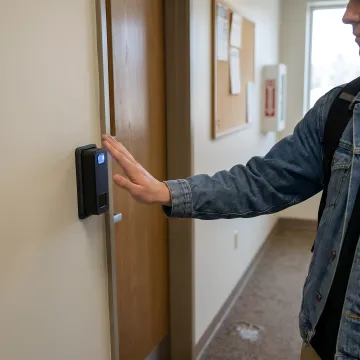
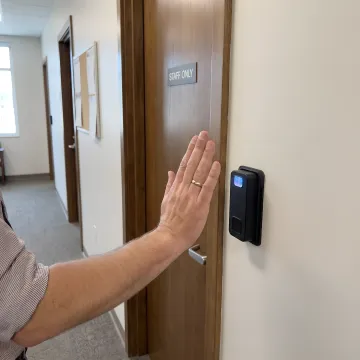
What is the purpose of biometrics in schools?
Biometrics in schools serve multiple purposes: preventing unauthorized campus access, eliminating buddy punching for attendance, speeding student flow during busy periods like lunch or morning arrival, preventing credential sharing and lost ID cards, creating audit trails for compliance with safety regulations like the Clery Act, and protecting sensitive areas like research labs or server rooms. Palm vein scanning specifically offers contactless verification that's hygienic, accurate to 99.99991%, and impossible to share or forge, making it ideal for educational environments where traditional ID cards create security gaps.
How does biometric access control improve campus safety?
Biometric systems create a positive identity verification that can't be borrowed, shared, or stolen like ID cards. Our palm vein technology verifies identity in under 2 seconds while checking for liveness, preventing spoofing attempts. Systems generate real-time alerts for denied entry attempts, track complete entry/exit audit trails, and allow time-bound permissions for contractors and visitors. This prevents tailgating, eliminates identical name confusion, and ensures only authorized individuals access dormitories, laboratories, or administrative areas while maintaining comprehensive records for compliance and investigation purposes.
Is palm vein scanning safe for students and children?
Absolutely. Palm vein scanning is completely contactless—students simply hold their hand over the reader without touching any surfaces, improving hygiene compared to fingerprint scanners or shared ID cards. The technology uses harmless near-infrared light to read the vein pattern beneath the skin, with no radiation or health risks. Unlike facial recognition, it doesn't capture photographic images, addressing privacy concerns. The biometric template is a mathematical representation, not an image, and cannot be reverse-engineered. The technology has been extensively tested and is used globally in educational institutions, hospitals, and financial institutions.
How long does biometric enrollment take for students?
Initial enrollment takes approximately 30-60 seconds per student and follows a simple process: the student places their hand over the scanner three times while the system captures and encrypts their unique palm vein pattern. Our "enroll once and done" capability means students never need re-enrollment unless specifically requested. For a typical school, complete campus enrollment can be completed within a few days using multiple enrollment stations. The system works immediately after enrollment, and because palm vein patterns are stable throughout life, enrolled students remain in the system even as they grow from elementary through high school.
What happens if the biometric scanner fails to recognize a student?
Our palm vein technology achieves 99.99991% accuracy with verification completed in under 2 seconds, making recognition failures extremely rare. When they occur, they're typically caused by improper hand placement. The system provides immediate visual feedback guiding proper positioning. For additional security layers, our systems support two or three-part authentication combining biometrics with PIN codes or backup credentials. Administrative override capabilities allow authorized staff to manually verify and grant access when needed. The system maintains detailed logs of all access attempts, successful or denied, ensuring complete accountability and audit trails.
Can parents receive notifications when children arrive or depart?
Yes, our student transportation management system automatically sends text messages or emails to parents and guardians as their child boards or exits the school bus, providing real-time peace of mind. For daycare applications, the system records precise arrival and departure times with biometric verification of authorized pickup individuals, creating indisputable custody transfer records. These notifications can be customized to parent preferences and include timestamps, location data, and confirmation of who performed the pickup. The system maintains comprehensive records accessible through secure parent portals, eliminating sign-in sheet errors and providing complete transparency.
How does the system prevent buddy punching in school attendance?
Buddy punching—when one student checks in for another—is physically impossible with palm vein biometrics because each person's vein pattern is unique, even among identical twins, derived from 5 million reference points. The technology cannot be fooled by photographs, fake hands, or any spoofing attempt because it checks for blood flow during verification. Unlike ID cards that can be shared or PIN codes that can be disclosed, biometric identity can't be transferred, lost, forgotten, or stolen. This creates an indisputable record of exactly who was present, when they arrived, and when they departed, eliminating time theft and improving attendance accuracy.
What integration is required with existing school management systems?
Our biometric solutions are designed for flexible integration with minimal IT burden. For access control, systems interface with existing infrastructure via standard Wiegand or OSDP protocols, working seamlessly with electric strikes, mag-locks, turnstiles, and gate controllers. For attendance and data management, our solutions can operate standalone without core system integration or connect via secure APIs to student information systems and payroll platforms. Time and attendance data exports in standard formats compatible with most administrative software. For schools with multiple buildings or campuses, systems network together providing centralized management while operating independently if network connectivity is lost, ensuring continuous security.